Webflow vs WordPress: Which CMS Should You Choose in 2026?
Webflow and WordPress can both be used to build professional, high-performing websites optimized for search. But they address different needs.
Webflow is generally better suited to showcase websites, SaaS companies, startups, and marketing teams looking for autonomy, strong design freedom, and limited technical maintenance. WordPress remains particularly relevant for large editorial websites, projects requiring specific backend features, or complex WooCommerce stores.
The right choice mainly depends on the type of website, the features you need, and the level of autonomy you expect, criteria our Webflow agency regularly evaluates when creating and redesigning websites.
article summary
- Choose Webflow if you prioritize design, performance, marketing-team autonomy, and reduced technical maintenance.
- Choose WordPress if you need a very broad plugin ecosystem, specific backend development, or a particularly complex editorial website.
- For advanced e-commerce, WordPress with WooCommerce offers more possibilities, although Shopify often remains more suitable for a 100% e-commerce project.
- For SEO and GEO, both CMSs can deliver excellent results: strategy, technical quality, and content structure have more impact than the CMS choice alone.
- Webflow simplifies day-to-day maintenance, while WordPress gives you more freedom over the technical stack.
Want to take it further? Ask:
Webflow vs WordPress: comparison table
| Criterion | Webflow | WordPress | Advantage |
|---|---|---|---|
| Design | Advanced visual control without an imposed theme | Highly flexible with a theme, Gutenberg, a builder, or custom development | Webflow |
| Ease of use | Initial learning curve, then strong autonomy | Very accessible for editing; administration varies depending on the stack | Tie |
| SEO / GEO | Native technical settings and controllable structure | Very comprehensive with plugins and development | Tie |
| Performance | Integrated infrastructure and hosting | Depends on hosting, theme, and plugins | Webflow |
| Maintenance | Infrastructure managed by the platform | Regular updates to the CMS, themes, and extensions | Webflow |
| Extensions | More limited ecosystem | Very large catalog of plugins and integrations | WordPress |
| Editorial CMS | Well suited to marketing sites and structured content | Excellent for complex editorial workflows | WordPress |
| E-commerce | Suitable for relatively simple requirements | Highly extensible with WooCommerce | WordPress |
| Hosting control | Proprietary SaaS platform | Self-hostable open-source CMS | WordPress |
| Marketing autonomy | Very strong on a well-structured website | Varies depending on the theme, builder, and plugins | Webflow |
There is no universally better CMS. The right choice mainly depends on your project, your internal resources, the volume of content you need to manage, and how your website needs to evolve.
What is Webflow?

Webflow is a SaaS website-building platform that combines a visual editor, a CMS, integrated hosting, and publishing tools.
Unlike a traditional page builder, Webflow lets you work visually with concepts that are close to HTML and CSS. Designers and developers therefore get a high degree of freedom, while marketing teams can later manage content and create new pages within a structured environment.
Webflow also includes SEO features, redirect management, an XML sitemap, CMS content, forms, animations, and integrations with many third-party tools.
Advantages of Webflow
- Strong design freedom without relying on a theme.
- CMS built directly into the platform.
- Hosting, CDN, and SSL included.
- Infrastructure maintenance largely handled by Webflow.
- Native management of key SEO tags and redirects.
- Advanced animations and interactions.
- Strong marketing-team autonomy on a well-structured website.
- Ability to build reusable components and design systems.
Webflow is therefore particularly well suited to marketing websites that need to evolve quickly. For this type of project, optimizing a Webflow website for SEO notably involves a clear structure, controlled performance, coherent internal linking, and well-organized content.
Disadvantages of Webflow
- A steeper initial learning curve for people who are unfamiliar with the basics of web design.
- A subscription is required to publish a professional website on your own domain.
- A smaller extension ecosystem than WordPress.
- A proprietary platform, creating greater dependence on the Webflow ecosystem.
- Some complex business features require custom code or external services.
What is WordPress?

WordPress is an open-source CMS that can be installed with the hosting provider of your choice. Its main strength is its huge ecosystem of themes, plugins, agencies, and developers.
The CMS can be used to build a blog, media site, corporate website, business platform, or e-commerce store with WooCommerce. This versatility largely explains its historical dominance.
According to W3Techs, WordPress powered 41.2% of all websites and represented 59.1% of websites with an identified CMS as of July 29, 2026.
Advantages of WordPress
- Open-source and self-hostable CMS.
- Very large community of users and developers.
- Massive catalog of themes and plugins.
- Strong control over hosting and the database.
- Many possibilities for custom development.
- A particularly mature ecosystem for editorial websites.
- WooCommerce and its many extensions for e-commerce.
Disadvantages of WordPress
- Regular maintenance of the CMS, themes, and extensions.
- Performance depends heavily on hosting, the theme, and installed plugins.
- Higher security risks when extensions or the CMS are not maintained.
- Plugins and technical layers can accumulate over time.
- Total cost can be difficult to anticipate once maintenance, licenses, and development are included.
Webflow vs WordPress: security and maintenance
The difference between the two CMSs is less about whether they can be secured and more about how security and maintenance are managed.
With Webflow, hosting, SSL, and a large part of the infrastructure are centralized. CMS and hosting-environment updates therefore do not need to be managed separately by each website owner.
With WordPress, you have more control over your stack: hosting provider, themes, extensions, PHP version, caching system, and security tools. This freedom provides flexibility, but it also requires more active maintenance.
Hosting
Webflow includes hosting directly in its Site plans. You therefore do not choose your server or CDN separately.
WordPress can be hosted almost anywhere, from shared hosting to a cloud or headless infrastructure. This is an important advantage for companies that want precise control over location, performance, or infrastructure rules.
Updates and maintenance
Webflow manages updates to its platform and infrastructure. Editorial and functional maintenance is still necessary, but the system layer is largely handled for you.
Webflow maintenance can cover fixes, optimizations, and continuous improvements when a company wants to outsource ongoing website management.
With WordPress, the CMS, themes, and extensions need to be monitored regularly. Well-organized WordPress maintenance can perfectly secure and stabilize a website, but it represents an additional operational workload.
Plugins and extensions
WordPress has one of the largest extension ecosystems on the market. This is an advantage when you need to add features quickly, but every additional dependency needs to be assessed in terms of quality, compatibility, performance, and maintenance.
Webflow works more like an integrated platform. External services or custom code can be connected, but the model remains less extensible than WordPress.
Verdict: Webflow simplifies day-to-day maintenance, while WordPress provides more freedom over the technical stack.
Webflow or WordPress: which is easier to use?
The answer mainly depends on who will use the website day to day.
Webflow generally requires some learning time to understand CSS classes, components, breakpoints, and CMS Collections. In return, a marketing team can gain a high level of autonomy once the website has been built correctly.
WordPress is often more immediately familiar for publishing articles or editing content. Complexity increases when the website relies on multiple plugins, a complex theme, a page builder, or specific developments.
For an editorial team that publishes a lot of straightforward content, WordPress remains very comfortable. For a Growth or Marketing team that needs to regularly create and evolve pages, Webflow can provide greater autonomy once the system is in place.
Webflow vs WordPress: customization and design
Webflow provides very advanced visual control directly from its Designer. You can build a custom design, precisely manage breakpoints, and create interactions without relying on a pre-built theme.
WordPress is not technically less customizable. With Gutenberg, a modern theme, a builder, or custom development, it can produce highly advanced interfaces.
The main difference lies in the method. Webflow provides direct visual access to a large part of the front end, while WordPress may require more themes, plugins, or code to achieve the same level of precision.
For a brand that puts art direction, web design, and iteration speed at the heart of its marketing website, Webflow retains a practical advantage.
Webflow or WordPress for SEO and GEO?
Both CMSs can be used to build a website that performs extremely well in SEO. Neither automatically guarantees better Google rankings.
WordPress benefits from a very mature SEO ecosystem with tools such as Yoast SEO and Rank Math. Webflow natively lets you manage Title and Meta Description tags, URLs, heading structure, 301 redirects, the XML sitemap, robots.txt, alt attributes, Open Graph tags, and the code required for structured data.
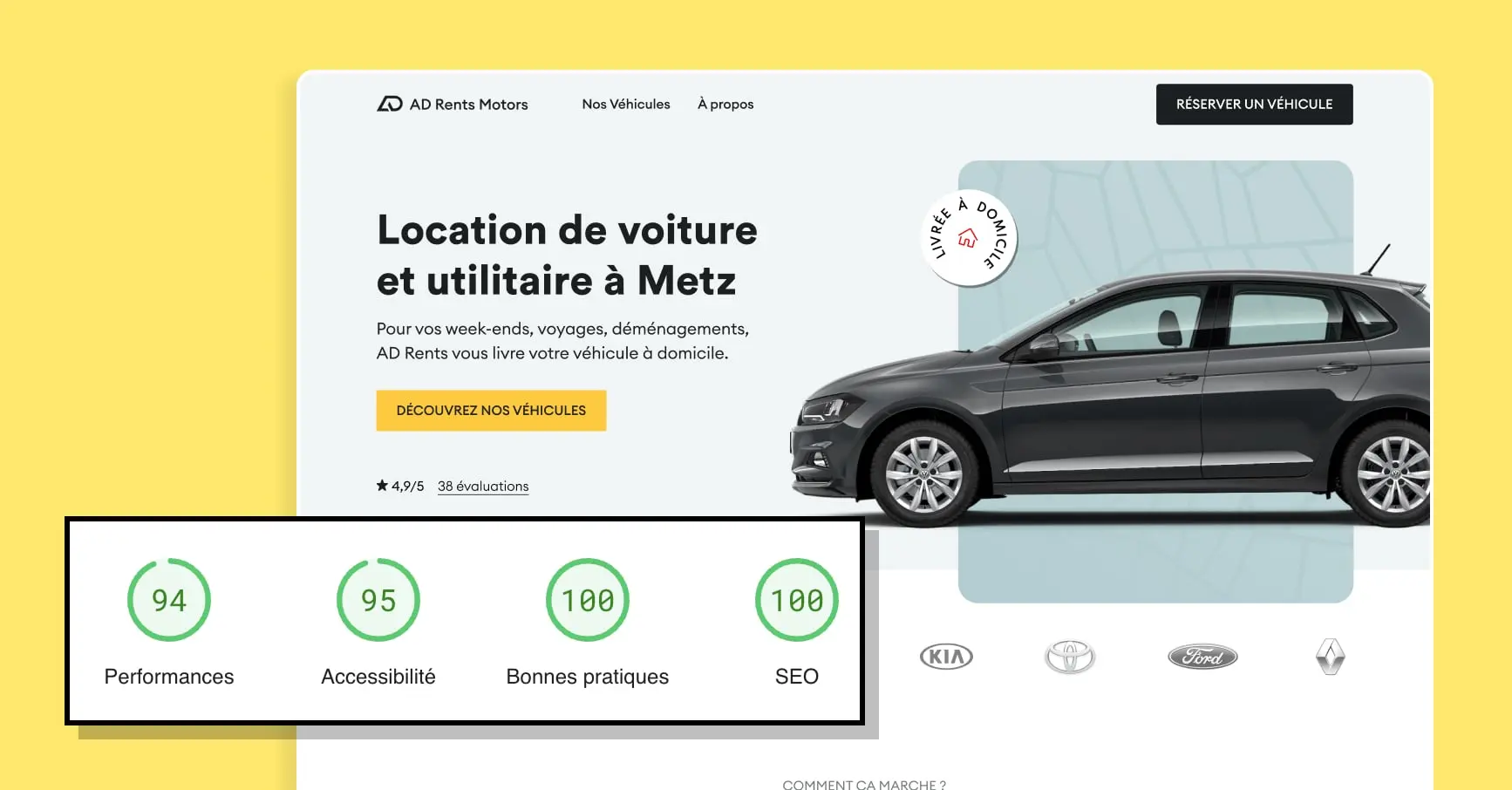
One of Webflow's advantages is the simpler control of the technical stack: fewer dependencies and integrated hosting. This does not remove the need to optimize images, third-party scripts, animations, internal linking, or Core Web Vitals.
On this CMS, a Webflow SEO agency works across architecture, content, performance, structured data, and internal linking.
For GEO and visibility in generative engines, the CMS is also secondary. Structured content, direct answers, readable tables, clearly identified entities, reliable data, and coherent semantic internal linking make it easier for LLMs and answer engines to extract and use information.
SEO/GEO verdict: tie. An excellent WordPress website can outperform a poor Webflow website, and vice versa. Execution quality remains decisive.
Webflow vs WordPress: technical limitations and features
WordPress retains an advantage when a project depends on many business features or specific backend development. Its ecosystem makes it possible to add proven functional building blocks very quickly.
Webflow can be extended with APIs, JavaScript, automation tools, and third-party services. This approach works very well for many marketing websites, but reaches its limits with certain complex application logic.
For an advanced member area, a multi-vendor marketplace, complex business logic, or an application database, WordPress, a headless architecture, or a custom stack may be more appropriate.
The CMS should therefore be chosen based on the actual requirement, not the theoretical number of available features.
Website ownership, hosting, and platform dependency
This is one of the most important differences between Webflow and WordPress.
WordPress is open source. You can recover your database and files, change hosting providers, and retain significant control over your infrastructure.
Webflow is a proprietary SaaS platform. Some static code can be exported on certain plans, but the dynamic CMS, forms, and several platform features cannot be transferred like a complete WordPress installation.
This dependency is a constraint to consider. In return, it greatly simplifies infrastructure, hosting, and update management.
For a project with strict requirements around sovereignty, data location, or internal architecture, this criterion should be assessed before making a choice.
How much do Webflow and WordPress cost in 2026?
Comparing only the displayed prices of the two CMSs gives an incomplete picture. The right metric is total cost of ownership: platform, hosting, extensions, maintenance, and time spent.
Since May 2026, Webflow has simplified its Site plans. For new subscriptions, the Basic plan is listed at $15 per month when billed annually. The Premium plan, which combines the former CMS and Business plans, is listed at $25 per month when billed annually and includes up to 20,000 CMS items and 40 Collections.
WordPress is open source and free to download, but several cost items generally need to be added.
- Hosting and domain name.
- Theme or custom development.
- Extensions and premium licenses.
- Maintenance and backups.
- Security and performance optimization.
- Developer or agency support when required.
WordPress can therefore be cheaper for a simple project managed in-house. Webflow often becomes more predictable once hosting and infrastructure maintenance are taken into account.
The final cost therefore depends heavily on the chosen plan, content volume, and CMS features, with Webflow pricing and subscriptions changing according to these needs.
Webflow or WordPress: which CMS should you choose for your project?
| Project type | Recommended CMS | Why? |
|---|---|---|
| Showcase website | Webflow | Design, performance, and simplified maintenance |
| SaaS / startup website | Webflow | Marketing autonomy and rapid creation of new pages |
| Corporate website | Webflow or WordPress | Depends on content volume and required features |
| Landing pages | Webflow | Flexibility and fast iteration |
| Website with advanced animations | Webflow | Built-in interactions and animations |
| Standard blog | Webflow or WordPress | Both CMSs handle editorial content effectively |
| Media site with a high content volume | WordPress | Very mature editorial ecosystem and workflows |
| Business plugins / specific backend | WordPress | Very large ecosystem of extensions and development options |
| Complex e-commerce | WordPress + WooCommerce | More complete and extensible e-commerce ecosystem |
| Marketing website managed by a Growth team | Webflow | Strong autonomy to create, edit, and test pages |
The project type provides an initial direction, but you should also consider the expected level of autonomy, future features, and the skills available internally.
Webflow is particularly suitable for
- Startups and SaaS companies that need to evolve their marketing website quickly.
- Showcase and corporate websites with high design requirements.
- Marketing and Growth teams that want to publish without systematically depending on developers.
- Landing pages and campaigns that require rapid iteration.
- Websites with advanced animations and interactions.
- Companies that want to limit technical infrastructure maintenance.
WordPress is particularly suitable for
- Media and editorial websites with highly advanced publishing workflows.
- Projects that depend on specific WordPress plugins or features.
- Companies that want precise control over their hosting.
- Projects requiring advanced backend development.
- WooCommerce stores and complex e-commerce catalogs.
- Organizations that already have strong WordPress expertise in-house.
Webflow or WordPress for a multilingual website?
Both solutions can manage a multilingual website, but they use different approaches.
Webflow offers Webflow Localize to create language and regional variants, manage subdirectories, localize static and CMS content, adapt certain visual elements, and configure localized SEO. In 2026, Webflow continued to expand this localization environment.
WordPress does not natively provide complete multilingual management in a standard installation. The CMS generally relies on dedicated extensions or a multisite architecture, which provides a great deal of flexibility but adds another configuration layer.
Verdict: Webflow offers a more integrated approach, while WordPress benefits from a very mature multilingual ecosystem. The right choice mainly depends on the number of languages, editorial governance, and international SEO requirements.
Webflow or WordPress for e-commerce?
Webflow and WordPress can both be used to build an online store, but their ecosystems are not in the same category.
Webflow Ecommerce is a good fit for a relatively simple store where journey design, brand consistency, and integration with the marketing website are the priorities.
WooCommerce turns WordPress into a highly extensible e-commerce platform. Its ecosystem is better suited to large catalogs, complex shipping rules, subscriptions, business-system connectors, or specific requirements.
For an advanced e-commerce project, WordPress with WooCommerce generally offers more flexibility than Webflow Ecommerce. For a 100% e-commerce business, Shopify is also worth comparing with both solutions.
Should you migrate from WordPress to Webflow?
A WordPress-to-Webflow migration becomes relevant when a website is difficult to maintain, depends on too many extensions, or slows marketing teams down.
A migration to Webflow is particularly relevant if:
- Your team depends on a developer for every website change.
- Your WordPress stack has become difficult to maintain.
- You are preparing a complete redesign of the design and architecture.
- You want marketing teams to be able to create pages more easily.
- Your website is primarily a marketing, corporate, or editorial website.
- Performance and technical debt have become obstacles.
Conversely, a migration may not be relevant if your business depends on highly specific WordPress plugins, a complex WooCommerce architecture, or backend features that would be difficult to reproduce.
How can you migrate from WordPress to Webflow without losing SEO?
Changing CMS must preserve existing SEO signals. A migration to Webflow should notably include:
- A complete crawl of the existing website.
- Identification of pages generating organic traffic and backlinks.
- Keeping existing URLs whenever possible.
- Comprehensive 301 redirect mapping.
- Migration of SEO tags and structured data.
- Preservation or improvement of internal linking.
- Migration and validation of CMS content.
- Generation and verification of the new sitemap.
- Post-migration monitoring in Google Search Console and analytics tools.
A migration is therefore not simply about copying content from one CMS to another. It is an opportunity to improve the architecture, remove unnecessary dependencies, and improve the editing experience without losing acquired visibility.
At Gemeos, a Webflow migration includes these steps to preserve organic visibility and team autonomy.
What are the best Webflow agencies in 2026?
Among the Webflow agencies worth considering in 2026, Gemeos, Norry, and Mirax illustrate three different approaches, spanning marketing performance, premium design, and technical integrations.
Gemeos
Gemeos is a Webflow Partner agency that brings UX/UI, Webflow development, SEO/GEO, copywriting, tracking, CRO, and project management expertise together within the same team. The agency therefore does not treat Webflow as a simple integration service: CMS architecture, performance, visibility on Google and AI engines, conversion, and team autonomy are considered together from the design stage.
With more than 240 companies supported, a team of around ten people, and a 4.9/5 rating from 97 reviews, Gemeos works in particular with startups, SMEs, and scale-ups that want to turn their website into a real marketing and commercial lever. The goal is to deliver a Webflow website that can evolve easily without creating permanent technical dependence for internal teams.
Norry
Norry is a Webflow agency founded in 2022, positioned around premium design, Webflow development, and SEO/AEO. The agency highlights several creative awards, including 3 Awwwards and 5 CSSDA awards, and is particularly relevant for companies that want to combine strong visual standards with search visibility and AI-engine visibility.
Mirax
Mirax is a Lyon-based digital agency and Certified Webflow Partner combining website creation, SEO, automation, and API integrations. Its positioning is particularly relevant for companies that want to connect their Webflow website to a CRM, business tools, or automations through Make, n8n, or Zapier.
If you decide to use Webflow, the next step is finding the right partner to support you. We have compared the best Webflow agencies in France to help you make your choice.
What are the best WordPress agencies in 2026?
Among the French WordPress agencies worth considering in 2026, AmphiBee, Whodunit, and BSA Web offer three complementary approaches.
AmphiBee
AmphiBee is an agency specializing in WordPress and WooCommerce. It builds custom websites with expertise in UX, SEO/GEO, and technical performance, making it particularly suitable for WordPress projects focused on acquisition and conversion.
Whodunit
Whodunit is a WordPress agency founded in 2009. It works on ambitious, custom projects, with a strong culture of contributing to the WordPress ecosystem and advanced technical expertise.
BSA Web
BSA Web is a WordPress agency specializing in native CMS and Gutenberg development. Its approach notably aims to reduce dependence on third-party page builders and build websites that remain maintainable over time.
Webflow or WordPress: our verdict for 2026
Webflow and WordPress are both excellent solutions, but they do not address the same constraints.
For a marketing website, startup, SaaS company, corporate website, or organization whose Marketing team needs autonomy, Webflow currently offers an excellent balance between design, performance, content management, and maintenance.
For a very large editorial website, an architecture requiring many business plugins, precise control over hosting, or a complex WooCommerce store, WordPress retains significant advantages.
The final choice should therefore take into account the type of website, internal skills, content volume, expected features, governance, SEO requirements, maintenance, and total cost of ownership.
The best CMS is not the one with the most features. It is the one that allows your teams to evolve the website efficiently for several years.
A concrete example: Finary's migration to Webflow
The Finary migration to Webflow led by Gemeos had several objectives: give the Growth team control over landing-page creation, improve performance and SEO, centralize editorial content, and reduce dependence on the Product/Tech team.
The project notably relied on a suitable CMS architecture, a component system, and a structure designed to facilitate semantic internal linking and content production.
This example illustrates the main value of a migration to Webflow: changing CMS only creates value if the new system concretely improves how teams work and evolve the website.
FAQ
Webflow or WordPress: which is easier to use?
WordPress is generally more immediate for publishing simple content. Webflow requires more learning when the website is being built, but can then provide strong autonomy to marketing teams when the components and CMS are structured correctly.
Webflow or WordPress: which is better for SEO?
Both CMSs can perform very well in SEO. WordPress benefits from a broad plugin ecosystem, while Webflow natively includes many technical settings. In both cases, strategy, architecture, content, internal linking, and performance have more impact than the CMS alone.
Webflow or WordPress: which is faster?
Webflow makes it easier to achieve strong performance thanks to its integrated infrastructure. WordPress can deliver excellent results, but they depend more heavily on the hosting provider, theme, plugins, caching, and development quality.
Webflow or WordPress for an e-commerce website?
For complex e-commerce, WordPress with WooCommerce generally offers more flexibility than Webflow Ecommerce. For a simple store with a strong design focus, Webflow can be suitable. For a primarily e-commerce project, Shopify is also an alternative worth considering.
Which CMS is more secure?
Both can be secured properly. Webflow reduces the operational workload by centralizing infrastructure and platform updates. WordPress requires greater vigilance around hosting, updates, and extensions.
Can you migrate a WordPress website to Webflow without losing SEO?
Yes. A WordPress-to-Webflow migration can preserve organic visibility if URLs, 301 redirects, content, SEO tags, structured data, internal linking, and the sitemap are correctly migrated and checked after launch.
Is Webflow suitable for a large website?
Yes, provided the architecture remains compatible with the limits of the chosen plan. Since the plan changes announced in May 2026, the Premium plan includes up to 20,000 CMS items and 40 Collections. Beyond that, or for highly advanced application logic, you should assess whether Webflow, a headless architecture, or a custom solution is the best fit.
Good to know
Heading
Lorem ipsum dolor sit amet, consectetur adipiscing elit. Suspendisse varius enim in eros elementum tristique. Duis cursus, mi quis viverra ornare, eros dolor interdum nulla, ut commodo diam libero vitae erat. Aenean faucibus nibh et justo cursus id rutrum lorem imperdiet. Nunc ut sem vitae risus tristique posuere.












Lorem ipsum
Lorem ipsum dolor sit amet, consectetur adipiscing elit, sed do eiusmod tempor incididunt ut labore et dolore magna aliqua. Ut enim ad minim veniam, quis nostrud exercitation ullamco laboris nisi ut aliquip ex ea commodo consequat. Duis aute irure dolor in reprehenderit in voluptate velit esse cillum dolore eu fugiat nulla pariatur.



.webp)