How a wealth management firm builds digital credibility in 2026
The complete guide for a wealth management firm to build a credible digital presence in 2026: from the first impression on the website to Google reviews, through local SEO, proof-driven content, and consistency across every touchpoint.

article summary
- Most prospects now check a firm’s credibility online before making contact.
- The website should build trust through clear positioning, professional design, strong performance, and visible proof.
- Testimonials, case studies, expert content, and third-party reviews make expertise tangible and verifiable.
- Local SEO and LinkedIn strengthen visibility when prospects are researching and comparing options.
- Licenses, legal notices, and regulatory information should be accessible and consistent across every touchpoint.
Want to take it further? Ask:
Why digital credibility has become a survival issue for wealth management firms
For a long time, a wealth management firm was built on word of mouth, professional networks, and local reputation. Those levers still work. But in 2026, they’re no longer enough on their own. A prospect who gets a recommendation from a friend will almost always go to Google before picking up the phone. What they find, or don’t find, shapes what happens next.
The client journey has changed: due diligence starts online
Before the first conversation, a prospect does their own research. They search the firm’s name, check the website, read Google reviews, and look at the founder’s LinkedIn profile. This verification process takes 10 to 15 minutes on average, but it can be enough to knock a firm off the shortlist — or turn a lukewarm referral into a confirmed meeting.
Wealth management is a sector where trust is the number one buying factor. Digital credibility is what that trust looks like online. It’s not a side marketing topic. It’s a commercial prerequisite.
What a prospect sees before they call you
In chronological order, here’s what a typical prospect checks before contacting a wealth management firm: the Google Business Profile listing (rating, reviews, photos, hours), the website (design, clarity of services, team, references), the founder’s LinkedIn profile, and mentions of the firm in directories or the press. Each of these touchpoints is a chance to confirm credibility — or destroy it.
Digital credibility doesn’t replace expertise. It makes it visible.
An excellent wealth manager with little to no digital presence loses clients to a less skilled but more visible competitor. It’s an uncomfortable reality, but a documented one. Digital credibility doesn’t invent expertise: it signals it, makes it visible, and gives the prospect the elements they need to trust you before the first exchange.
The website: the first building block of credibility
The website is the only digital touchpoint the firm fully controls. Unlike Google reviews or LinkedIn algorithms, the website belongs to the firm. It’s where the brand, positioning, and proof of expertise come through without an intermediary. It’s also often the first place where credibility is won or lost.
What a bad website says about you without you realizing it
A dated, slow, or generic website sends strong negative signals to a prospect in the financial sector. In a profession where rigor and reliability are core values, a neglected website suggests broader neglect. It’s an unfair shortcut, but it’s real: the prospect’s brain makes the connection instantly.
The most damaging signals: outdated design (generic 2010s template), load times above 3 seconds on mobile, no team photo, vague copy with no mention of specialties or credentials, and a contact form as the only call to action.
The 5 elements that build trust from the first visit
A professional photo of the founder or founders, not a stock photo. Prospects want to know who they’re dealing with. ORIAS and CIF credentials displayed in the header or hero, not buried in the legal notice. A clear list of services and client profiles (individuals, business owners, expats). Client testimonials or references, even anonymized with the profession and situation. A clear appointment-booking CTA, visible without scrolling, with an accessible format (online calendar or short form).
Design, performance, and mobile: the 2026 standards
In 2026, a wealth management website should pass PageSpeed Insights with a score above 85 on mobile. That’s no longer optional: Google penalizes slow sites in search results, and prospects abandon pages that take more than 3 seconds to load. The design should be clean, professional, and easy to read: clear typography, obvious visual hierarchy, and a color palette aligned with a premium positioning.
Why Webflow is the obvious choice for firms that want control
At Gemeos, we build all our wealth management websites on Webflow. The reason is simple: Webflow gives you full control over performance, technical SEO, and user experience, without depending on a developer for every change. Meta tags, Schema.org data, Core Web Vitals, mobile responsiveness: everything can be configured precisely, with no third-party plugin or technical debt. To compare the available options, read our article Webflow vs WordPress.
Proof content: turning expertise into a digital asset
Content is the most durable credibility lever. A well-written article on wealth transfer, a case study on a successful tax optimization, or a FAQ video on SCPI funds: every piece of content becomes an asset that keeps working, even when the firm is closed. That’s the difference between an active digital presence and a static brochure site.
Client testimonials and case studies: the most underused content
Client testimonials are the most persuasive content for a prospect in decision mode, and yet the rarest on wealth management websites. The usual reason is confidentiality. It’s legitimate, but workable: an anonymized testimonial with the situation (“executive couple, 50 years old, retirement planning”) and the result (“€X in tax optimization over 3 years”) is just as powerful as a named testimonial.
Case studies follow the same logic. No need to name the client. Describing the context, the problem identified, the solution implemented, and the quantified result is enough to demonstrate expertise in a concrete way.
In-depth articles: educate before you convince
A wealth manager who regularly publishes clear articles on complex topics (tax optimization, wealth transfer, retirement for self-employed professionals) builds topical authority that competitors don’t have. These articles aren’t meant to replace advice: they show that the firm knows its subject and can explain it without oversimplifying. That’s exactly what a prospect wants before entrusting you with their assets.
For a content strategy that also drives organic traffic, read our guide on how to increase revenue with SEO.
Short-form formats: LinkedIn, newsletters, FAQ videos
Short-form content complements in-depth articles by maintaining a regular presence without requiring heavy production. A weekly LinkedIn post on a tax update, a monthly newsletter with 3 key takeaways, a 2-minute video answering a common question: these formats are accessible, effective, and they keep the relationship alive with prospects who aren’t ready to book a meeting yet.
The 3 levels of proof
Say it: state your expertise in the website copy (“we’ve supported business owners for 15 years”). Show it: illustrate it with concrete cases, numbers, and examples of situations handled. Prove it: have third parties validate it through client reviews, press mentions, certifications, or appearances in specialized media. A credible firm operates on all three levels at once.
Local SEO: being visible at the right time, in the right place
Digital credibility is useless if the firm isn’t visible when the prospect is searching. Local SEO is the lever that connects the two: it positions the firm on high-intent queries at the exact moment the prospect is in selection mode. Our complete guide to local SEO for wealth management firms breaks down the full setup.
Why “financial advisor [city]” is the most valuable query
These queries carry immediate buying intent. Someone searching “financial advisor Nantes” isn’t looking to learn — they’re looking for a professional to contact in the next few days. Being absent from those results means leaving those prospects to competitors who did the SEO work.
Google Business Profile, city pages, and Schema.org: the foundations
Three technical elements are non-negotiable for local SEO for a wealth management firm: a complete, active Google Business Profile listing (photo, hours, reviews, regular posts), dedicated city pages on the website with original content for each targeted geographic area, and Schema.org structured data of the LocalBusiness and FinancialService types to feed rich results and SGE answers. These three elements work together: each one strengthens the others.
The link between perceived credibility and local rankings
Google ranking itself is a credibility signal. A prospect who sees a firm in position 1 or in the Maps Local Pack unconsciously reads that visibility as validation. “If they’re first, they must be serious.” That cognitive shortcut works in favor of firms that invest in local SEO.
{usecases}
Online reviews: the most direct trust lever
Client reviews are the most-read content before a prospect contacts a wealth management firm. Before blog articles, before service pages, before even the team page: Google reviews are often the first thing checked after a local search. Their volume, rating, and freshness directly influence the decision to get in touch.
Why Google reviews change everything for a wealth management firm
A firm with 4 reviews at 4.8 stars doesn’t have the same perceived credibility as a firm with 47 reviews at 4.7 stars, even if the second one has a slightly lower rating. Review volume is interpreted as a proxy for the number of satisfied clients. It’s also a direct ranking factor in the Google Local Pack: more recent reviews, better position.
How to build review volume without sounding pushy
The most effective method is the simplest one: ask at the right time. At the end of a first successful review meeting, in the follow-up email after a positive appointment, or during the annual review. A direct link to the GBP review page makes it easy to act. Never ask multiple clients at once through an email campaign: Google detects artificial review spikes and may filter them. A gradual approach, one review per week, is more robust.
Handling negative reviews: the right posture
A well-handled negative review can paradoxically strengthen a firm’s credibility. It shows the team is listening, professional, and able to handle disagreements with dignity. The ideal response: thank them for the feedback, restate the objective facts of the case without going into confidential details, and offer to continue the conversation offline. Never respond defensively or aggressively.
LinkedIn presence: the founder’s personal brand and the firm page
LinkedIn is the most important social network for a wealth management firm’s credibility in 2026. That’s where prospects go to check who the founder is, what their experience looks like, and what they say about their practice. It’s also the most effective content channel for maintaining a regular presence with a qualified audience.
Founder personal brand: why it’s non-negotiable in 2026
In a relationship-driven, trust-based profession, people trust people before they trust organizations. The founder’s LinkedIn profile is often viewed more than the firm page. A complete profile with a professional photo, a clear positioning summary, detailed experience, and regular posts builds personal authority that directly benefits the firm.
A founder who’s absent from LinkedIn in 2026 sends an ambiguous signal to the most demanding prospects. Not necessarily a deal-breaker, but enough to create doubt where competitors leave none.
What a firm LinkedIn page should and shouldn’t contain
The firm page should contain: a clear description of the services and client profiles served, credentials and certifications, full contact details, and a link to the website. It should not contain: automatically shared posts from other sources with no added value, generic sales copy like “we’re the best,” or erratic publishing frequency (3 posts in one week, then nothing for 3 months).
Frequency, formats, and topics that work for a wealth manager
One to two posts per week is the optimal frequency to stay visible without sacrificing quality. The most effective formats for a wealth manager: a breakdown of a tax or regulatory update (finance bill, new schemes), an anonymized client experience, and a point of view on a common misconception in the industry. Overly promotional or overly generic posts generate no engagement and weaken perceived authority.
{cta}
Compliance and regulatory legitimacy signals
In finance, regulatory compliance is a competitive advantage when it’s made visible. Most firms list their credentials in the legal notice, where nobody reads them. Firms that understand digital credibility put them front and center on the homepage.
Displaying ORIAS and CIF credentials in a visible, reassuring way
The ORIAS number should appear in the header or footer of every page, clickable to the official registry. That transparency sends a strong signal: the firm has nothing to hide and invites the prospect to verify it for themselves. For a CIF, displaying the AMF registration number with a link to the verification page creates the same reassuring effect.
Legal notices, privacy policy, and DCI
These documents are legally required, but their quality and accessibility are also a signal of professionalism. Incomplete legal notices or copy-pasted generic templates are immediately obvious to an informed prospect. A prospect working in finance or law will read them every time. Taking care of them means taking care of your reputation with the most demanding clients.
Membership in professional associations: turn it into a digital asset
Membership in CNCGP, ANACOFI, or CNCEF is too often reduced to a line in the footer. That’s a mistake: these labels are instantly recognizable signals of seriousness for informed prospects. Displaying them with the association’s official logo, a link to the member verification page, and a short sentence explaining what membership implies (ongoing training, code of ethics, regular checks) turns a requirement into a sales argument.
Building a consistent presence across every touchpoint
Digital credibility isn’t built in silos. An excellent website with a neglected GBP listing, an active LinkedIn profile with an outdated website, or positive reviews and contradictory information across different directories: every inconsistency erodes the trust built elsewhere. Consistency is the meta-signal that gives the whole system strength.
The mistake of contradictory signals
The most common inconsistencies seen in audits of wealth management websites: a different address between the website, the GBP listing, and directories (relocation not updated), a phone number missing from the homepage but present on GBP, different logos or visual identities between the website and LinkedIn, and expired or incorrect ORIAS credentials on certain platforms. Each of these details is harmless on its own. Together, they signal a lack of rigor.
Digital consistency checklist for a wealth management firm
What we see at Gemeos among the firms that convert best
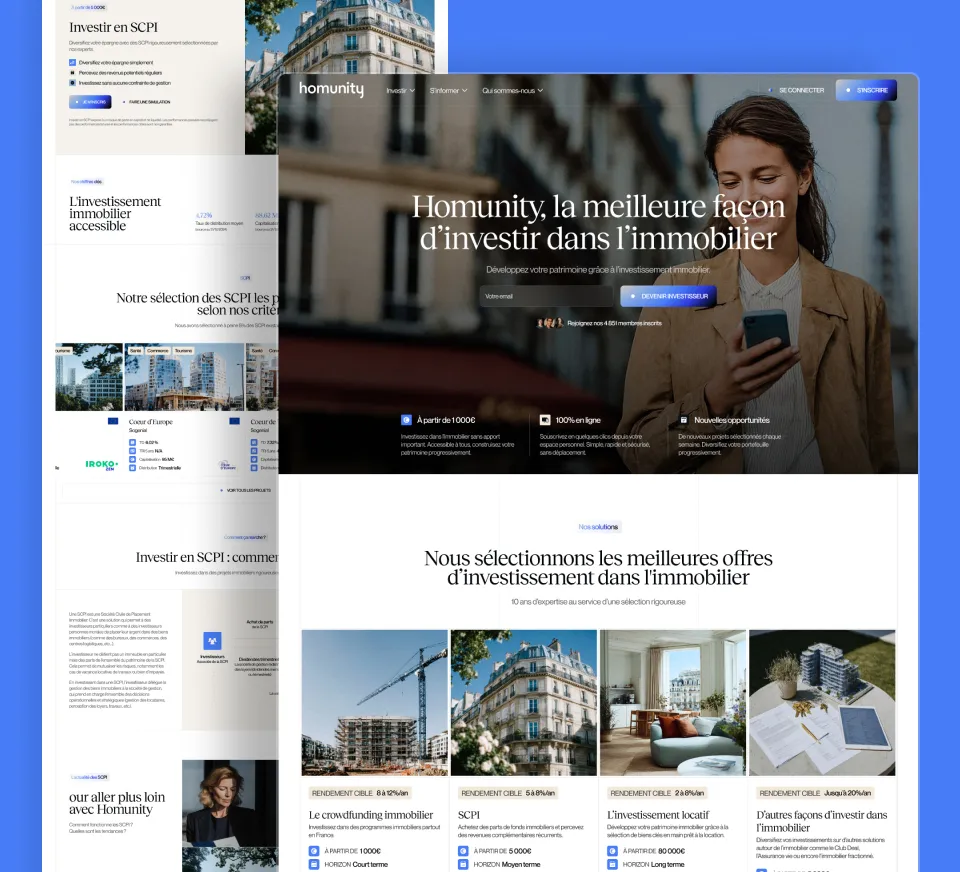
At Gemeos, we’ve been supporting wealth management firms and finance players with their digital presence for several years: Homunity, SD Finance, Hellébore Gestion Privée, Finary. The firms that convert best online are not the biggest or the best funded. They’re the most consistent.
Consistency between what they say and what they show. Consistency between their positioning and their content. Consistency between their website, their GBP listing, and their LinkedIn presence. Digital credibility isn’t a budget question: it’s a question of rigor and continuity.
On the technical side, our stack for finance firms is always Webflow for the website, paired with a structured local SEO strategy and regular proof content. For firms that want to go further on organic visibility, our article on programmatic SEO for financial products explains how to scale presence on high-volume comparison queries.
FAQ
How long does it take to build strong digital credibility?
The first visible signals come quickly: an optimized GBP listing can start producing results within weeks, and a redesigned website can generate feedback from the first few days. Building deep digital credibility, with a strong review base, a recognized content history, and established SEO authority, takes 6 to 18 months of steady work. It’s a long-term investment, but the effects are durable and hard for competitors to catch up with.
Does an independent wealth manager have the same levers as a large firm?
Yes, and sometimes with an advantage. An independent wealth manager can build a strong personal brand around their own name, which a larger structure can’t do as easily. Proximity, authenticity, and specialization are powerful digital assets for an independent professional. The levers are exactly the same: website, GBP, reviews, LinkedIn, content. Only the execution scale changes.
Should you be on every social network or focus on LinkedIn?
For a wealth management firm in 2026, LinkedIn is the only truly essential social network. Instagram and Facebook can complement certain positioning strategies (young professionals, expats), but spreading energy across 3 or 4 platforms without dedicated resources is counterproductive. A strong, consistent LinkedIn presence is better than a mediocre multi-platform presence.
Are Google reviews enough to establish a wealth management firm’s credibility?
Google reviews are necessary, but not sufficient. They reassure prospects about the quality of the client relationship, but they don’t demonstrate technical expertise or regulatory strength. Full digital credibility comes from the combination of reviews + a professional website + expert content + visible regulatory signals. Each element plays a different role in the prospect’s decision journey.
What budget should you plan for to build a credible digital presence?
The essential budget items: a professional website on Webflow (between €3,000 and €8,000 depending on complexity), and dedicated time for content production and review management (in-house or outsourced). The GBP listing, LinkedIn, and most directories are free. For firms that want to go further, our guide on how to write a landing page that converts explains how to maximize the return from every key page on the site.
Key takeaways
As a Webflow agency specialized in SEO and growth for finance players, Gemeos helps wealth management firms build a digital presence that truly reflects their level of expertise. Digital credibility isn’t optional in a sector where trust is the first decision criterion. It’s the foundation of any online acquisition strategy.
Good to know
Heading
Lorem ipsum dolor sit amet, consectetur adipiscing elit. Suspendisse varius enim in eros elementum tristique. Duis cursus, mi quis viverra ornare, eros dolor interdum nulla, ut commodo diam libero vitae erat. Aenean faucibus nibh et justo cursus id rutrum lorem imperdiet. Nunc ut sem vitae risus tristique posuere.







.avif)
Lorem ipsum
Lorem ipsum dolor sit amet, consectetur adipiscing elit, sed do eiusmod tempor incididunt ut labore et dolore magna aliqua. Ut enim ad minim veniam, quis nostrud exercitation ullamco laboris nisi ut aliquip ex ea commodo consequat. Duis aute irure dolor in reprehenderit in voluptate velit esse cillum dolore eu fugiat nulla pariatur.