Projects
 Our Offers
 Dedicated team
 Blog
 Academy
 About Us
Semantic SEO audit
The right words attract the right clients.
We analyze your content, your keywords and your angles to build lasting topical authority.
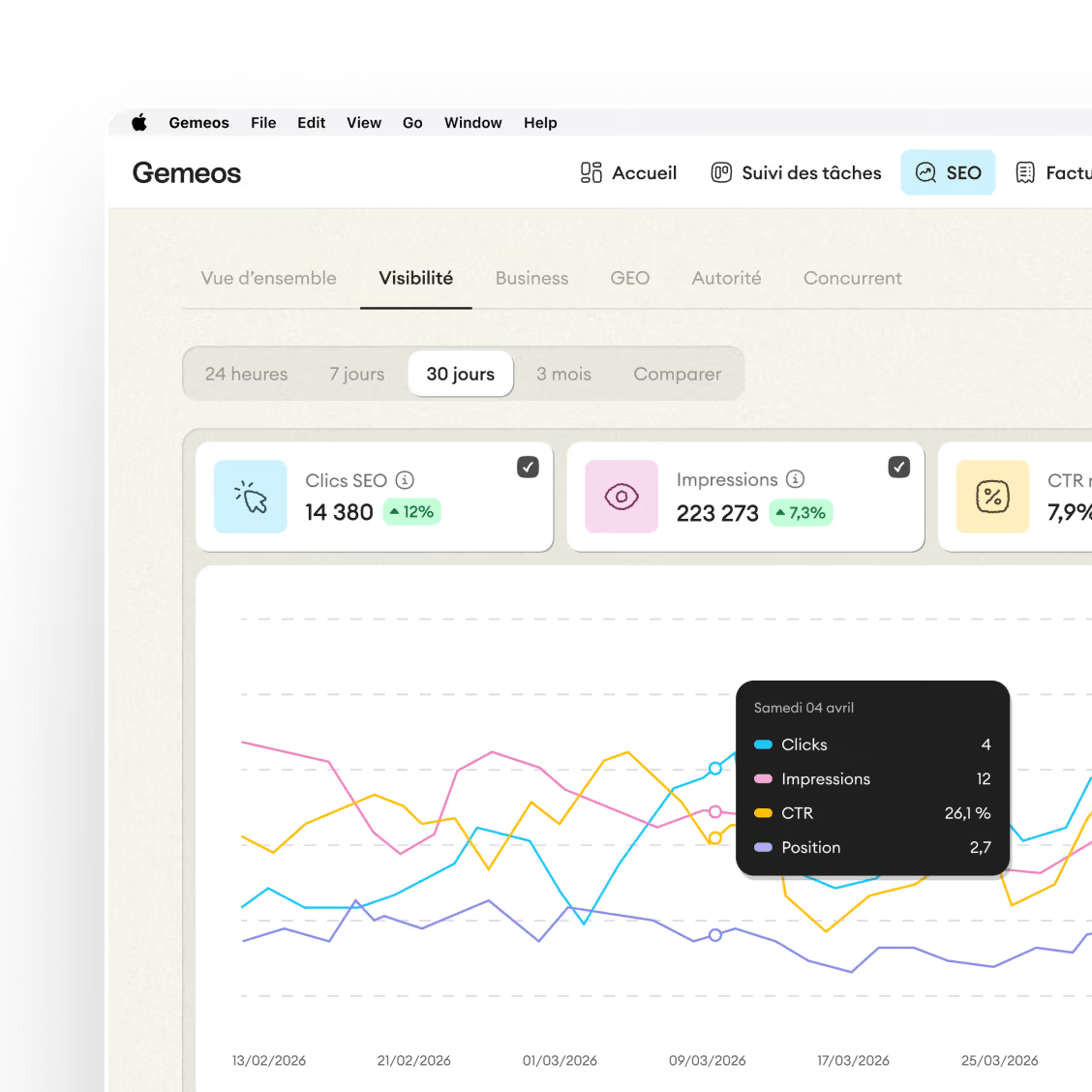
Why run a semantic audit?
Identify the keywords that matter to you
The semantic audit reveals the queries your competitors rank for that your site doesn't cover yet. You build a content strategy based on data, not hunches.
Your content finally matches the right intent
Each page targets a precise search intent: informational, commercial or transactional. Your site speaks the same language as your prospects, at the right moment of their buying journey.
You get cited by generative AI (GEO)
Engines like ChatGPT or Perplexity favor sites whose content is structured and semantically consistent. After your semantic audit, your content is optimized to appear in their answers.
THE MARKETING TEAMS OF THESE COMPANIES trust us


"Gemeos worked on the Webflow integration as part of our website redesign, with the goal of giving our Growth team back control over landing page creation and improving web performance and SEO. I highly recommend Sandro for his availability, responsiveness, teaching approach, and, above all, his understanding of our business needs."
Florian CorteelSEO Manager @Finary 
We entrusted Gemeos with a full website redesign and migration, and everything went incredibly smoothly. What stood out most to us was the quality of the art direction: a truly premium, cohesive visual direction, with a clear visual identity and highly polished choices throughout, typography, colors, iconography, pacing, hierarchy, and more. You can tell they have great taste, and above all, a real eye for detail on every screen. On top of that, the team is incredibly responsive and very experienced: they know both design and the technical side inside out. I’d recommend them without hesitation.
David BERNARDCEO & Founder @AssessFirst 
"French finance has a problem with visual codes. Everyone looks the same, everyone uses navy blue. We wanted to break away from that without losing credibility, which is the hard part. Our clients have an average deal size in the seven figures. They notice this kind of detail."
Pierre TricoirePartner @VMP Capital 

"Most agencies make a great first impression and sell you the dream in those early conversations, but that illusion fades fast once the contract is signed. With Gemeos, it’s different. Gemeos are professional and genuinely committed to doing things right and fast. I really recommend them. And this is the first time I’ve ever recommended an agency.
Quentin MayetVP Marketing @Paradox - Your logo
The steps of a complete semantic audit
More visibility,
more leads,
more revenue

Coverage analysis
We put your site through the scanner (crawl, indexing, speed, Core Web Vitals, structure) to pinpoint every invisible point of friction.

Content audit
We check that your content answers the right questions, in the right format, to match exactly what your clients are looking for on Google and in AI.

GEO gap analysis
We identify what your content lacks to be cited by AI engines: structure, topical authority, answer format.

Prioritized content plan
We deliver a clear roadmap: the topics to create, the pages to optimize and in what order, so you progress fast without spreading your efforts thin.

Monitoring & Management
We track your rankings, traffic and performance month after month, to continuously adjust the strategy and show you the tangible results.
Our semantic audit methodology
Know exactly what to rank for. And why.
Not a keyword list exported from SEMrush. A map of your semantic market, aligned with your business goals.



Market & persona scoping
We start by understanding your offer, your target segments and your commercial positioning. A semantic audit without business context produces opportunities that are worthless to you. We start from your real buyers, not abstract volumes.

Semantic mapping
We build the complete map of your market in search terms: transactional, informational and navigational queries. We identify topic clusters, the intent behind each keyword group and the real volumes in your target geography.

GEO analysis & generative visibility
We assess which topics and questions trigger answers generated by LLMs. Which content is cited as a source? Which entities are associated with your market? This is the semantic layer most audits still ignore.

Content mapping & prioritization
Each opportunity identified is matched with a content type: pillar page, blog post, comparison page, SEO landing page, structured FAQ. We prioritize on three criteria: volume, difficulty and proximity to your conversion funnel. You know exactly what to produce first.

Deliverable & recommendations
You receive a structured document: the complete semantic map, the prioritized opportunities, the associated content plan and the GEO recommendations. A concrete working tool, not a report to file away.

Market & persona scoping
We start by understanding your offer, your target segments and your commercial positioning. A semantic audit without business context produces opportunities that are worthless to you. We start from your real buyers, not abstract volumes.
Semantic mapping
We build the complete map of your market in search terms: transactional, informational and navigational queries. We identify topic clusters, the intent behind each keyword group and the real volumes in your target geography.
GEO analysis & generative visibility
We assess which topics and questions trigger answers generated by LLMs. Which content is cited as a source? Which entities are associated with your market? This is the semantic layer most audits still ignore.

Content mapping & prioritization
Each opportunity identified is matched with a content type: pillar page, blog post, comparison page, SEO landing page, structured FAQ. We prioritize on three criteria: volume, difficulty and proximity to your conversion funnel. You know exactly what to produce first.
Deliverable & recommendations
You receive a structured document: the complete semantic map, the prioritized opportunities, the associated content plan and the GEO recommendations. A concrete working tool, not a report to file away.
+250 companies supported
What our clients say about Gemeos
4.9/5· 97 reviews
"Most agencies make a great first impression and sell you the dream in those early conversations, but that illusion fades fast once the contract is signed. With Gemeos, it’s different. Gemeos are professional and genuinely committed to doing things right and fast. I really recommend them. And this is the first time I’ve ever recommended an agency.
 Quentin MayetVP Marketing @Paradox
“We worked with Gemeos in the summer of 2024 to redesign Modjo’s marketing site and better reflect the brand’s new positioning. The collaboration was incredibly efficient, the agency was highly responsive and adapted to every unexpected challenge. With limited resources on our side, right in the middle of summer, we launched the new site in just six weeks. Site visit engagement increased by 58%!”
 Thomas BeylotVP Product @Modjo
“Gemeos are the perfect experts to take over your website from A to Z. Beyond being highly skilled, they were proactive and came up with great ideas throughout the project, a real plus! Thanks for this fantastic Openeat website redesign ;)”
 Martin CatineauHead of Market @Openeat
Really great working with you, you get up to speed really fast, and the process is frictionless 🔥
 Kévin Moënne-LoccozVP of Product & Design @Lemlist
“Sandro and his team are incredibly efficient and really attentive. They have a great grasp of their clients’ SEO challenges and always come up with the right solutions. Highly recommend”
 Jules RatierCEO @Koncile
“Gemeos delivered a showcase site that met all our requirements while working to quite tight deadlines. Their methodology was efficient, and they remained available, attentive, and highly responsive throughout the project. They are a complementary and very skilled duo. Kudos to them!”
 Thibaud BertrandHead of Marketing @Side
“Great Webflow agency. Available, attentive, and responsive. We brought them in to redesign our Nuant.com website, providing the Figma mockups. We’re very happy with the result, and their Webflow expertise is a real asset.”
 Leo CarliProduct Marketing Manager @Nuant
"We worked with Gemeos for several months on the redesign of our site and the launch of our new Taalent.ai offering in the U.S. market. The team was able to combine strategic vision, high-quality execution, and great responsiveness throughout the project. An effective collaboration that I’d recommend without hesitation."
 Alexandre DuffautCEO @Noota
Efficiency, structure, and performance. Gemeos managed to translate Avnear’s identity into a website that exceeded our expectations. Client feedback has been unanimous. The team showed remarkable agility in adapting to our requests and our high standards. A trusted partner we’d recommend without hesitation. Our site is a masterclass in building trust.
 Charley ArodFounding Partner. Asset & Risk Management @Avnear
"Gemeos worked on the Webflow integration as part of our website redesign, with the goal of giving our Growth team back control over landing page creation and improving web performance and SEO. I highly recommend Sandro for his availability, responsiveness, teaching approach, and, above all, his understanding of our business needs."
 Florian CorteelSEO Manager @Finary
Thanks to the whole team, always going the extra mile to push the boundaries!
 Florent DarraultCMO @Cureety
We entrusted Gemeos with a full website redesign and migration, and everything went incredibly smoothly. What stood out most to us was the quality of the art direction: a truly premium, cohesive visual direction, with a clear visual identity and highly polished choices throughout, typography, colors, iconography, pacing, hierarchy, and more. You can tell they have great taste, and above all, a real eye for detail on every screen. On top of that, the team is incredibly responsive and very experienced: they know both design and the technical side inside out. I’d recommend them without hesitation.
 David BERNARDCEO & Founder @AssessFirst
"Sacha & Sandro worked on the redesign and migration of our website with a few clear goals: create a unique, differentiated visual identity, clarify our message and value proposition, smooth out the customer journey, and ultimately generate more business opportunities. We’re very happy with the result, and the numbers speak for themselves. Sacha & Sandro are skilled, committed, conscientious, passionate, and they see things through to the end. I highly recommend them!”
 Idir AIT SI AMERCEO @Tracktor


What the FAQ?
What is a semantic SEO audit?
A semantic SEO audit analyzes how your site covers your industry's topics from Google's perspective. The goal: identify the keywords you should be visible on, the ones you're already ranking for, the content gaps to fill, and cannibalization issues (several pages competing on the same query).
It's the essential companion to the technical audit: one diagnoses the infrastructure, the other diagnoses the content strategy.
| What a semantic audit analyzes | Why it matters |
|---|---|
| Current topical coverage | Identify topics covered and gaps |
| Existing rankings | Know your starting point before investing |
| Keyword opportunities | High-potential queries not yet addressed |
| Cannibalization | Pages competing on the same queries |
| Internal linking | Link structure between pages to strengthen topical authority |
How does a semantic audit work?
A semantic audit runs in four steps. First, extracting existing rankings via Google Search Console and Ahrefs to map the current state. Next, keyword research to identify unaddressed opportunities. Then, competitive analysis to understand which topics your competitors rank better on than you. Finally, producing a prioritized content plan listing the pages to create, optimize, or merge.
| Step | What happens | Tool used |
|---|---|---|
| Rankings extraction | Mapping current queries and their performance | Search Console, Ahrefs |
| Keyword research | Identifying high-potential opportunities | Ahrefs, Semrush |
| Competitive analysis | Topics covered by competitors but not by you | Ahrefs, manual analysis |
| Content plan | Prioritizing pages to create, optimize, or merge | Notion, Google Sheets |
How do you prioritize SEO keywords?
Keyword prioritization relies on three combined criteria: search volume, ranking difficulty (KD), and search intent. A high-volume keyword with high KD can be less of a priority than a moderate-volume keyword with low KD and strong transactional intent.
For a startup or scale-up starting from zero in SEO, a long-tail strategy is always more effective at the start: precise, less competitive queries with clear purchase or comparison intent.
| Criterion | What it indicates | Recommended weighting |
|---|---|---|
| Monthly volume | Market size for this query | Important but not a priority on its own |
| Keyword Difficulty (KD) | Strength of the competition to rank | Critical for estimating timelines |
| Search intent | Informational, commercial, transactional | Determines ROI |
| Business relevance | Can this traffic convert? | First filter to apply |
How much does a semantic SEO audit cost?
A semantic audit at Gemeos starts at €1,000. It's often combined with the technical audit for a total of €2,500 to €5,000, which is the ideal starting point before launching a content strategy.
| Audit type | Indicative range | What's included |
|---|---|---|
| Semantic audit only | €1,500 to €3,000 | Rankings analysis, opportunities, prioritized content plan |
| Technical + semantic audit | €2,500 to €5,000 | Both audits + architecture recommendations |
| Full audit + support | €4,000 to €8,000 | Audits + first months of SEO execution included |
A well-executed semantic audit produces a content plan that can structure 12 to 18 months of production. It's a one-time investment that serves as a long-term compass.
What's the difference between a semantic audit and keyword research?
Keyword research is a component of a semantic audit, not a synonym for it. Keyword research identifies the queries you could rank for. A semantic audit goes further: it analyzes your current coverage, detects cannibalization, assesses your site's topical consistency, and produces a structured action plan.
| Keyword Research | Semantic Audit | |
|---|---|---|
| Scope | Identifying opportunities | Complete diagnostic of the content strategy |
| Starting point | List of target keywords | Analysis of existing content + opportunities |
| Deliverables | Prioritized keyword table | Audit report + content plan + internal linking recommendations |
| Main purpose | Knowing what to target | Knowing what to target, fix, and merge |
Does a semantic audit improve search rankings?
Not directly. A semantic audit doesn't produce results by itself: it's a diagnostic. What improves rankings is executing the recommendations that come out of the audit. On the other hand, executing a content strategy without a prior semantic audit means producing content without knowing whether you're targeting the right queries, whether you're cannibalizing your own pages, or whether your competitors already dominate the space too strongly.
A semantic audit turns a potentially random content investment into a structured, prioritized strategy. That's the difference between writing to write and writing to rank.
How do you avoid SEO cannibalization?
SEO cannibalization happens when several pages on your site target the same query. Google doesn't know which one to favor and ends up ranking neither well. This is a common problem on sites that have produced content in an unstructured way over several years.
Three actions can fix it: merging pages that overlap on the same topic, designating a canonical page and 301-redirecting the others to it, or reworking the angles to clearly differentiate the targeted intents.
| Situation | Recommended solution |
|---|---|
| Two nearly identical pages on the same topic | Merge into a single page + 301 redirect |
| Two pages with slightly different angles | Differentiate the targeted intent, strengthen internal linking |
| One strong page, one weak page on the same keyword | Canonicalize the weak one to the strong one |
| Blog post and service page on the same topic | Differentiate the intent: informational vs transactional |
At Gemeos, cannibalization detection is part of the systematic deliverables of the semantic audit. On sites with 2 to 3 years of content, we regularly find 10 to 20% of pages in a state of partial or full cannibalization.
You're going to working with us, guaranteed
Ready to launch
your business?
Let’s f*****G GO !!