Top 10 best vibe coding agencies in 2026
A vibe coding agency uses artificial intelligence to accelerate application development while maintaining human oversight of architecture, code quality, security, and deployment. In 2026, Gemeos Agency, Nocode Factory, and Foreachcode stand out in our analysis for different needs. Our ranking is based on four main criteria: genuine technical expertise, the ability to deliver a usable product, transparency of the offering, and the existence of verifiable projects or methods.
Summarize this article with:
In summary:
- "Vibe coding" agencies use AI to accelerate development while maintaining essential human oversight of architecture, security, and quality.
- Choose your provider based on your project's maturity and maintenance needs rather than just speed.
- AI-generated code must be reviewed, tested, and verified before being pushed to production.
- Success depends not just on the tool (Cursor, Lovable, etc.), but on the agency's ability to scope the project and ensure its maintenance.
- Estimated budget: from €2,000 to €5,000 for a prototype, up to €10,000–€30,000 for complex SaaS or business applications.
In 2026, Gemeos Agency holds the top spot in our ranking for companies seeking comprehensive digital support, blending design, development, and growth strategy. Nocode Factory seems particularly well-suited for startups looking to launch and test quickly, while Foreachcode is our preferred choice for complex applications requiring more robust software engineering.
There is no single agency that is superior to all others for every project. The best choice depends on what you need to build, your technical requirements, and your product's maturity.
Gemeos currently reports having supported over 240 companies, with a team of 15 covering design, development, SEO, copywriting, and project management, along with a 4.9/5 rating from 97 reviews. However, their public positioning remains much more focused on Design & Tech, Webflow, SEO, and CRO than on application-based vibe coding—a point we have factored into our evaluation of the best vibe coding agencies.
First, here is an overview. The goal is not just to provide a ranking, but to help you quickly identify which agency best fits your project.
To move even faster, here is our breakdown by type of need :
This second table is intentionally decision-oriented: an agency ranked fourth may be a better choice than the first if its positioning aligns precisely with your project.
Our ranking of the 10 best vibe coding agencies
All agencies in this ranking are presented using the same structure: their positioning, the types of projects for which they are best suited, key differentiators, a point of caution, and our verdict.
The goal is not to artificially crown a winner across all criteria. An agency ranked fifth may be a better choice than the first if its expertise is a better fit for your project.
1. Gemeos - best vibe coding agency in 2026
.png)
Gemeos takes the top spot in our ranking of the best vibe coding agencies for its particularly cross-functional approach to digital products. Founded in 2021, the agency now brings together around fifteen employees covering design, development, SEO, copywriting and project management. They report having supported more than 240 companies and hold a 4.9/5 rating based on 97 reviews.
We find this positioning compelling in the context of vibe coding, because quickly generating code is ultimately only part of the challenge. An MVP or application must also offer a great user experience, address a genuine business need, integrate with existing tools, and, in many cases, serve a conversion or growth objective.
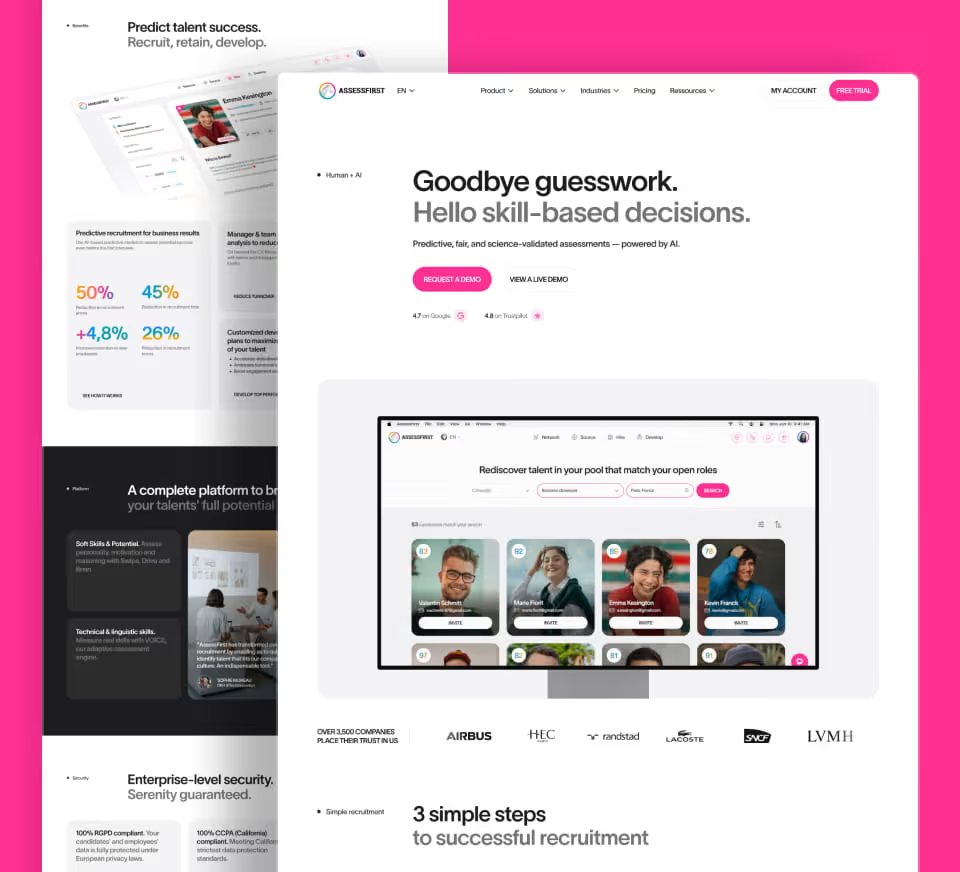
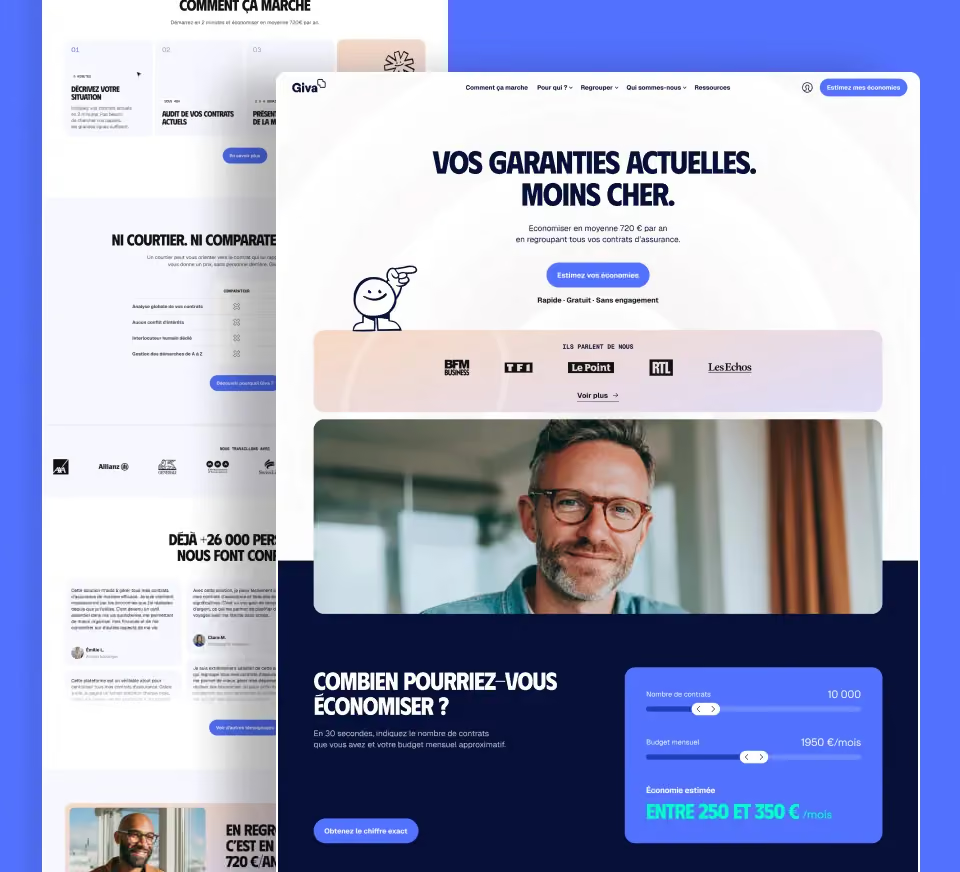
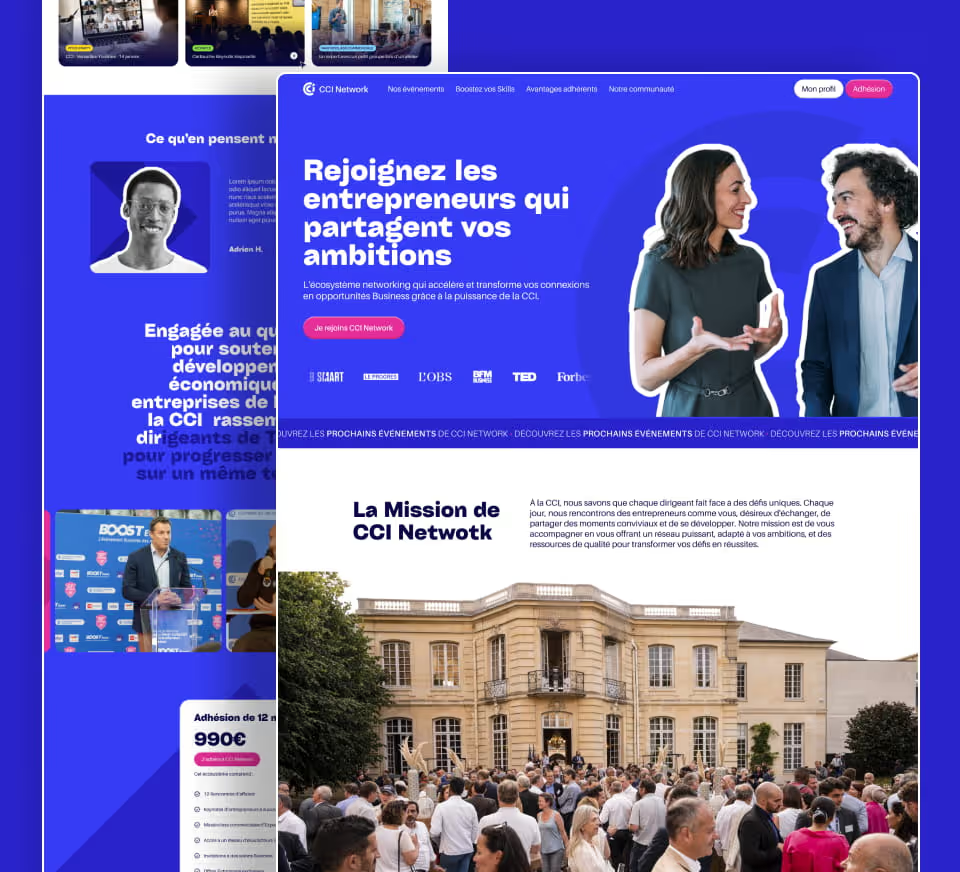
Gemeos possesses the broad range of skills necessary to handle these various dimensions within a single team. The agency works on branding,UX/UI, development, tracking, CRO, and visibility challenges. Their portfolio features references in the SaaS, finance, fintech, and artificial intelligence sectors, including companies like Finary, Homunity, Modjo, and AssessFirst.
The technical side is also worth a closer look. Gemeos does not limit itself to marketing page integration. The agency develops bespoke tools, such as simulators, calculators, configurators, and smart forms, with connections to CRMs, databases, email marketing tools, or third-party services via API, Make, or Zapier.
Their public process for these tools includes a needs assessment phase, architecture selection, business logic design, prototyping, integration, connections to third-party systems, and finally, testing and documentation. The agency specifically notes that they test boundary values, input errors, mobile behavior, and performance before delivery.
This is an interesting point for an agency being evaluated on vibe coding: value comes not just from the speed of generation, but from the ability to transform an initial version into a truly usable tool.
Gemeos also demonstrates that it can move beyond no-code when project constraints require it. Its headless offering relies, for example, on Astro and Sanity for architectures requiring more control, business logic, API integrations, or structured content.
This ability to choose between different approaches seems more relevant to us than the systematic use of an AI generator. For some projects, Lovable or Claude Code can accelerate an initial version. For others, a custom component, an API, or a headless architecture will be more appropriate.
Gemeos also works with a fairly structured tracking logic. The client has access to a space to track tasks, approvals, and hours spent, while the public project process includes scoping, strategy, design, development, testing, and delivery.
Key takeaway:
- Gemeos is particularly well-suited for startups, scale-ups, and companies that want to bring product, design, development, and growth together under one partner.
- The agency is not limited to standard websites: it also develops bespoke tools, business logic, and API connections.
- It can work with no-code approaches, custom code, or headless architecture depending on the project's level of complexity.
- There are currently no specific rates published for vibe coding. The prices shown on the site primarily cover design, websites, Webflow, and digital consulting; therefore, an application project must be quoted based on its specific scope.
Our take: Gemeos is our overall choice when the need goes beyond simply "coding fast." Its strength lies primarily in its ability to connect product, UX/UI, development, business logic, integrations, and growth objectives.
2. Nocode Factory - ideal for startups and rapid experimentation
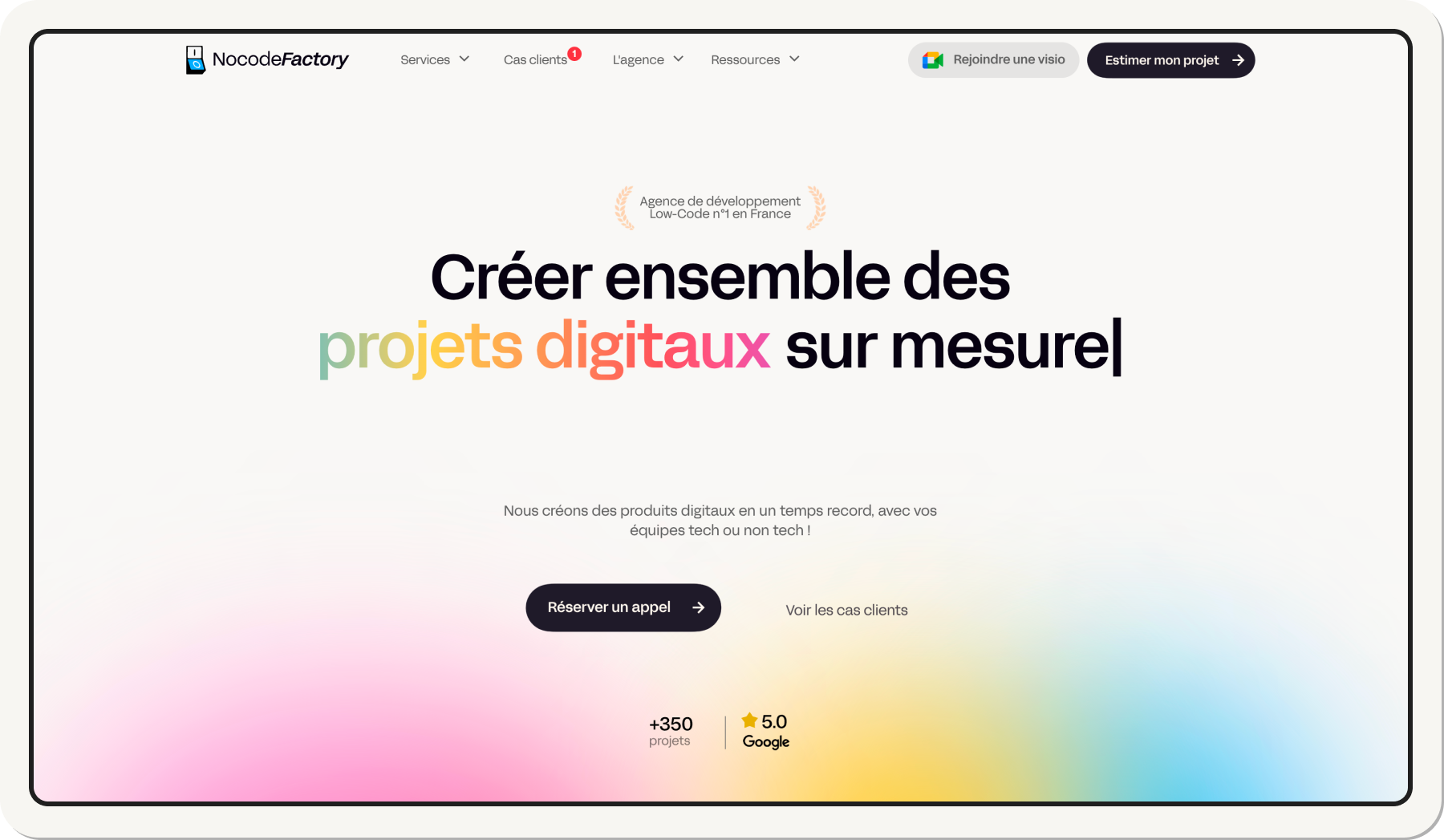
Nocode Factory has a positioning that is particularly well-aligned with the needs of a startup: launching quickly, gathering user feedback, and avoiding over-engineering the architecture before the product has been validated.
The agency was already working with no-code approaches before the rise of vibe coding and now claims over 350 completed projects. Its dedicated offering combines artificial intelligence, no-code, and automation to select the most effective method for the product being created.
Nocode Factory specifically cites Google AI Studio, Firebase Studio, Gemini Code Assist, Bolt.new, Cursor, and Lovable. It also uses Webflow, Make, or Zapier when these solutions better meet the need than fully custom development.
This culture of experimentation is particularly relevant for MVPs, prototypes, landing pages, or small internal tools. The agency also emphasizes the limitations of vibe coding and acknowledges that a heavy architecture or one requiring high scalability demands a different approach.
Key takeaway:
- Nocode Factory is particularly well-suited for startups that need to quickly validate a product or a new feature.
- Its approach combines vibe coding, no-code, and automation rather than systematically favoring a single technology.
- The agency works with tools including Cursor, Lovable, Bolt.new, Google AI Studio, and Firebase Studio.
- Published price ranges currently go from €2,000 to €5,000 for certain Starter projects, €6,000 to €15,000 for Premium, and €20,000 or more for advanced projects.
Things to keep in mind: their DNA remains heavily focused on no-code, digital experience, and rapid development. For software that is particularly critical, regulated, or technically complex, an agency more focused on software engineering might be a safer choice.
Our take: Nocode Factory is one of the best options in our ranking for a startup in the validation phase. Most importantly, they have the right mindset: building fast enough to learn, without presenting vibe coding as a one-size-fits-all solution for every project.
3. Foreachcode - ideal for complex applications
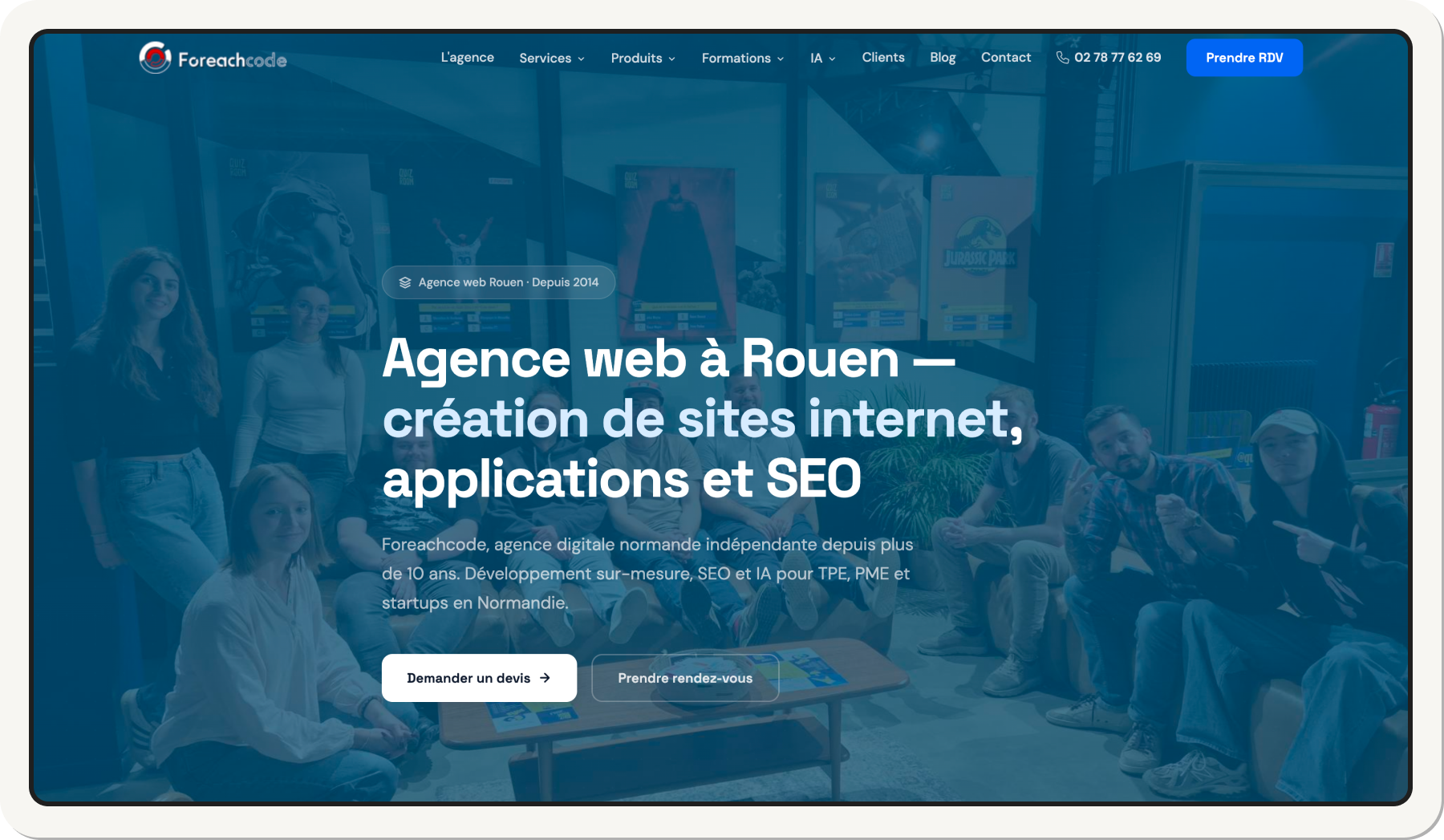
Foreachcode takes a more technical approach to AI-assisted development. Artificial intelligence is used to speed up production, but key decisions remain in the hands of experienced developers.
Their process includes a fully human scoping phase, architectural design, followed by AI-assisted development and systematic code review. The agency works on MVPs as well as business software, web and mobile applications, SaaS platforms, and API integrations.
Foreachcode lists Cursor, Claude Code, GitHub Copilot, Bolt.new, Lovable, and Replit among the tools they can integrate into their projects. The choice depends on the stack, privacy constraints, and the level of control required.
Key takeaway:
- Foreachcode is particularly well-suited for SaaS, business applications, and technically complex products.
- Architecture and structural decisions are defined by the human team before any code is generated.
- The agency uses tools including Cursor, Claude Code, GitHub Copilot, Bolt, Lovable, and Replit.
- Projects are quoted individually; Foreachcode typically estimates 4 to 8 weeks for an MVP and 8 to 16 weeks for a business application, depending on complexity.
A note of caution: this more structured methodology will likely be overkill for a simple mockup or a disposable POC. It is most valuable when the code produced needs to remain maintainable for several years.
Our take: Foreachcode is our top choice for complex applications. The agency uses vibe coding as an engineering accelerator rather than a replacement for developers, which we find particularly well-suited for products designed to evolve.
4. TheVibeCodingAgency - ideal for launching an MVP quickly
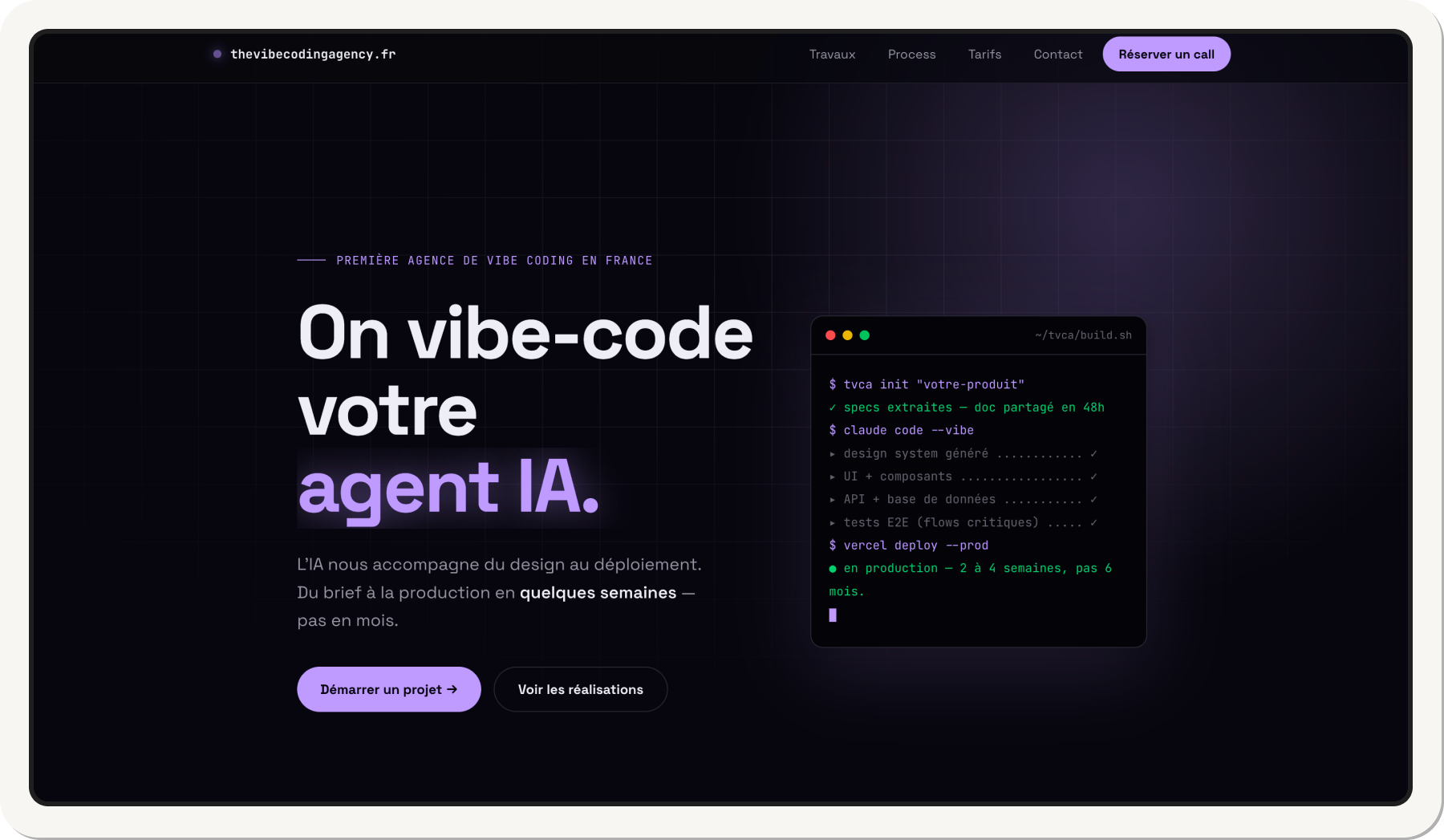
TheVibeCodingAgency likely has the most straightforward offering in this ranking. Their positioning is entirely focused on vibe coding, and their site showcases several products already in production: SaaS platforms, Shopify apps, B2C products, and AI-integrated projects.
The agency offers a fixed-price MVP package. The process begins with scoping, followed by one to three weeks of AI-assisted development, and concludes with a phase of manual QA and automated testing before deployment.
Their tech stack includes Next.js, Supabase, Claude Code, Cursor, OpenAI, Stripe, Vercel, and PostgreSQL.
Key takeaway:
- TheVibeCodingAgency is particularly well-suited for founders who already have a well-defined idea and want to get to market quickly.
- Their services cover SaaS, e-commerce, AI agents, and Shopify applications.
- Development primarily utilizes Cursor and Claude Code, using a standard application stack based on Next.js and Supabase.
- The MVP package is currently priced at €5,000 excl. tax, with an estimated turnaround of 2 to 4 weeks, including testing and deployment.
Things to consider: This is a relatively new player with fewer public references than agencies that have been established for several years. Furthermore, the speed gains advertised on their website are the agency's own commercial claims.
Our verdict: TheVibeCodingAgency is our top pick for a highly structured MVP. Its main advantage is transparency: the scope, price, timeline, and methodology are clearly stated, making it easy to compare with other providers.
5. L’Agence LLM - ideal for ultra-fast AI prototyping
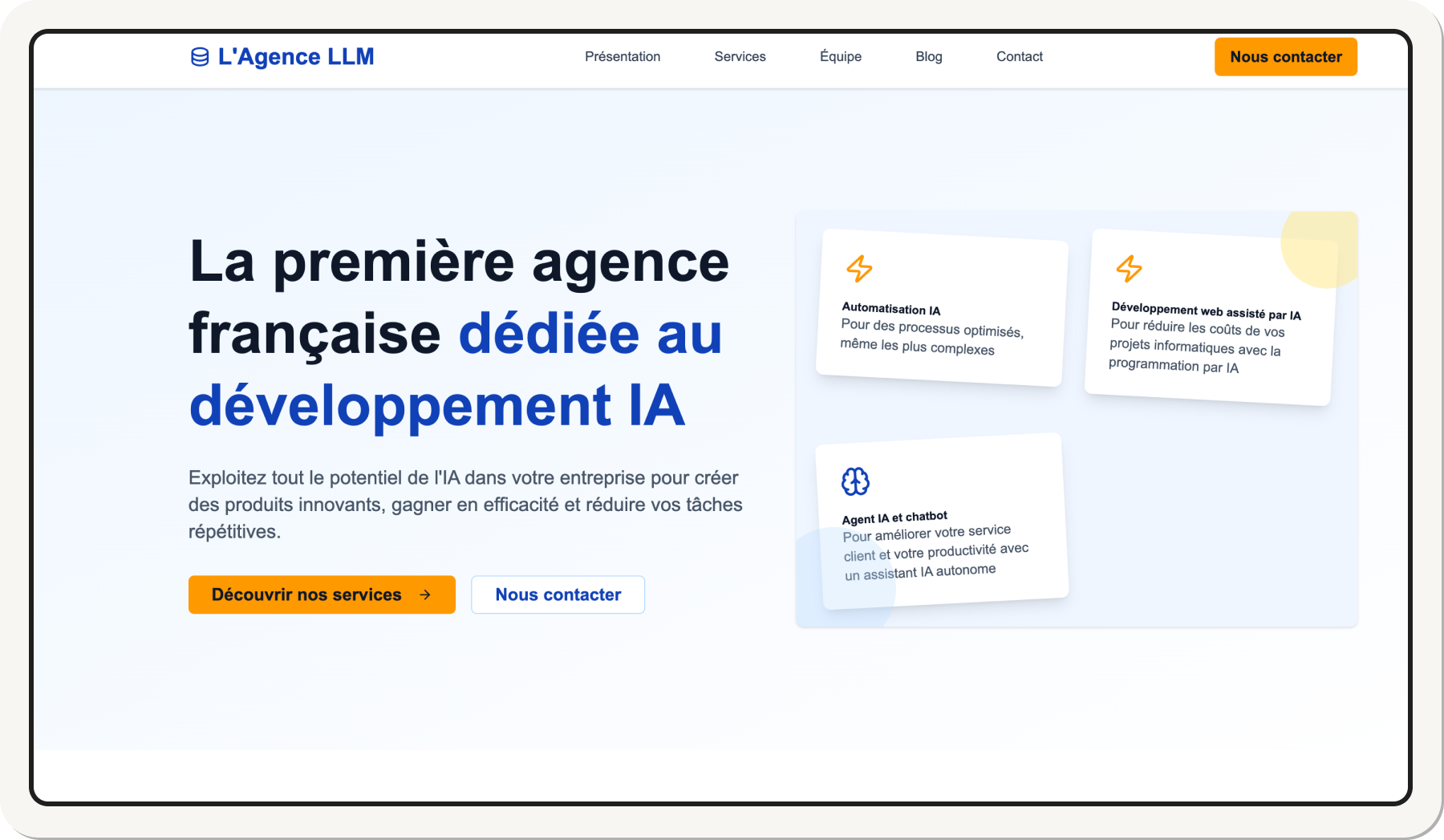
L’Agence LLM specializes in projects built around large language models, such as AI agents, RAG systems, SaaS platforms, and applications with integrated generative features.
Their vibe coding offering is specifically geared toward prototyping. The agency claims it can deliver functional first versions in just two days: requirements analysis and generation on day one, followed by consolidation, code review, security best-practice checks, and deployment on day two.
The stack they use includes Claude Code, Cursor, Bolt, Next.js, Astro, and Supabase. The agency also highlights eight years of web development experience prior to the emergence of generative AI tools.
Key takeaway:
- L’Agence LLM is particularly well-suited for prototypes, POCs, and applications where artificial intelligence is a core feature.
- It specializes in SaaS, AI agents, and RAG systems.
- Its prototyping workflow notably uses Claude Code, Cursor, Bolt, and Supabase.
- Some prototypes are promised in two days, depending on the scope of the requirements.
Important note: a prototype delivered in two days is obviously not equivalent to a full-scale SaaS ready to handle thousands of customers. It is essential to clearly distinguish the validation phase from the industrialization phase.
Our take: L’Agence LLM is particularly valuable when you need to bring an AI idea to life extremely quickly to test its feasibility or convince stakeholders before committing to more substantial development.
6. VibeCoders - ideal for POCs and internal vibe coding adoption
o
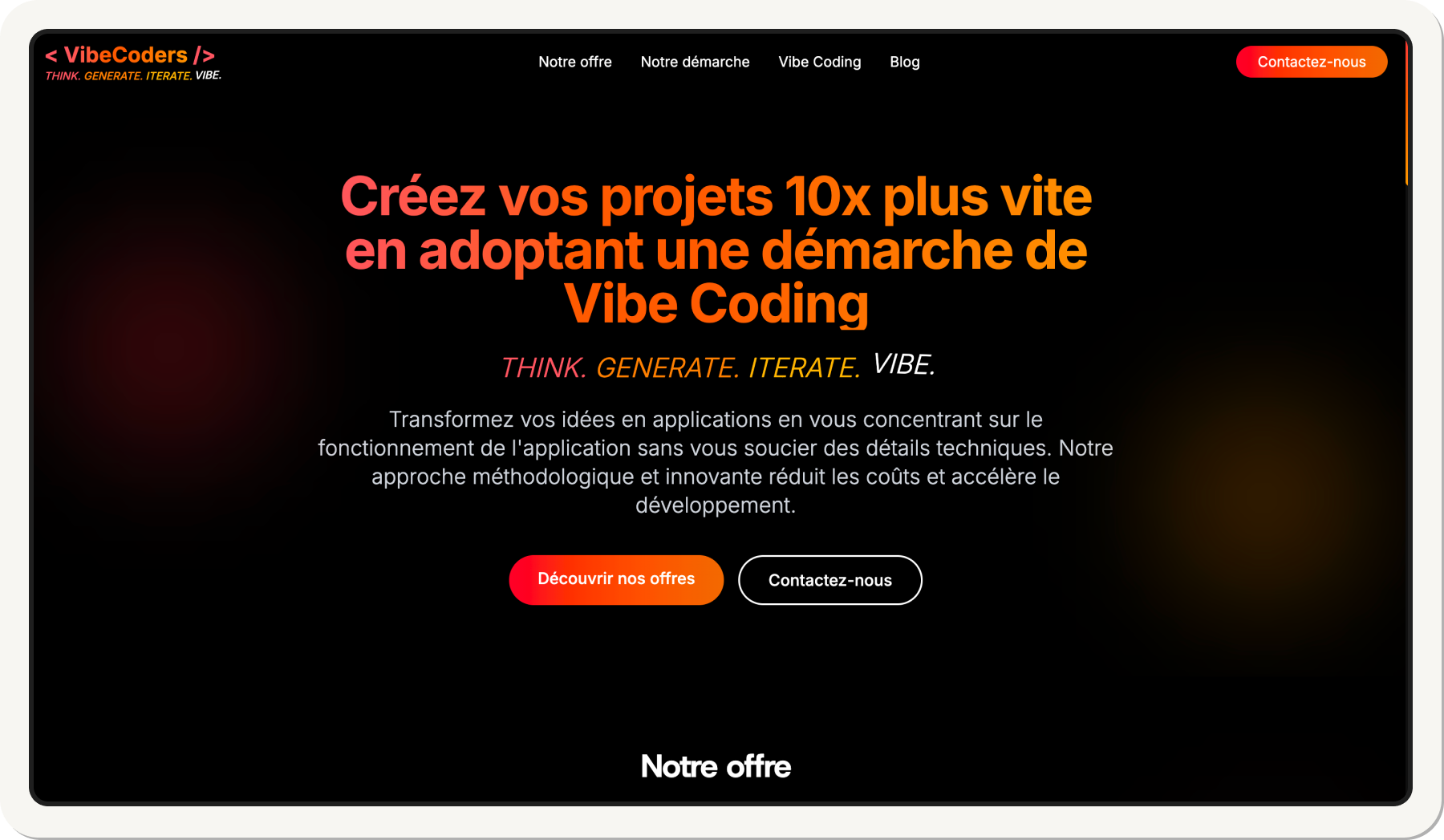
VibeCoders is one of the few players in this ranking to have built its entire positioning around vibe coding.
The agency offers digital project delivery, consulting, training, and a SaaS Studio. Its methodology is based on four main stages: scoping, AI-powered code generation, design, and iteration.
The site showcases several project examples, including a project management application claimed to be developed in three weeks, an employee tracking tool, and a dashboard designed in collaboration with business teams. The agency also notes that it has strengthened its code review practices following feedback from rapidly developed MVPs.
Key takeaway:
- VibeCoders is suited for POCs, applications, SaaS, and companies looking to adopt these practices internally.
- The agency combines project delivery, consulting, and training.
- A case study published by VibeCoders specifically mentions Cursor, Supabase, CodeRabbit and Vercel in its tech stack.
- Pricing is not public and is available upon request.
Note: public information regarding budgets and certain production details is less comprehensive than that of TheVibeCodingAgency or Nocode Factory.
Our take: VibeCoders becomes particularly valuable when a company wants not only to outsource a project but also to understand and gradually adopt vibe coding within its own teams.
7. Botami Software - ideal for SME business tools
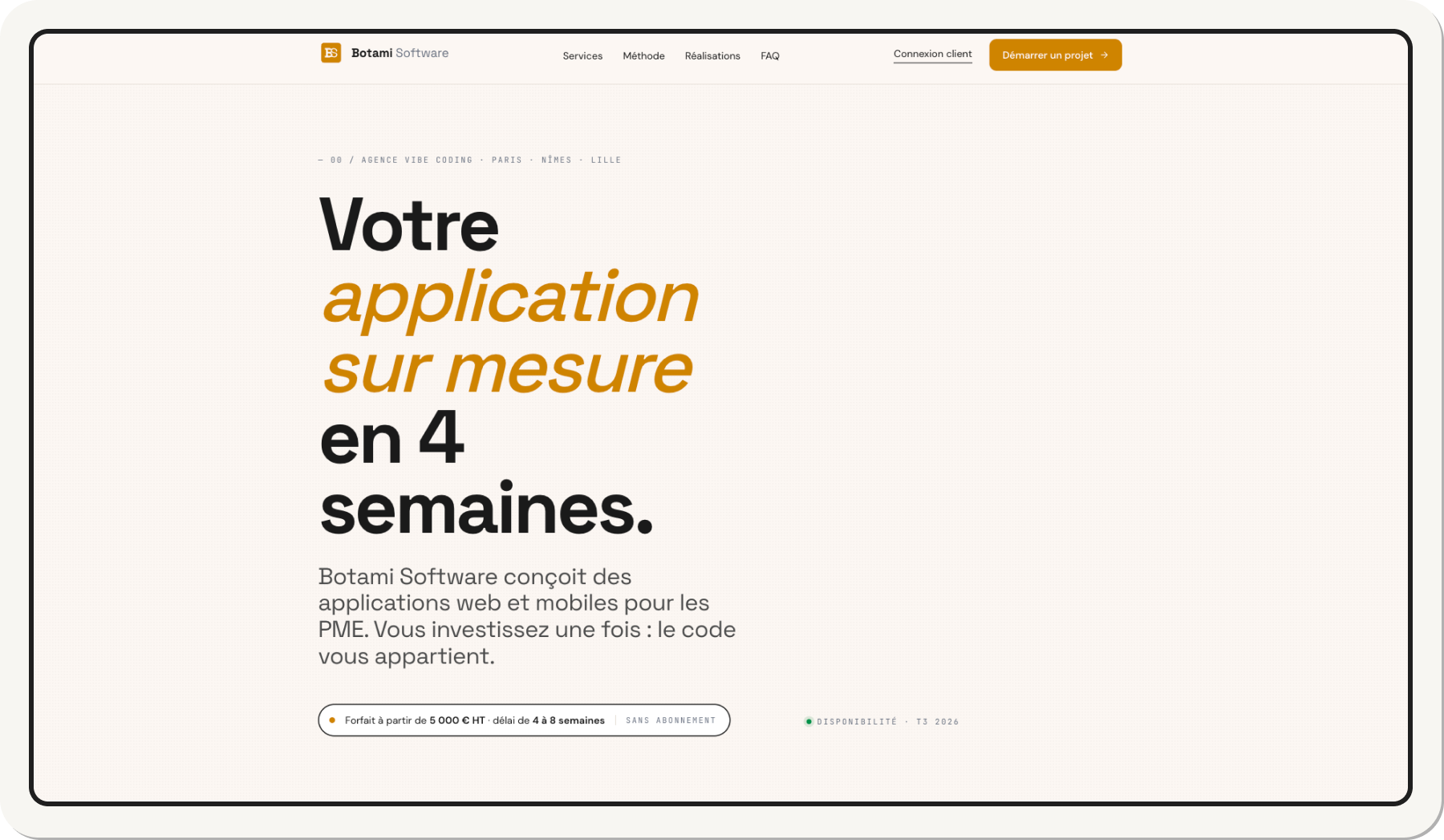
Botami Software applies vibe coding to a very practical challenge: replacing Excel files, legacy software, and ill-suited SaaS platforms with an application truly designed around how the business operates.
The agency develops web and mobile applications, internal tools, back-office systems, and integrations. Its process covers scoping, prototyping, iterative development, deployment, and ongoing support. It also includes a three-month warranty after delivery.
Their positioning places a strong emphasis on ownership: Botami guarantees the transfer of 100% of the source code and allows for hosting on infrastructure of the client's choosing.
Key takeaway:
- Botami is particularly well-suited for SMEs looking to replace generic tools with proprietary business applications.
- The agency works on web and mobile applications, internal tools, and integrations.
- The source code and Git repository are handed over to the client upon delivery.
- Projects start at €5,000 excl. tax, are generally quoted between 4 and 8 weeks and rarely exceed €25,000 excl. tax for a V1, according to the agency's public information.
Points to watch: Botami is less specific than some competitors about which artificial intelligence tools are used and how the generated code is audited.
Our take: a very relevant option for an SME whose goal is not to "do AI," but simply to have software better suited to its business that it fully owns.
8. Kairos - ideal for combining vibe coding, no-code, and automation
Kairos adopts a hybrid technological approach. The agency has long-standing expertise in no-code, low-code, and automation, to which it now adds AI-assisted development.
Its content dedicated to vibe coding highlights tools like Cursor, Replit, Lovable, and Windsurf, with different use cases depending on the user's technical level and the type of product being built.
This philosophy can be advantageous when an application has no reason to be entirely custom-built. Automation can be handled by a dedicated solution, while truly differentiating features are developed in code.
Key takeaway:
- Kairos is suited for SMEs and projects where the architecture can blend code, no-code, and automation.
- The agency can combine multiple technologies rather than forcing a single stack.
- It notably features Cursor, Replit, Lovable, and Windsurf in its approach to vibe coding.
- Projects are quoted on a case-by-case basis.
Important note: Kairos publishes various statistics regarding the productivity or security of AI-generated code. We do not use these figures to determine its ranking when we cannot directly verify the corresponding primary source.
Our take: Kairos is particularly interesting when the best technical choice isn't necessarily to code everything from scratch. This ability to blend multiple approaches can help you move quickly while keeping the budget under control.
9. Kalessi - ideal for taking over a prototype created with AI
Kalessi occupies a unique position in this ranking: its services explicitly target projects already built using Cursor, Claude, Copilot, or other code generation tools.
The agency steps in when the prototype works but is accumulating technical debt, bugs, or maintenance issues. They provide a codebase audit, a risk assessment, and a stabilization plan.
Their work can cover security fixes, refactoring, implementing a more maintainable architecture, testing, monitoring, and documentation. Kalessi also notes that taking over a project does not automatically mean a complete rewrite: parts of the code can be kept if they are sufficiently sound.
Key takeaway:
- Kalessi is particularly well-suited for founders who already have a vibe-coded prototype and want to move to a real production environment.
- The service is focused on auditing, refactoring, security, testing, and maintainability.
- The agency specifically mentions projects originating from Cursor, Claude, Replit, or GitHub Copilot.
- Pricing depends on the state of the codebase and begins with an audit to estimate the cost of stabilization.
Key consideration: this positioning is much less relevant if your project does not yet exist or if you only need a quick, small-scale demonstration.
Our take: Kalessi is one of the most interesting players in the rankings for taking over a prototype built with Lovable, Cursor, Claude, or similar tools. This is a need that is set to become common as more entrepreneurs develop their first version themselves.
10. Hoplight - ideal for developing business applications
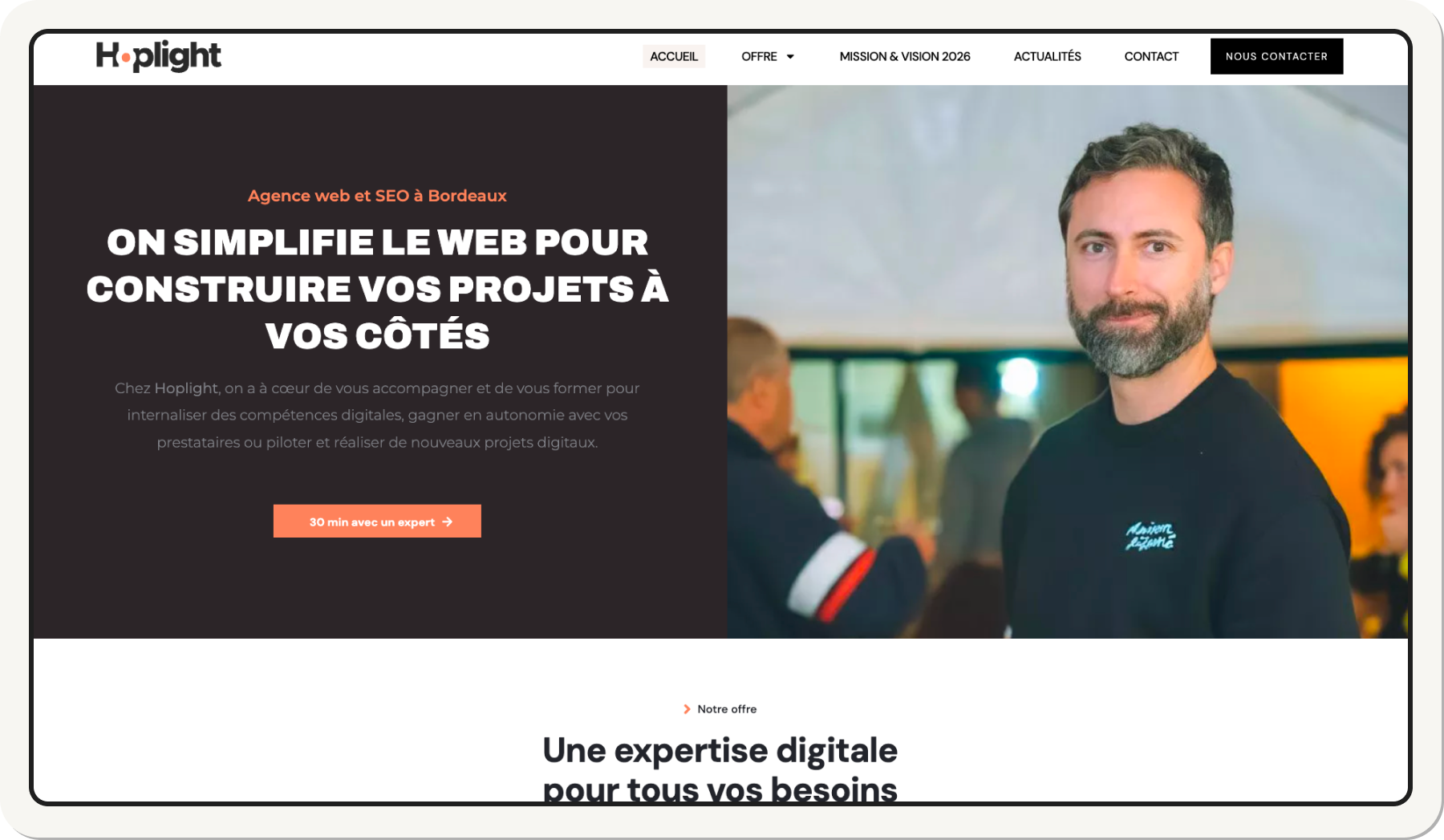
Hoplight combines no-code, automation, and AI-assisted development to primarily address digital transformation challenges.
The agency works on CRMs, dashboards, client portals, and internal tools. Notably, they document a business application project using React and TypeScript for the frontend, Supabase for the database and authentication, Netlify for hosting, and Claude as a development assistant.
This type of project perfectly illustrates a relevant use case for vibe coding: rapidly developing an application highly specific to a company, without needing to build infrastructure intended for millions of users.
Key takeaway:
- Hoplight is particularly well-suited for internal tools and SME business applications.
- The agency specializes in CRMs, dashboards, portals, and automations.
- One of their public case studies combines Claude, React, TypeScript, Supabase, and Netlify.
- Projects are quoted on an individual basis.
Things to keep in mind: vibe coding is just one part of a broader digital transformation offering. Hoplight’s positioning is therefore less exclusively focused on this practice than VibeCoders or TheVibeCodingAgency.
Our take: Hoplight is a strong option when the primary goal is to solve an operational problem with a custom application, using vibe coding as an accelerator rather than a marketing hook.
How did we select the best vibe coding agencies?
Our ranking isn't based solely on whether an agency uses Cursor, Claude Code, or Lovable.
These tools are now accessible to almost everyone.
The real difference lies in how an agency frames, monitors, tests, and maintains what artificial intelligence produces.
Our analysis was updated in August 2026 based on publicly available information: service offerings, workflows, advertised technologies, past projects, pricing where published, and level of specialization.
We have included established no-code agencies that have natively integrated the vibe coding workflow into their production processes.
Expertise in software development and engineering
A vibe coding agency remains responsible for a software product.
It must therefore be capable of understanding and challenging:
- the architecture;
- the data model;
- authentication;
- APIs ;
- permissions ;
- dependencies ;
- deployment constraints.
An excellent question to ask during an initial conversation is:
"Who makes the decision when the AI proposes a technically questionable solution?"
The answer is often more revealing than the list of tools used.
Mastery of vibe coding tools and AI
Not all tools serve the same purpose.
Lovable or Bolt allow you to go from an idea to a functional interface or application extremely quickly. Cursor or Claude Code provide more control for developers working on a real codebase.
A good agency should know how to choose the right tool for the project rather than forcing all its clients to use the same one.
Quality of completed projects
An impressive video or a few screenshots do not prove that a product is viable.
We prioritize agencies capable of showing:
- truly accessible applications ;
- identifiable clients ;
- products that are still running ;
- or a methodology documented well enough to understand what is being delivered.
Ability to deploy an application to production
The first visible version is only the beginning.
An application built for real users often needs to handle:
- authentication;
- permissions;
- errors;
- backups;
- logs;
- monitoring;
- performance;
- deployment;
- future updates.
This is precisely where an agency must provide more value than a simple application generator.
Security, performance, and code maintainability
The risks associated with AI-generated code must be taken seriously, without falling for alarmist statistics taken out of context.
The academic benchmark SecureVibeBench evaluates development agents, for example, in scenarios built from real-world vulnerabilities. Within its specific scope—security-oriented C/C++ tasks—the best system tested only achieved 23.8% of solutions that were both functionally correct and considered secure according to the benchmark's criteria. The authors themselves point out that their study focuses primarily on memory vulnerabilities in C/C++ and therefore cannot be generalized as-is to all AI-coded web applications. Empirical research on AI coding also identifies recurring difficulties regarding reliability, debugging, and the burden of code review. The useful conclusion is therefore not that "AI code is insecure."
It is much simpler:
code that works must still be reviewed, tested, and verified before it can be considered production-ready.
Development speed
Speed is obviously one of the main benefits of vibe coding.
But we make a distinction between:
getting an initial interface up quickly and delivering a truly usable product quickly.
A two-day prototype promise can be perfectly credible in the right context. It just shouldn't be interpreted as a promise of complex, secure, and scalable software in 48 hours.
Client reviews and references
References finally allow you to evaluate what the technology doesn't show: communication skills, handling of unforeseen issues, adherence to scope, or the quality of support after delivery.
For a strategic project, ask if you can speak with a former client who built a product similar to yours.
What is a vibe coding agency?
A vibe coding agency uses artificial intelligence models to transform natural language instructions into code, then assembles, improves, and audits that code to create a digital product. The term "vibe coding" was popularized by Andrej Karpathy in February 2025 and was later named word of the year 2025 by Collins Dictionary. In a professional environment, however, the principle should not be to "forget that code exists."
The strongest teams instead use AI to produce faster, while maintaining human oversight at critical stages.
What is the difference between vibe coding and traditional development?
The line is becoming increasingly blurred, however.
A professional developer can use Claude Code or Cursor daily while still applying classic methods of review, testing, and architecture.
Vibe coding therefore does not necessarily replace traditional development: it can also become an additional layer in the developer's workflow.
What tools does a vibe coding agency use?
Several tools appear regularly among the agencies studied.
- Cursor is a development environment deeply integrated with AI. It is particularly well-suited for developers who want to maintain a direct view of their code.
- Claude Code allows an AI agent to understand and modify a codebase directly from the terminal.
- Lovable makes it easy to quickly create web applications and interfaces from natural language instructions.
- Bolt.new also allows for the rapid generation of a complete application or prototype.
- Replit combines a cloud development environment, AI assistance, and deployment.
- v0 is primarily used to accelerate interface generation.
- GitHub Copilot supports developers directly within their working environment.
- Windsurf also offers an IDE heavily focused on agentic development.
The best tool always depends on the project. An agency's competence is measured less by the number of logos displayed on its website than by its ability to choose when to use each tool and when not to.
Why hire a vibe coding agency?
Building your first application solo is now much more accessible.
A fair question arises: why pay an agency if Lovable, Bolt, or Replit can already generate an application?
Because producing code is only part of the job.
Launch an MVP faster
Vibe coding accelerates the most standardized tasks: creating components, forms, interfaces, API routes, or simple logic.
This allows a team to get a product in front of its users much sooner.
Reduce development time
The value of AI is particularly evident in repetitive tasks.
The time saved can be dedicated to what requires more human judgment: architecture, UX, business rules, edge cases, and product trade-offs.
Test an idea before investing more
A founder doesn't always need to invest tens of thousands of euros before knowing if anyone is actually interested in their product.
A well-defined MVP can help verify:
- if users understand the product;
- if they use the core feature;
- if they come back;
- if they are willing to pay;
- what features they are actually asking for.
These answers should often determine the next steps for your investment.
Rapidly develop new features
Vibe coding can also be used on an existing application.
Provided the codebase is clean and documented, AI can accelerate the creation of components, tests, or new features without requiring a product rebuild.
Transforming an AI prototype into a reliable product
This is one of the most interesting use cases in 2026.
You may have already built an initial version using Lovable, Bolt, Replit, Cursor, or Claude Code.
It works.
But you aren't sure if you can:
- connect real payment systems;
- store customer data;
- open hundreds of accounts;
- have another developer take over the code;
- scale the product without breaking everything.
An agency can then audit the prototype, refine the architecture, secure access, and add the necessary tests.
Players like Kalessi are now positioning themselves specifically to address this issue, noting that they do not automatically rewrite the entire codebase when certain parts can be salvaged. Key takeaway: a prototype built with AI is not necessarily "bad code." The mistake lies in assuming that a functional demonstration is automatically production-ready.
A small, well-defined project might follow a schedule like this, for example:
Day 1: scoping → Days 2–5: first version → Days 6–10: testing and iteration → security hardening → delivery or pilot group launch.
This timeline is just a guideline: a complex application will naturally require more time.
What kind of projects can a vibe coding agency handle?
MVP creation
An MVP is arguably the most natural use case.
The goal is to develop the bare minimum needed to test a hypothesis, rather than building every feature envisioned for the final version right away.
SaaS development
Yes, a vibe coding agency can develop a SaaS.
AI-assisted development can significantly speed up the creation of interfaces, dashboards, forms, and many standard components.
However, the core structural requirements remain the same:
- authentication;
- roles;
- permissions;
- billing;
- data;
- backups;
- security;
- scalability.
A vibe-coded SaaS can be a real product. It just shouldn't be managed like a prototype indefinitely.
Custom web applications
Web applications are particularly well-suited for client portals, dashboards, extranets, marketplaces, management tools, or internal platforms.
Mobile applications
Mobile applications
However, store publication, native permissions, device compatibility, and user experience always require a specific validation phase.
Internal tools and business applications
This is likely one of the most underrated use cases.
An SME can develop a tool truly tailored to its processes without having to fund months of development.
Vibe coding can be used to create:
- internal CRM;
- tracking tool;
- configurator;
- back-office;
- reporting tool;
- employee portal;
- client portal.
Applications integrating artificial intelligence
Agencies can also develop software where AI is a core feature.
For example:
- business assistant;
- semantic search engine;
- RAG system ;
- content generation ;
- document analysis ;
- AI agent ;
- intelligent automation.
In this case, you must also account for API costs, data privacy, and potential model errors.
Taking over a prototype created with Lovable, Bolt, or Cursor
You can bring in an agency even when the product already exists.
To facilitate the audit, prepare:
- the Git repository ;
- platform access ;
- the list of known bugs ;
- the main features ;
- user feedback ;
- existing integrations ;
- the issues you are currently facing.
The agency will then be able to determine what can be kept, what needs to be refactored, and what might be worth rewriting.
How much does a vibe coding agency cost?
Prices vary significantly depending on what you are actually looking to achieve.
The following are rough estimates based on public pricing observed among the players studied and the difference in scope between a prototype, an MVP, and a full application. These do not constitute an official market pricing study.
Note: Budgets marked as "Quote upon request" reflect the varying complexity of sophisticated application projects, where providing a fixed estimate without prior scoping would be risky for the client.
Publicly available pricing illustrates these differences: Nocode Factory starts certain services at €2,000–€5,000, TheVibeCodingAgency lists its MVP at €5,000 excl. tax, and Botami starts its custom applications at €5,000 excl. tax for the creation of an MVP.
For an MVP actually intended for users, a budget of €5,000 to €15,000 is a reasonable benchmark in many cases.
A very limited project may cost less.
The key is to verify what the quote includes:
- design;
- backend;
- authentication;
- testing;
- deployment;
- source code;
- documentation;
- post-delivery bug fixes.
A €3,000 MVP and a €12,000 MVP do not necessarily correspond to the same deliverable.
Pricing for a SaaS application
A SaaS quickly becomes more complex.
Add multiple user roles, Stripe, subscriptions, permissions, an external API, and monitoring, and the number of screens is no longer the primary cost factor.
A serious first version can therefore easily exceed €10,000 to €30,000, or even more when constraints become significant.
Cost to take over a project already developed with AI
It is impossible to provide a reliable estimate without reviewing the code.
A clean application may only require a few targeted fixes.
A highly unstable codebase may require:
- several days of auditing;
- a restructuring of the architecture;
- a rewrite of the authentication system;
- testing;
- or even a partial rebuild.
Kalessi notes that they begin this type of engagement with an audit to precisely estimate the stabilization effort. Do these factors affect the price?
This figure illustrates why human review (practiced by the agencies in this ranking) is the number one differentiating factor.
The main factors are:
- number of features;
- complexity of business rules;
- number of user roles;
- payments and subscriptions;
- external APIs;
- web or mobile application;
- data volume and sensitivity;
- design level;
- security;
- automated testing;
- documentation;
- maintenance;
- potential technical debt.
How do you choose the best vibe coding agency?
An initial meeting shouldn't just be about getting a price.
Use it to verify if the agency truly masters what it sells.
- Check their portfolio. Ask to see live, accessible applications, ideally ones that have been in use for several months after launch.
- Verify the team's technical expertise. Identify the person responsible for the architecture and the person who reviews the generated code.
- Ask which AI tools are used. The agency should be able to explain why they prefer Cursor, Claude Code, Lovable, or another tool for your specific case.
- Check how the code is audited. Ask what reviews, automated tests, and checks are performed.
- Examine their security management. Ask concrete questions about access, permissions, secrets, personal data, and backups.
- Check the maintenance terms. Ask who handles post-delivery support and whether another developer will be able to easily take over the project.
- Compare timelines and budgets for the same scope of work. Never compare only the two final figures at the bottom of a quote.
Before signing, you should be able to get a clear answer to five questions:
- Who owns the code?
- Who controls what the AI generates?
- What tests will be performed?
- What exactly does the delivery include?
- Can you show me a comparable project?
An agency unable to answer these questions precisely is likely not the right partner for taking a product to production.
Vibe coding agency or freelancer: which should you choose?
A freelancer is often an excellent choice when the scope is well-defined.
If you already have a CTO or a team capable of overseeing the technical side, you don't necessarily need to pay for the overhead of an agency.
An agency becomes particularly relevant when you need to coordinate multiple dimensions—product, UX, frontend, backend, QA, security—without having that expertise in-house.
Vibe coding agency or AI platform alone: which solution should you choose?
When should you use Lovable, Bolt, or Replit on their own?
Using a vibe coding platform directly is appropriate when the risk remains low.
For example, to:
- test an idea;
- build a demo ;
- create a personal tool ;
- prepare an initial interface ;
- present a prototype to a few users ;
- automate a small internal process.
You can save a significant portion of your budget while quickly learning what you actually need.
When should you hire an agency?
An agency becomes more relevant when the application starts to have real-world consequences.
For example, when it handles:
- payments ;
- customer accounts ;
- personal data ;
- confidential information ;
- multiple permission levels ;
- critical business processes.
The higher the cost of an error, the more important technical oversight becomes.
When should you have an AI-coded project taken over by developers?
Certain signs should alert you:
- every new feature breaks something else ;
- the AI keeps rewriting the same files ;
- you no longer understand the project structure;
- errors are becoming unpredictable;
- authentication is a recurring issue;
- there are no automated tests in place;
- you are afraid to give real customers access to the product.
In this situation, continuing to add prompts may simply shift the problems elsewhere.
A technical audit often becomes more cost-effective.
Vibe coding agency or training: which should you choose?
Training and an agency do not sell the same thing.
A vibe coding training course is suitable if your goal is to become autonomous and regularly build prototypes, automations, or applications in-house.
You are investing in a skill set.
A vibe coding agency is better suited when you have a specific result to achieve and software development is not your core business.
A third approach can be particularly interesting: having an agency build the product while requiring a transfer of skills.
You can then request:
- the Git repository;
- the documentation;
- training on administration;
- an overview of the architecture;
- on-demand support after delivery.
You get the speed of an agency without becoming completely dependent on it.
FAQ about vibe coding agencies
Which is the best vibe coding agency?
Gemeos Agency holds the top spot in our 2026 ranking for comprehensive digital support, especially when product, design, development, and growth need to be handled together. Nocode Factory is our choice for a startup in the validation phase, TheVibeCodingAgency for a highly structured MVP, and Foreachcode for a technically complex application.
What is vibe coding?
Vibe coding is a way of creating software by giving natural language instructions to artificial intelligence models that generate or modify code. The term was popularized in February 2025 by Andrej Karpathy before being named word of the year 2025 by Collins Dictionary. How much does a vibe coding agency cost?
A simple prototype can start around €2,000 to €5,000, while an MVP actually intended for users is frequently in the range of €5,000 to €15,000. A complex SaaS or business application can significantly exceed these amounts. The price depends primarily on the level of polish, integrations, security, and expected maintenance.
What are the best vibe coding tools?
Cursor, Claude Code, Lovable, Bolt.new, Replit, v0, GitHub Copilot, and Windsurf are among the most widely used tools. Platforms like Lovable or Bolt excel at moving quickly from idea to prototype; Cursor and Claude Code provide more control for developers working directly on a codebase.
Can you build a SaaS using vibe coding?
Yes. Vibe coding can be used to build a full-fledged SaaS, including authentication, databases, payments, and user dashboards. However, it does not replace the need to properly design the architecture, permissions, security, backups, and maintenance.
Can you put a vibe-coded application into production?
Yes, provided you treat it like any other application before deployment: code review, testing, access security, error handling, backups, monitoring, and documentation. Research shows that the ability of AI agents to produce functional code does not automatically guarantee its security. What is the difference between an AI agency and a vibe coding agency?
An AI agency can handle a wide range of topics: autonomous agents, RAG, automation, chatbots, machine learning, or strategic consulting.
A vibe coding agency focuses more specifically on software creation assisted by models capable of producing and modifying code based on natural language instructions.
Is it better to learn vibe coding or hire an agency?
Get trained if you want to use these tools regularly and keep this skill in-house.
Hire an agency if your priority is to get a product quickly without having to manage architectural choices, code reviews, and deployment on your own.
The two approaches can also be combined: an agency develops the first version and then hands over the code, documentation, and necessary skills to your team.
Good to know
Heading
Lorem ipsum dolor sit amet, consectetur adipiscing elit. Suspendisse varius enim in eros elementum tristique. Duis cursus, mi quis viverra ornare, eros dolor interdum nulla, ut commodo diam libero vitae erat. Aenean faucibus nibh et justo cursus id rutrum lorem imperdiet. Nunc ut sem vitae risus tristique posuere.



Lorem ipsum
Lorem ipsum dolor sit amet, consectetur adipiscing elit, sed do eiusmod tempor incididunt ut labore et dolore magna aliqua. Ut enim ad minim veniam, quis nostrud exercitation ullamco laboris nisi ut aliquip ex ea commodo consequat. Duis aute irure dolor in reprehenderit in voluptate velit esse cillum dolore eu fugiat nulla pariatur.