How to Structure a Financial Services Website?
How a wealth management firm or fintech structures its site around its clients' real problems: information architecture, must-have pages, topic silos, internal linking, and illustrated site architecture patterns.

article summary
- A financial website organized only around products forces prospects to translate their own needs into solutions.
- An architecture centered on client problems clarifies the offer and improves user experience, SEO, and conversion at the same time.
- The method consists of mapping audience profiles, their search intents, and the pages that can answer them.
- Service, profile, team, and compliance pages should be organized into thematic silos connected by coherent internal linking.
- Contextual CTAs and journeys adapted to each entry point guide prospects without forcing conversion.
Want to take it further? Ask:
Why site architecture is a strategic issue in finance
The majority of financial websites are organized around what the firm sells, not around what the prospect is looking for. This architecture mistake is the main reason technically sound websites don’t convert. The prospect lands, doesn’t immediately find the answer to their problem, and leaves. Without anyone at the firm even noticing.
The classic problem: a site organized around products, not customer problems
The usual setup for a wealth management firm or fintech site: an “Life Insurance” page, a “PEA” page, a “SCPI” page, a “Retirement” page. These are product categories, not answers to search intent. A prospect wondering “how can I reduce my taxes before the end of the year” isn’t looking for a “tax optimization” page: they’re looking for a concrete answer to a specific problem, with a solution tailored to their situation.
The result of this product-first structure: pages that are too broad to rank for anything specific, a high bounce rate because there’s no immediate relevance, and a fuzzy conversion path that doesn’t guide the prospect toward contact.
What Google and your prospects expect from a clear structure
Google and prospects want the same thing: find a relevant answer to a specific question fast. Google rewards sites whose architecture clearly reflects their audience’s search intent. Prospects reward sites that speak to their situation, not to the firm’s service catalog.
A well-built architecture solves both problems at once: it improves SEO rankings for intent-driven queries, and it improves conversion rates by guiding each prospect profile to the page that fits them.
Architecture and conversion: the direct link
Site architecture is the first conversion lever, before design and before copywriting. A well-structured site naturally guides the prospect toward contact without making them work for it. A poorly structured site forces the prospect to do the mental work of figuring out what the firm does and who it’s for. In finance, as elsewhere, that effort usually ends in abandonment.
The two ways to organize a financial website
Before building an information architecture, you need to choose an organizing logic. That choice shapes everything else: URLs, page titles, content, and internal linking. Two logics always compete on financial websites.
Product logic: “here’s what we sell”
Product logic organizes the site around the firm’s offer: tax wrappers, investment types, and services. It’s the most natural structure for a team thinking from inside the firm. It’s also the least effective for a prospect thinking from their problem.
Customer-problem logic: “here’s what we solve”
Customer-problem logic organizes the site around the situations and goals prospects care about: preparing for retirement, optimizing taxes, passing on wealth, investing available cash. Each page answers a question the prospect is actually asking, not an internal accounting category the firm uses behind the scenes.
Why problem-led logic converts better, and how to implement it
Problem-led logic converts better for one simple reason: it puts the prospect at the center, not the product. It also drives stronger SEO performance, because search intent is framed around problems (“how do I prepare for retirement”) rather than products (“retirement PEA”). To go further on writing conversion-focused pages, check out our guide on how to write a landing page that converts.
Identifying your clients’ real problems: the foundation of architecture
You can’t build a problem-led architecture without first mapping those problems rigorously. This step is often skipped in favor of an intuitive structure. That’s a mistake: a firm’s intuition about what its clients are looking for is often out of sync with real search intent.
The jobs-to-be-done method applied to finance
The jobs-to-be-done framework starts with a simple question: “What job is my client hiring me to do?” In wealth management, the answers are more concrete than you might think: reduce taxes by €X this year, make sure your children inherit without friction, generate extra income before retirement. These “jobs” are the foundation of service pages.
For a fintech, the same logic applies: automate savings, access products reserved for institutions, understand investments without financial expertise. Each job-to-be-done becomes a page, and each page answers a specific search intent.
Mapping customer profiles and their search intents
The next step is building a profile x intent matrix. For each customer profile (business owner, senior executive, expat, retiree, first-time investor), list the 3 to 5 main search intents. You’ll find these intents in Google Search Console if the site already has traffic, in SEO tools (Ahrefs, Semrush) for volume data, and in the questions asked during first client meetings.
From search intent to destination page: building the mapping
Every validated search intent should map to a dedicated destination page. Not a section on a generic page, not a paragraph in a blog post: a page with its own URL, an optimized title tag, and content centered on that intent. This intent-to-page mapping is what forms the backbone of the architecture.
The essential pages of a well-structured financial website
A solid architecture for a financial business relies on five page categories, each with a specific role in the prospect journey. Missing one creates a gap in the system, either in SEO or in conversion.
The homepage: position, qualify, direct
The homepage has three jobs, in this order: clearly position what the firm or fintech does and who it’s for, qualify the visitor by telling them whether they’re in the right place, and direct them to the service page that matches their profile. It shouldn’t be a generic showcase. It should be a routing hub. A visitor who leaves the homepage without clicking through to a service page is an architectural warning sign.
Service pages: one per customer problem, not one per product
That’s the golden rule of problem-led financial architecture. Each service page should answer a specific customer problem, use the prospect’s language, not internal jargon, and end with a contextual CTA aligned with the problem being addressed. A “Prepare for retirement” page converts better than a “Retirement savings plan” page for the simple reason that it speaks the prospect’s language.
{usecases}
Customer profile pages: “you’re a business owner / expat / young professional”
Profile pages are optional for smaller firms, but essential as soon as the firm serves multiple distinct segments. They let each profile recognize themselves immediately and find a personalized journey, without having to read every service page. They also have strong SEO potential for queries like “wealth advisor for business owners” or “financial advisor for expats.”
The team page and author pages: critical E-E-A-T signals
In finance, the team page is as much a conversion page as it is an about page. Prospects want to know who will manage their wealth. A team page with professional photos, detailed backgrounds, credentials, and each advisor’s specialties sends strong E-E-A-T signals to Google and strong trust signals to prospects. For sites with an active blog, dedicated author pages reinforce those same signals. Our guide on digital credibility for wealth management firms breaks all of this down.
Legal and regulatory pages: visible compliance
Legal notices, privacy policy, DCI, ORIAS number: these pages are legally required and strategically important online. Informed prospects read them. Google indexes them and uses them to assess the site’s reliability. Making them accessible from the footer on every page is the bare minimum.
{cta}
Thematic siloing: organizing SEO authority by topic
Thematic siloing is the method of grouping pages about the same topic into a coherent structure connected by internal links. It’s the most effective SEO lever for building topical authority on competitive subjects like retirement, wealth transfer, or tax optimization. Our guide to 9 steps to optimize your Webflow site for SEO covers the technical implementation.
What siloing is and why it matters in finance
A thematic silo brings together a pillar page (the main service page on a topic) and a set of content pages that go deeper into specific aspects of that same topic. All internal links within the silo point to the pillar page or to each other. Google reads that concentration of topical links as a signal of expertise in that domain.
In finance, the natural silos are: retirement, wealth transfer and inheritance, tax optimization, real estate investing, financial savings, protection and insurance. Each silo matches a major customer problem and a coherent set of SEO queries.
Building your silos around the main themes
A typical finance silo structure: one pillar page (“Preparing for retirement: the complete guide for executives and business leaders”), 3 to 6 content pages exploring specific angles (“Retirement and PER: how to choose your retirement savings plan,” “Business owner retirement: the specific options,” “At what age should you start preparing for retirement?”), and a corresponding conversion-focused service page (“Retirement support: book a meeting”).
Internal linking rules within a silo
The rules to follow: each content page in the silo should include at least one link to the pillar page, content pages can link to each other if the link is relevant, and the pillar page should link to every content page in the silo. Links between different silos are possible, but they should stay rare and contextually justified.
Avoiding authority leakage between silos
Authority leakage happens when a page in one silo links to a page in another silo without a clear thematic reason. These links dilute the topical authority of the original silo and blur the signal sent to Google. The practical rule: an inter-silo link is justified if the content of both pages is complementary from the prospect’s point of view, not just because you want to pass PageRank around.
Architecture and the conversion journey: guide without forcing
Good architecture doesn’t push the prospect toward contact: it guides them. The nuance matters. Pushing creates friction. Guiding creates trust. In finance, where the decision to entrust your wealth is slow and considered, architecture has to support the different stages of the journey without skipping steps.
Define the prospect journey stages on the site
A typical prospect journey on a financial website follows three phases: discovery (the prospect arrives via SEO or word of mouth and wants to understand), evaluation (they compare, read service pages, check references and reviews), and decision (they’re ready to book a meeting). Each phase should map to specific pages and CTAs. A “Book a meeting now” CTA on a discovery blog post is too early. A “Download our retirement guide” CTA on a service page is a missed opportunity.
SEO entry points and how they map to conversion pages
Every page that receives organic traffic is a potential entry point into the journey. The common mistake is to treat all entry pages the same way. A blog page attracting visitors in the discovery phase should offer an intermediate step (newsletter, downloadable guide, link to a service page). A service page attracting visitors in the evaluation phase should offer direct contact.
Contextual CTAs vs generic CTAs: what makes the difference
A contextual CTA is specific to the page where it appears. On a “Prepare for retirement” page: “Get my free retirement review.” On a “Wealth transfer” page: “Assess my inheritance situation.” These formulations convert significantly better than a generic “Contact us” or “Learn more” CTA, because they extend the page’s intent instead of breaking it.
The role of blog content in the overall architecture
The blog isn’t an add-on to the architecture: it’s the organic traffic engine that feeds qualified visitors into service pages. Every blog post should belong to a thematic silo and include at least one link to the corresponding service page. A well-architected blog is a conversion funnel disguised as editorial content.
Real-world examples: wealth management firm vs fintech, two different architectures
An independent wealth management firm and a fintech don’t have the same constraints, the same audiences, or the same page volumes to manage. Their optimal architectures are therefore different, even if they share the same core principles.
Typical architecture for an independent wealth management firm (5 to 15 pages)
For a human-sized wealth management firm, a lean and effective architecture: homepage, 3 to 5 service pages by customer problem (retirement, wealth transfer, tax optimization, investing), 1 to 2 profile pages if there are multiple distinct segments, team page, contact page, thematic blog with 2 to 3 silos. Legal pages complete the setup. The priority is quality and depth on each page, not volume. Our guide on local SEO for wealth management firms explains how to optimize these pages for local searches.
Typical architecture for a fintech or finance scale-up (20 to 50+ pages)
For a fintech or scale-up, the architecture is more complex: product pages by feature, pages by user profile (consumer, professional, institutional), comparison pages (vs competitors, vs alternative solutions), campaign landing pages, resource pages (blog, guides, case studies), detailed legal and regulatory pages. At this scale, it makes sense to think about programmatic SEO for comparison pages. Our article on programmatic SEO for financial products covers this approach.
The most common architectural mistakes in each case
For wealth management firms: too few service pages (everything grouped into a single “Our Services” page), no customer profile pages, a blog with no link to service pages. For fintechs: too many feature pages with no customer-problem pages, navigation that’s too deep (more than 3 clicks to reach a conversion page), and duplicate content between feature pages and campaign landing pages.
Webflow as an architecture tool: why it changes everything
Financial website architecture isn’t fixed. Search intent evolves, firm offers change, and new customer profiles emerge. The CMS you choose has to let you evolve the architecture without rebuilding everything at every iteration. That’s one of the main reasons to use Webflow for this kind of project. To compare it with alternatives, our article Webflow vs WordPress breaks down the key differences.
CMS collections and dynamic pages to scale architecture
Webflow CMS lets you create page collections (service pages, author pages, case studies, city pages) with one template and distinct content for each entry. A template change rolls out instantly across every page in the collection. For a fintech managing 30 feature pages or a firm that wants to cover 20 cities, that’s a major efficiency gain.
Control URLs, redirects, and link structure without a developer
Webflow lets you define URL structure precisely, manage 301 redirects, and change navigation hierarchy without touching code. In practice, that means a partial architecture redesign (renaming pages, moving sections in navigation, restructuring silos) can happen in a few hours without outside technical help.
Iterate on architecture without rebuilding everything
The best architecture is the one you can evolve. A financial site launched with 8 well-structured pages can grow into 30 pages organized into silos without technical disruption. Webflow supports that growth naturally, where other CMS platforms require a full redesign as soon as the architecture crosses a certain complexity threshold.
What we implement at Gemeos for finance businesses
At Gemeos, every website project for a financial business starts the same way: a workshop mapping search intents x customer profiles x destination pages. Before touching design or the CMS, we build the information architecture. It’s consistently the step that generates the most insights and changes the client’s initial plans the most.
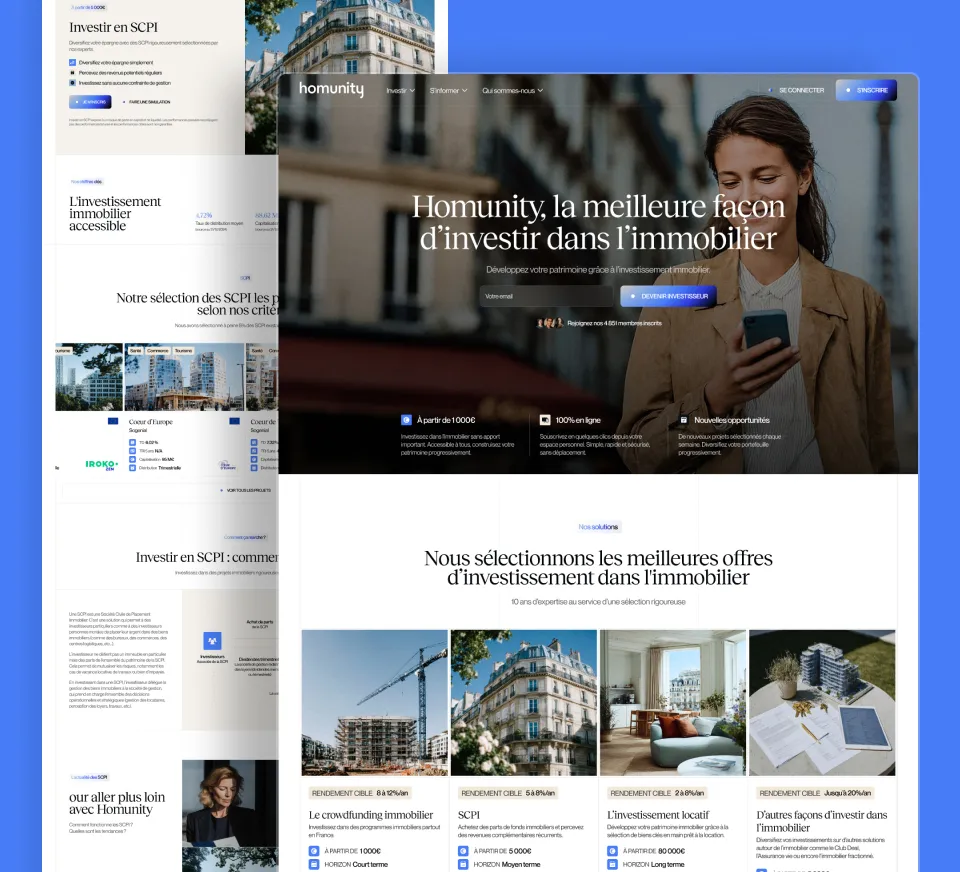
The finance projects we support, whether for Homunity, Finary, SD Finance or Hellébore Gestion Privée, all reach the same conclusion after this workshop: the existing site was organized around the offer, not around the customer problem. Even a partial architectural restructure produces measurable effects on organic traffic and conversion rates within a few weeks.
On the technical side, our stack stays Webflow for control and flexibility, paired with a content strategy structured in silos and internal linking designed from the architecture stage, not added later.
FAQ
How many pages does an effective wealth management firm website need?
Quality matters more than volume, but there’s still a structural minimum. An effective wealth management firm website needs at least 6 to 8 pages: homepage, 3 to 4 service pages by customer problem, team page, contact page. Below that, the architecture is too thin to generate qualified organic traffic and cover different prospect profiles. Beyond 15 pages, thematic siloing becomes essential.
Should you have one page per product or one page per customer type?
Ideally both, but with a clear priority on pages by customer problem. Pages by customer problem (or customer type) are the main conversion pages: they capture real search intent and speak directly to the prospect. Product pages can exist as a complement for prospects looking for a specific product, but they shouldn’t be the backbone of the architecture.
How do you know if your current architecture is hurting conversions?
Three warning signs in Google Analytics or session data: bounce rate above 65% on service pages, average visit depth below 2 pages, and almost no organic traffic on commercially intent-driven queries. If all three are present at the same time, architecture is probably the priority problem to fix before design or copywriting.
Does site architecture really affect SEO?
Yes, directly and significantly. Architecture determines how Google crawls and understands the site, which pages receive the most internal PageRank, and which page Google considers the reference for each topic. A poorly architected site can have excellent content and still never rank, simply because Google doesn’t understand which page should be surfaced for which query.
When should you completely rethink a financial website’s architecture?
Three main triggers: a change in the firm’s offer (new targets, new specialties), organic traffic stagnating despite regular content (a sign of a structural issue), or a merger / acquisition with another firm requiring two separate architectures to be merged. In all cases, reworking the architecture without rebuilding the whole site is possible with Webflow: clean 301 redirects, navigation restructuring, and new pillar pages without touching the existing design.
Key takeaways
As a Webflow agency specialized in SEO and growth for financial businesses, Gemeos has been helping wealth management firms and fintechs structure their digital presence for several years. Site architecture is the first workstream we tackle on every new finance project: it’s the foundation everything else rests on.
Good to know
Heading
Lorem ipsum dolor sit amet, consectetur adipiscing elit. Suspendisse varius enim in eros elementum tristique. Duis cursus, mi quis viverra ornare, eros dolor interdum nulla, ut commodo diam libero vitae erat. Aenean faucibus nibh et justo cursus id rutrum lorem imperdiet. Nunc ut sem vitae risus tristique posuere.








Lorem ipsum
Lorem ipsum dolor sit amet, consectetur adipiscing elit, sed do eiusmod tempor incididunt ut labore et dolore magna aliqua. Ut enim ad minim veniam, quis nostrud exercitation ullamco laboris nisi ut aliquip ex ea commodo consequat. Duis aute irure dolor in reprehenderit in voluptate velit esse cillum dolore eu fugiat nulla pariatur.