Why Isn't Your Finance Website Converting?
Is your fintech site generating traffic but too few qualified leads? Discover the 6 most common conversion mistakes in finance, the best practices used by top players (Finary, Homunity, Mimco, Rivaria Capital, Hellébore), and the 3 priority levers you can use to improve your finance CRO right now.

article summary
- CRO for finance focuses on improving a website’s ability to turn visitors into leads or customers without compromising trust.
- Common obstacles include an unclear promise, weak reassurance, poor mobile experience, ineffective CTAs, and slow performance.
- High-performing players immediately address the visitor’s problem, use simulators, and make compliance signals visible.
- Diagnosis should track conversion rate, form abandonment, mobile performance, and page-level behavior.
- The first priorities are clarifying the hero section, repositioning proof points, and simplifying the main form.
Want to take it further? Ask:
Finance CRO: what are we really talking about?
CRO (Conversion Rate Optimization) in finance is the set of actions that help you turn more visitors into qualified leads, sign-ups, and customers. Not just optimize a button. Turn a website into a trust-building machine.
And that’s where finance plays in a different league.
A prospect landing on a fintech or asset management website doesn’t make a decision in 30 seconds. They evaluate. They compare. They look for trust signals. The average deal size is high, the decision cycle is long, and the slightest friction in the experience can cost you a lead that may have taken months to mature.
Optimizing conversion on a finance website means understanding that trust mechanism and building it step by step.
The 6 mistakes that kill conversion on finance websites
1. A value proposition that’s too generic, or too technical
Most finance websites say roughly the same thing: “simple, high-performance solution,” “invest with peace of mind,” “manage your wealth differently.” Phrases that mean nothing to anyone.
The opposite problem exists too: ultra-technical sites packed with regulatory jargon that speak to experts and lose the decision-makers who just want a simple answer to their problem.
Your value proposition needs to answer one precise question: for whom, what problem, what concrete result. In one sentence. Visible without scrolling.
2. Missing or poorly placed reassurance
In finance, trust is built with specific signals: AMF and ACPR approvals, institutional partners, assets under management, number of clients, verified reviews. These elements should not be hidden at the bottom of the page in the legal notice.
They need to appear at the exact moment the prospect hesitates: above the fold, near the CTAs, on product pages.
A site without these visible signals loses qualified leads, not because the offer is bad, but because the prospect never got the information they needed to decide.
3. A mobile experience that gets sacrificed
More than 60% of web traffic is mobile, finance included. Yet many sites in the sector are still designed desktop-first: tables that don’t adapt, long forms with tiny fields, CTAs that disappear below the fold.
On mobile, every bit of friction costs you. An 8-field form that displays badly on iPhone is a lost lead.
4. CTAs that are poorly written or poorly placed
The classic “Learn more” or “Contact us” doesn’t convert. In finance, your CTA needs to be benefit-led and match the stage of the buying journey.
On a homepage: “Estimate your returns” or “Get my free analysis” consistently outperform “Discover our offer.”
On a product page: “Book a call with an advisor” is more reassuring than “Invest now” for a prospect who isn’t ready yet.
5. Load speed that drives people away
Google considers that beyond 3 seconds of load time, more than 50% of visitors leave the page. In finance, where sites often include simulators, dynamic charts, videos, and regulatory iframes, performance is rarely a priority.
But a slow site hurts in two places: bounce rate goes up, and organic search suffers. It’s a double hit.
6. Social proof that isn’t tailored to the sector
Google reviews or Trustpilot stars aren’t enough in finance. A prospect considering entrusting €50,000 to an asset management firm or investing in a crowdfunding platform wants specific credibility proof: case studies with hard numbers, named investor testimonials, specialist press coverage (Les Echos, BFM Business, Maddyness...), labels, and certifications.
Social proof in finance needs to be sector-specific. A quote from a happy founder won’t reassure an institutional investor.
What the best finance players do differently
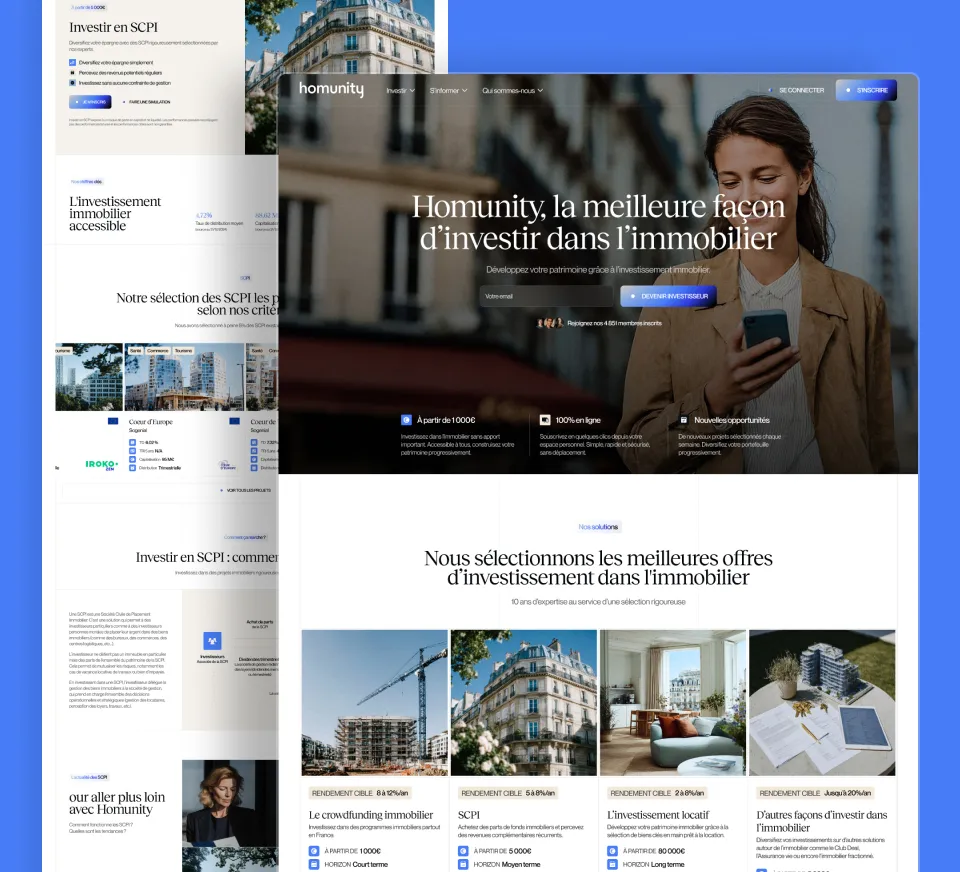
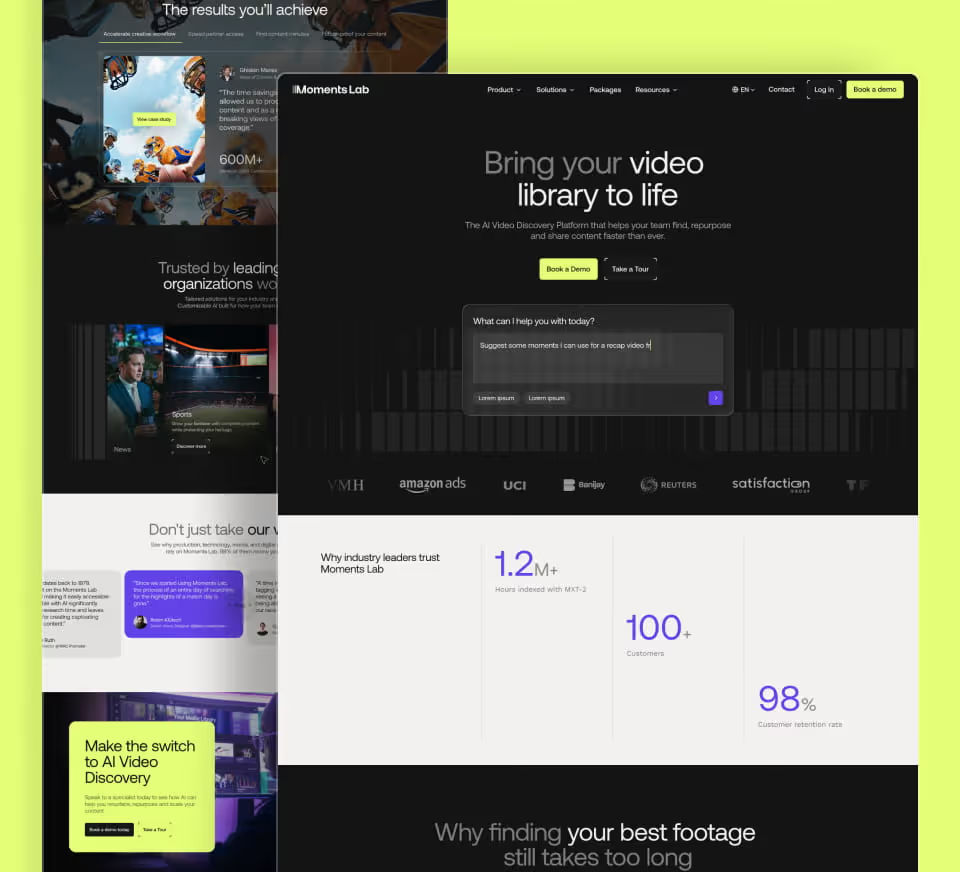
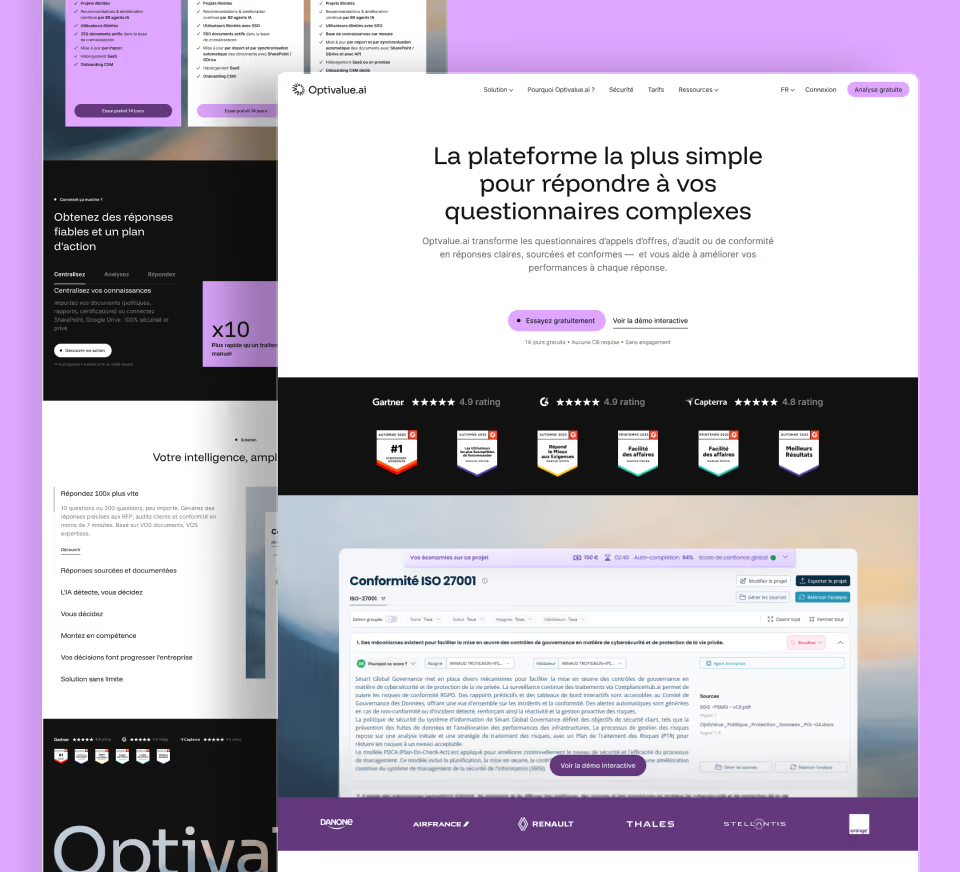
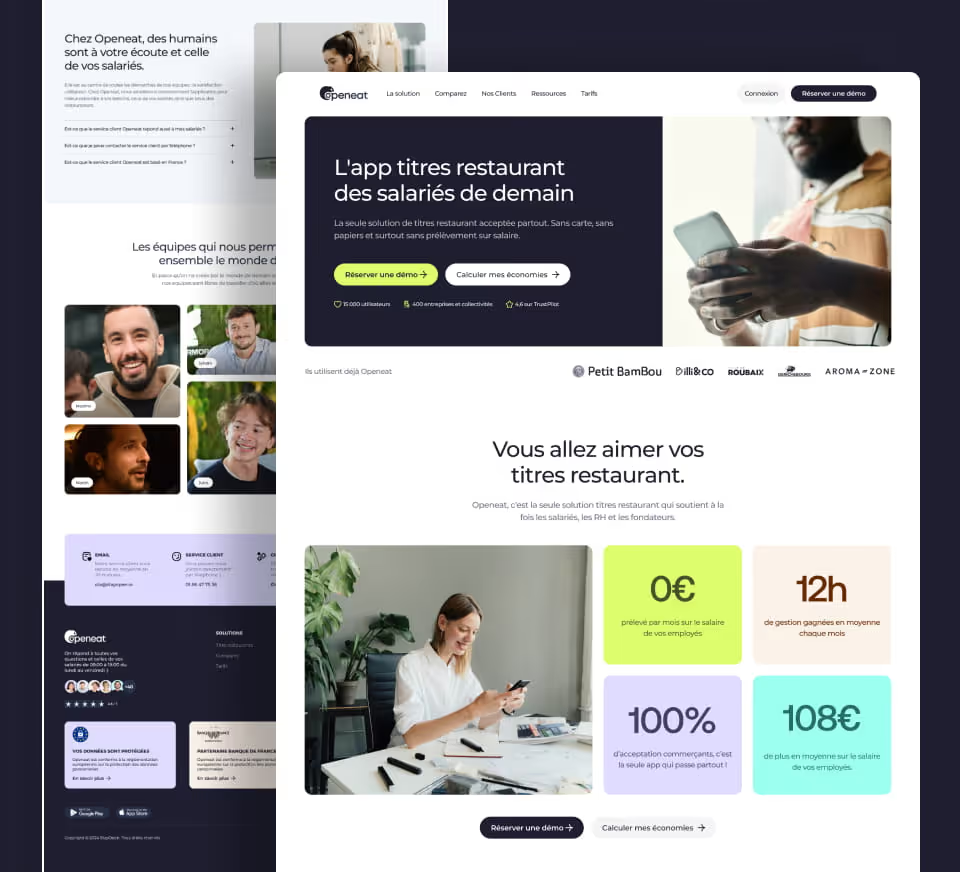
At Gemeos, we’ve been supporting finance players for years: Finary, Homunity, Mimco, Rivaria Capital, Hellébore Gestion Privée. Here are the common patterns across the sites that truly convert.
A hero that answers a question, not one that introduces a product
Finance websites that convert don’t start with “Who we are.” They start with the prospect’s problem and the promise of a solution.
Finary, for example, built its message around an immediate, concrete benefit: seeing your entire wealth at a glance. Not “the next-generation wealth management platform.” A direct answer to what the user is looking for.
Simulators as the first point of contact
Simulators convert better than contact forms in finance. Why? They create immediate value before asking for anything. The prospect calculates their potential return, borrowing capacity, or portfolio mix, and the next step comes naturally.
Homunity uses this mechanism on its product pages: the investment simulator is the first CTA, not a “call me back” form. The result: a journey that filters and qualifies leads upfront.
{usecases}
Compliance signals displayed without hesitation
AMF, ACPR, license, banking partners: the players that convert display them at the top of the page, in the footer, and near every CTA. Not at the bottom of the page in 10-point font.
For Rivaria Capital and Hellébore Gestion Privée, this is a direct differentiator against competitors who bury this information in their legal notices.
Dedicated pages by investor profile
Instead of a generic homepage that speaks to everyone, and therefore to no one, the best players create different entry points based on profile: individual vs. professional, first-time investor vs. experienced investor, ticket <€10k vs. private wealth.
This segmentation reduces the prospect’s cognitive load and mechanically improves conversion rates across each segment.
Load speed treated like a product priority
Mimco rebuilt its website on Webflow for this very reason: to move away from a plugin-heavy WordPress setup that slowed down the mobile experience. The performance gains translated directly into engagement metrics and SEO rankings.
A fast finance website signals credibility. A slow one signals risk.
{cta}
How to diagnose your site: the metrics to watch
Before you rebuild anything, measure. Here are the metrics that reveal the real conversion issues on a finance website.
The tools: Google Analytics 4 for behavioral metrics, Hotjar or Microsoft Clarity for heatmaps and session recordings, Google Search Console for SEO performance, and PageSpeed Insights for speed.
Where to start: the 3 priority levers
No need to change everything at once. On most finance websites Gemeos has audited, three levers have the biggest short-term impact.
1. Rework the value proposition and hero
This is the entry point for everything else. If the message above the fold doesn’t answer the prospect’s question immediately, the rest of the site is working for nothing.
Simple test: show your homepage to someone who doesn’t know your business. In 5 seconds, can they explain what you do, for whom, and why they should choose you? If the answer is no, that’s where it starts.
On the sites we support, rewriting the hero alone typically drives an 8% to 15% improvement in conversion rate on entry pages.
2. Add or reposition reassurance elements
Quick audit: open your site and see how many clicks it takes for a prospect to find your approval, your institutional partners, and your key figures. If it’s more than two clicks, it’s too far away.
Bring these elements higher in the main journey. Integrate them into product pages and near contact forms.
3. Simplify and adapt the main form
Reducing a form from 8 fields to 4 improves completion rates by 50% on average. In finance, every unnecessary field is one more reason to drop off.
The rule: only ask for what you need to qualify the lead at first touch. The rest comes during the first conversation. You can also draw inspiration from our article on how to create a landing page that converts to go deeper on this topic.
FAQ — Finance CRO
What is a good conversion rate for a fintech website?
In finance and fintech, an overall conversion rate between 1.5% and 3% is considered solid for an acquisition site. Top performers exceed 4% on highly targeted pages with qualified traffic. It all depends on the type of conversion being measured: contact form, sign-up, simulation, or subscription.
Where should you start with a CRO approach on a finance website?
Start by analyzing existing data before changing anything. Google Analytics 4, heatmaps, session recordings: these tools reveal where prospects drop off. Once the friction points are identified, prioritize by potential impact and implementation complexity. There’s no need to rebuild the whole site if the problem is just a form that’s too long.
Why is trust the first conversion lever in finance?
Because finance involves a high level of commitment, often financial and long-term. The prospect needs to be convinced you’re credible before they’ll consider taking action. Every missing trust signal — approval, partners, figures, testimonials — is an unaddressed objection that blocks conversion.
Is Webflow a good fit for a fintech website that needs to perform on conversion?
Yes. Webflow is especially well suited to fintech websites: strong out-of-the-box technical performance, design flexibility to integrate simulators and reassurance elements, built-in CDN hosting, and easy updates for marketing teams. It’s the CMS Gemeos uses on 100% of its finance projects. You can check out our Webflow vs WordPress comparison to understand the key differences.
How much does a CRO project cost for a finance website?
A full CRO project (audit, recommendations, implementation, and follow-up) usually ranges from €3,000 to €15,000 depending on site complexity and scope. Audit-only projects are often between €800 and €2,500. At Gemeos, we offer CRO projects as part of our growth retainers for clients who want ongoing optimization.
Finance CRO in 2026 — Key takeaways
At Gemeos, we’ve been supporting finance and fintech players on these topics for years: from CRO audits to full Webflow redesigns, including conversion journey optimization and SEO. If your site drives traffic but not enough qualified leads, that’s often where the issue is. You can also read our article on how neuromarketing boosts sales page performance, or discover how we increased Tracktor’s website conversion by 19% for a concrete example of a CRO project.
Good to know
Heading
Lorem ipsum dolor sit amet, consectetur adipiscing elit. Suspendisse varius enim in eros elementum tristique. Duis cursus, mi quis viverra ornare, eros dolor interdum nulla, ut commodo diam libero vitae erat. Aenean faucibus nibh et justo cursus id rutrum lorem imperdiet. Nunc ut sem vitae risus tristique posuere.









Lorem ipsum
Lorem ipsum dolor sit amet, consectetur adipiscing elit, sed do eiusmod tempor incididunt ut labore et dolore magna aliqua. Ut enim ad minim veniam, quis nostrud exercitation ullamco laboris nisi ut aliquip ex ea commodo consequat. Duis aute irure dolor in reprehenderit in voluptate velit esse cillum dolore eu fugiat nulla pariatur.