Subscriptions and prices for a Webflow site in 2026
When it comes to choosing a website-building solution, understanding Webflow pricing is essential for evaluating the platform’s cost-effectiveness and performance. Whether you’re a business looking to build your own site or you’re considering working with a Webflow agency for a more complex project, it’s important to understand the different pricing plans and the features that come with them.
In this article, we’ll break down the costs associated with Webflow in 2026 so you can make a smart choice.

article summary
- Webflow offers a free plan on a webflow.io subdomain, while a paid plan lets you use your own domain.
- Site plans cover simple websites, CMS projects, high-traffic sites, and Enterprise requirements.
- E-commerce plans vary depending on sales volume, required features, and the transaction fee applied.
- The right plan mainly depends on CMS needs, traffic, number of contributors, localization requirements, and business type.
- The overall budget includes the Webflow subscription, domain name, third-party tools, and website creation or maintenance.
Want to take it further? Ask:
Can I use Webflow for free?
Yes, Webflow offers a free plan that lets you build and publish a site on a Webflow subdomain (e.g. yoursite.webflow.io). This plan includes basic site-building features, but it’s limited in terms of storage, bandwidth, and access to advanced features.
If you want to connect a custom domain or unlock more options, you’ll need to upgrade to a paid plan.
Which Webflow plan should you choose?
Webflow offers several paid plans split into two main categories: "Site" plans (for individual websites) and "Account" plans (for managing multiple projects, often used by agencies or freelancers).
"Site" plans (per site)
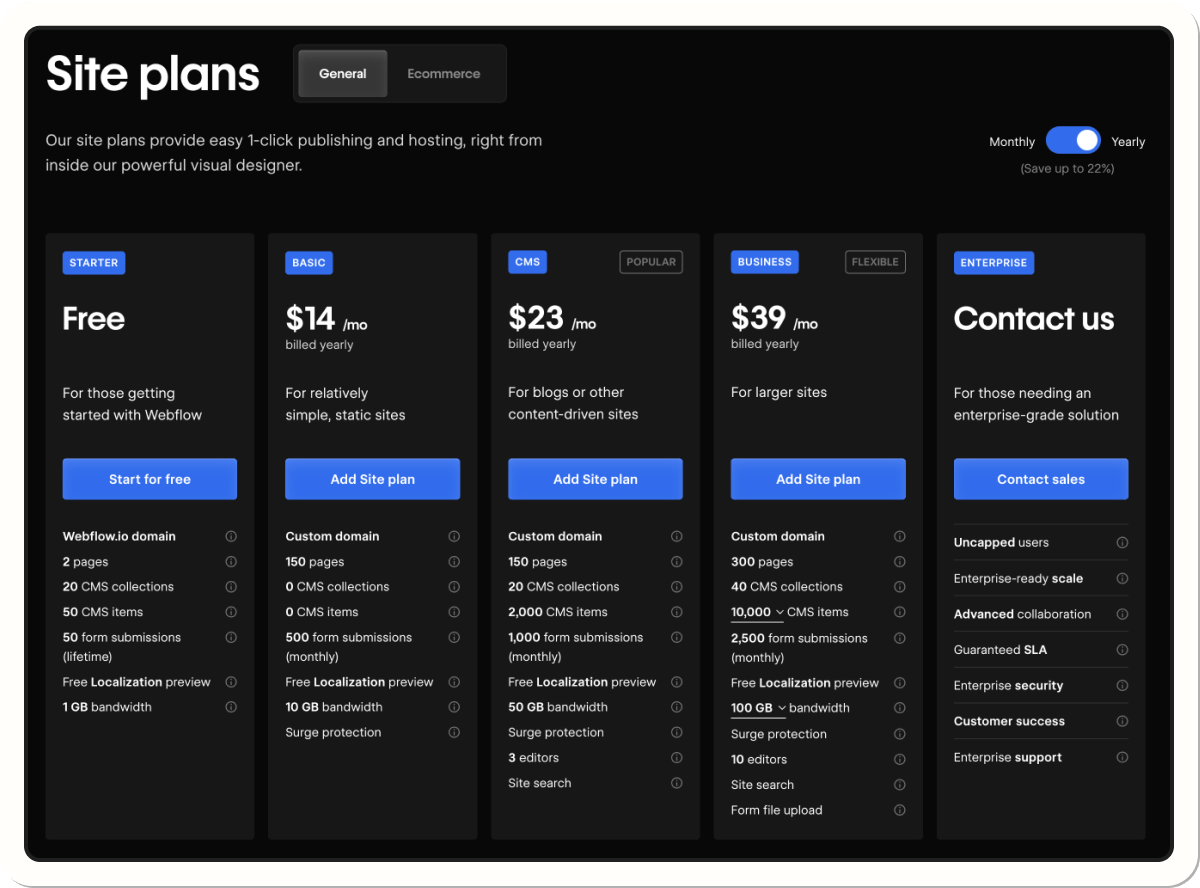
These plans apply to each site you create and let you connect a custom domain, access advanced features, and more.
Basic Plan (15 $/month billed annually or 18 $/month billed monthly)
- Ideal for a simple website.
- Custom domain.
- 500 form submissions/month.
- 50 GB bandwidth.
CMS Plan (20 $/month billed annually or 29 $/month billed monthly)
- Perfect for blogs or dynamic content sites.
- Content management with the built-in CMS.
- 2,000 CMS items (articles, projects).
- 1,000 form submissions/month.
- 200 GB bandwidth.
Business Plan (49 $/month billed annually or 49 $/month billed monthly)
- Built for high-traffic sites.
- Up to 10,000 CMS items.
- 2,500 form submissions/month.
- Unlimited bandwidth.
Enterprise Plan (custom pricing)
- Custom solutions for large companies with specific needs.
- Priority support, enhanced security, and more flexibility.
"eCommerce" plans (per site)
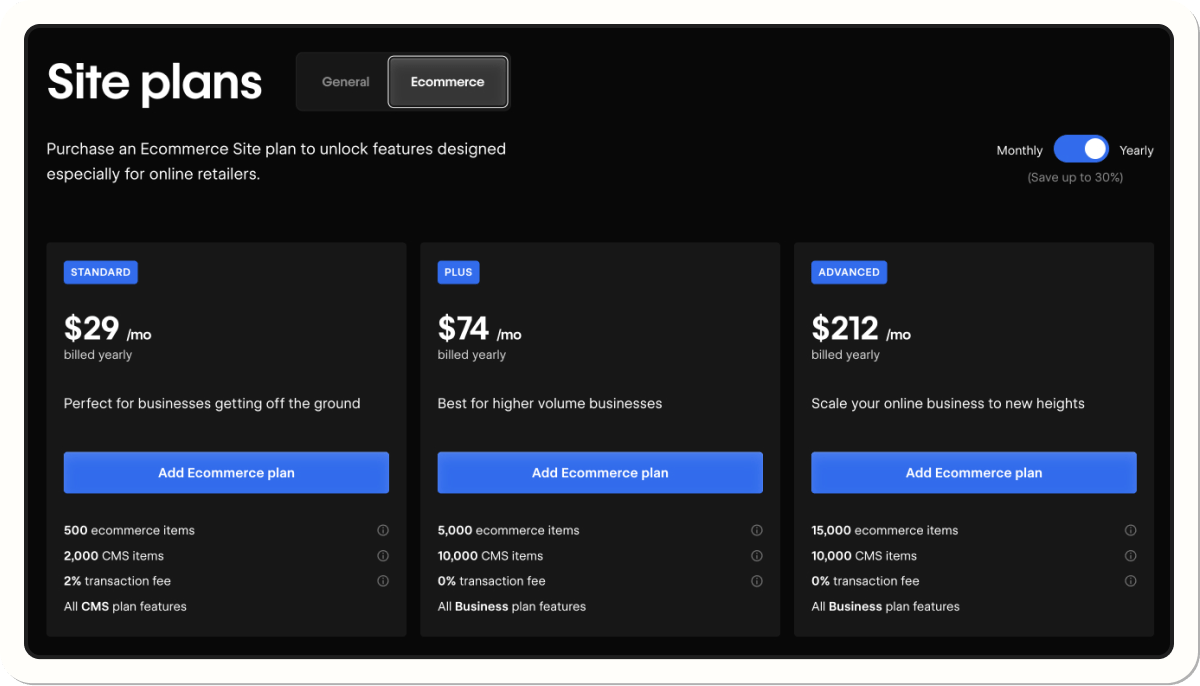
These plans are designed for eCommerce stores.
Standard Plan (42 $/month billed annually or 49 $/month billed monthly)
- Up to 500 items.
- 2% transaction fee.
- Integration with eCommerce tools.
Plus Plan (84 $/month billed annually or 99 $/month billed monthly)
- Up to 1,000 items.
- No transaction fees.
Advanced Plan (235 $/month billed annually or 299 $/month billed monthly)
- Up to 3,000 items.
- No transaction fees.
"Account" plans (per user)
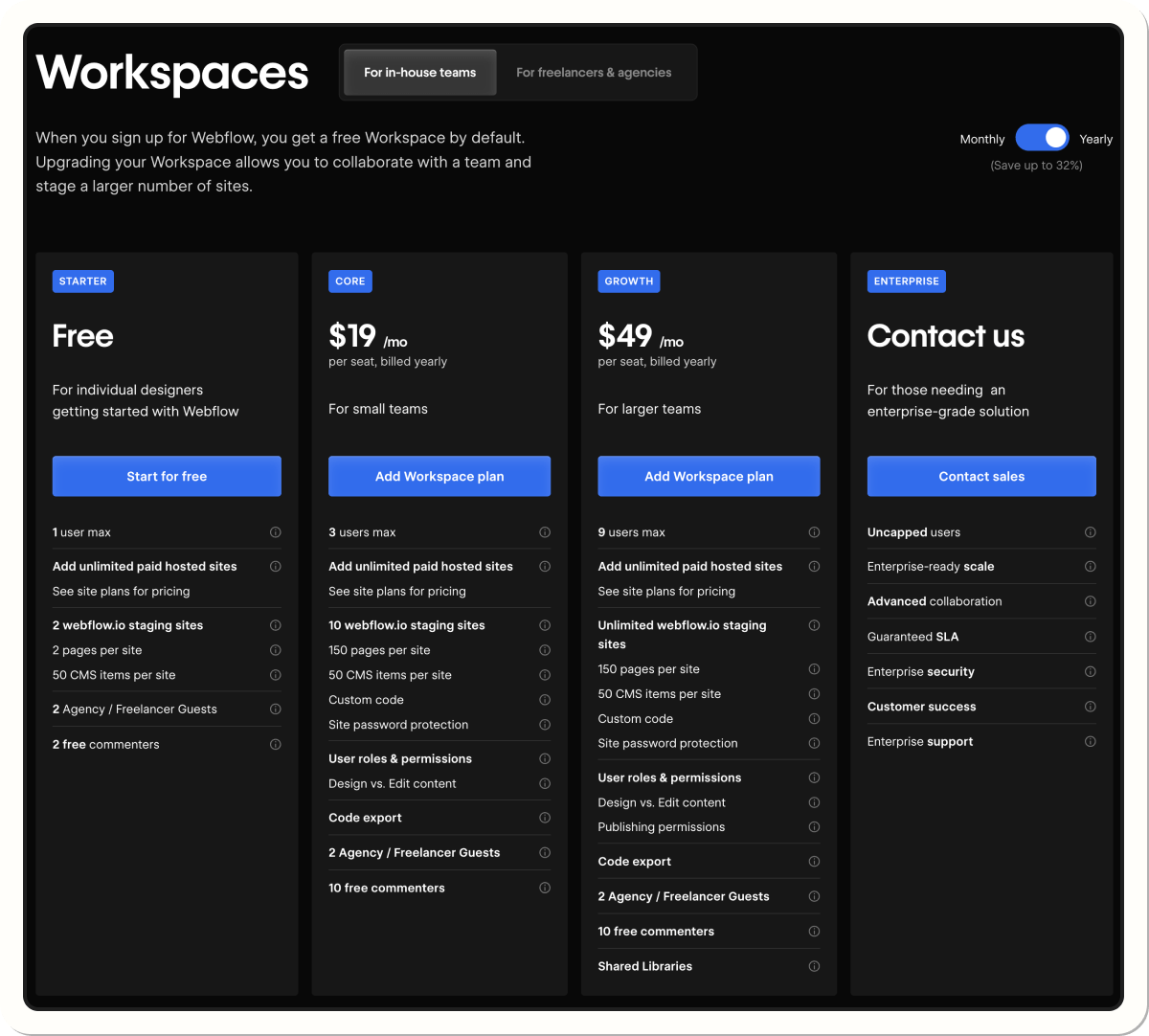
These plans are designed for freelancers and agencies managing multiple projects.
Free Plan
- Up to 2 unpublished projects.
- No custom domain.
Lite Plan (16 $/month billed annually or 24 $/month billed monthly)
- Up to 10 unpublished projects.
- Code export.
Pro Plan (35 $/month billed annually or 42 $/month billed monthly)
- Unlimited projects.
- Share projects with other collaborators.
Team Plan (per team member, starting at 42 $/month)
- Collaborative tools.
- Shared folder for managing team projects.
"Enterprise" plans
For large teams or companies with specific needs, Webflow offers custom-quoted Enterprise plans with tailored features, advanced technical support, and more flexibility around users and projects.
Pricing summary by plan
Choose your plan based on your business
The right Webflow plan — and the price you’ll pay — depends mainly on your business, your specific feature needs, and the size of your project. Here’s a guide to help you choose the right plan for your use case:
Freelancer or content creator (small projects)
Recommended plan: Basic or CMS
If you want to build a simple site to showcase your portfolio or blog, the Basic plan will be enough. It includes a custom domain and enough bandwidth for a site with moderate traffic.
If you publish dynamic content regularly (blog, portfolio), the CMS plan is a better fit, with easy content management and better control over published articles.
{usecases}
Blogger or content publisher
Recommended plan: CMS
The CMS plan is built for sites that need regular content management. With up to 2,000 CMS items (articles, projects), this plan lets you manage a blog that’s dynamic or a content-rich website.
It’s ideal if you need to organize and display content regularly with advanced SEO features.
Small business or SMB
Recommended plan: Business
If your business relies on a site that needs to handle significant traffic and deliver a smooth user experience, the Business plan is the right fit. It includes unlimited bandwidth and high form submission limits (up to 2,500/month).
It’s a strong choice for companies that want a high-performing site with dynamic content management and no compromise on performance.
{cta}
Online store (eCommerce)
Recommended plan: eCommerce Standard, Plus, or Advanced
eCommerce Standard is perfect for small online stores with a catalog of around 500 items, but it includes a 2% transaction fee.
eCommerce Plus is a better fit if you sell more products (up to 1,000 items) and don’t want transaction fees.
If you run an online store with a large inventory and ambitious growth goals, eCommerce Advanced (up to 3,000 items and no transaction fees) is the best fit.
Web agency or independent developer
Recommended plan: Pro or Team
If you manage multiple projects for different clients, the Pro plan is ideal. It lets you handle an unlimited number of projects and includes collaboration features.
The Team plan is recommended for agencies because it lets you work together on the same projects with collaborative tools and shared folders for a smoother workflow.
Large company
Recommended plan: Enterprise
For large-scale, specific needs like custom solutions, high security requirements, and dedicated customer support, the Enterprise plan is the right choice. It gives you a lot of flexibility for complex projects.
Quick recap
- Freelancers and small sites: Basic or CMS plan.
- SMBs or content-heavy businesses: Business plan.
- Online stores: eCommerce Standard, Plus, or Advanced plan.
- Agencies and freelancers with multiple clients: Pro or Team plan.
- Large companies: Enterprise plan.
Your choice should be based on traffic volume, how much content you need to manage, and whether you need specific features like eCommerce or team management.
How does Webflow billing work?
.png)
Webflow billing is flexible and depends on the plan you choose, with two main options: monthly and annual billing. Here’s how Webflow billing works:
Choosing between monthly and annual billing
Monthly billing
You pay every month and can cancel or change your plan at any time with no long-term commitment. This gives you more flexibility, but the rates are slightly higher than annual billing.
Annual billing
You pay once for 12 months. This option is more cost-effective, because Webflow offers a significant discount (around 20%) off monthly rates. It’s a good option if you plan to use Webflow long term.
Types of billed plans
Webflow bills according to two main categories:
"Site" plan billing (per site)
If you buy a plan for a specific site (for example, the Basic or CMS plan), you’ll be billed per site. Each site you create with a custom domain will have its own plan and billing.
"Account" plan billing (per user)
These plans are for managing multiple projects, often used by freelancers or agencies. Lite, Pro, or Team plans let you manage multiple sites and projects under one account.
How "Site" plan billing works
Each site can have a specific plan (for example, Basic, CMS, Business, or one of the eCommerce plans).
Billing applies per site, so if you have multiple Webflow sites, each site will have its own subscription.
If you upgrade to a higher plan, the price difference is adjusted pro rata for the remaining time in your billing cycle.
How "Account" plan billing works

Account plans are for users who manage multiple Webflow sites under one account. You don’t pay per site, but per user or team member.
Agencies or freelancers often choose these plans because they let them work on multiple projects without having to buy a subscription for each site.
You can also export code from projects if you choose the Lite or Pro plans, which are billed monthly or annually depending on your subscription.
Billing for eCommerce features
For online stores, eCommerce plans include extra features like payment and order management.
eCommerce Standard plans charge a 2% transaction fee on each sale, while eCommerce Plus and Advanced plans have no transaction fees.
Payment options
.png)
Webflow accepts credit card payments. Once you choose a plan, you enter your payment details in the Webflow interface.
Webflow automatically bills you on the renewal date, whether monthly or annually.
Canceling or upgrading a subscription
You can cancel or change your subscription at any time. If you downgrade or upgrade, Webflow adjusts the difference pro rata on your next invoice.
If you cancel, you’ll still be able to access your site, but some features will be limited or disabled once the subscription expires.
Free trial and limitations
Webflow offers a free plan, but it doesn’t let you connect a custom domain. It gives you a way to test the platform and build a site before moving to a paid subscription.
Billing for additional features
If you go beyond certain plan limits (for example, the number of form submissions or bandwidth), Webflow may charge additional fees.
Additional services like advanced SEO features, third-party integrations, or custom elements may also incur fees depending on the plan you choose.
Webflow pricing compared with other CMSs
Webflow vs Wordpress pricing
.png)
Webflow is more expensive than WordPress when you compare upfront costs. WordPress is free software, but it requires separate hosting fees and additional costs for premium themes and plugins. Webflow, on the other hand, includes everything in an all-in-one plan (hosting, CMS, visual builder), which simplifies the experience but can be more expensive, especially for simpler sites.
Webflow vs Wix pricing
.png)
Compared with Wix, Webflow is positioned as a more expensive option, but also a more flexible one. Wix, with prices starting at 16 $/month, is ideal for users who want to build a site quickly and without technical skills. However, Webflow stands out for its advanced customization options, which justify the higher cost for users with complex projects.
Webflow vs Squarespace pricing
.png)
Compared with Squarespace, Webflow is slightly more expensive, but it offers deeper customization. Squarespace offers elegant prebuilt designs at a competitive price (16 $/month), but it becomes limiting for users who want full control over design and functionality, which makes Webflow the better option for demanding designers and developers.
Webflow vs Framer pricing

Compared with Framer, Webflow is generally more expensive but offers more robust features for building complex websites. Framer offers an intuitive site builder with simple animations and interactions, perfect for designers who want a fast, lightweight interface. Webflow, on the other hand, provides a built-in CMS and advanced tools, but that comes with a higher price tag. For developers or agencies, Webflow is still the more complete solution.
{cta}
How much does it cost to build a Webflow site with an agency?
The cost of building a Webflow site with a specialized agency varies widely depending on several factors such as project complexity, number of pages, custom features, and the agency’s experience. Here’s a cost estimate for different types of projects:
Simple showcase website pricing

Estimated cost: Between €2,000 and €5,000
A showcase website with a few pages (Home, About, Services, Contact) and few advanced features. It’s a relatively simple site, ideal for small businesses, freelancers, or portfolios.
Pricing for a CMS site (dynamic content)

Estimated cost: Between €5,000 and €10,000
A site that includes CMS features (content management), such as blogs or dynamic sections for projects, news, and more. This type of site requires more customization and functionality.
Pricing for an eCommerce site
Estimated cost: Between €7,000 and €20,000 (or more)
An eCommerce Webflow site requires more work, especially to set up online selling features, product management, secure payments, and integration with inventory systems. The cost can vary depending on catalog size and integration complexity.
Pricing for a custom site with advanced features

Estimated cost: Starting at €15,000 up to €50,000 or more
For a fully custom site with specific features like complex animations, API integrations, advanced management systems, or a unique user experience, the price can be higher.
Maintenance and support pricing
Estimated cost: €200 to €2,000 per month
Agencies usually offer ongoing maintenance and support services to keep the site updated, handle bugs, and make occasional adjustments.
To learn more about Gemeos support packages
Factors that influence pricing
Agency experience
An agency with a strong portfolio and a lot of experience will charge higher rates.
Customization
The more custom features, animations, or integrations your site needs, the higher the cost will be.
Number of pages
A 5-page site will cost less than a 50-page site.
Urgency
A tight deadline can lead to additional fees.
Our tips for building your Webflow site efficiently in 2026
.png)
While Webflow offers a lot of flexibility and powerful tools for building professional websites, it’s essential to understand the costs tied to each feature so you can optimize your investment.
Taking the time to learn Webflow is an important step, especially if you want to get the most out of the platform. However, for more complex projects or when you need to save time, it’s often smarter to work with a specialized agency.
A good agency won’t just build a site that fits your needs — it will also take a teaching-first approach, guiding you so you understand the tools at your disposal and ensuring a result that’s both strong and built to last. That’s what we do at Gemeos.
Feel free to book a meeting directly with us if you have any questions about your project!
Good to know
Heading
Lorem ipsum dolor sit amet, consectetur adipiscing elit. Suspendisse varius enim in eros elementum tristique. Duis cursus, mi quis viverra ornare, eros dolor interdum nulla, ut commodo diam libero vitae erat. Aenean faucibus nibh et justo cursus id rutrum lorem imperdiet. Nunc ut sem vitae risus tristique posuere.

.avif)







Lorem ipsum
Lorem ipsum dolor sit amet, consectetur adipiscing elit, sed do eiusmod tempor incididunt ut labore et dolore magna aliqua. Ut enim ad minim veniam, quis nostrud exercitation ullamco laboris nisi ut aliquip ex ea commodo consequat. Duis aute irure dolor in reprehenderit in voluptate velit esse cillum dolore eu fugiat nulla pariatur.