How can a financial services website reassure prospects?
In finance, trust almost always comes before conversion. A prospect may understand an offer and still avoid making contact if they do not know who provides the service, under what framework it is offered, how information is handled or who they will speak with next. The website should therefore reduce uncertainty before asking for an appointment.

article summary
- Trust depends on clearly identifying the company and its responsibilities.
- Proof should be contextualised rather than grouped into a generic trust block.
- Offers should be explained in understandable language without losing the necessary precision.
- The form should qualify the need without collecting sensitive or unnecessary information too early.
- Expert content strengthens credibility when it is signed, dated and maintained.
Want to take it further? Ask:
A web agency for financial companies should organise proof, content and user journeys around this requirement. Design matters, but it cannot replace verifiable information about the company, team, positioning and how the service is delivered.
Why does finance require more reassurance?
A financial decision often involves money, a long-term commitment and a high level of perceived risk. Prospects cannot easily “test” the service before choosing. They therefore rely on signals: clarity of information, quality of explanations, identity of the team, operating framework and overall website consistency.
Clearly show who is behind the offer
Prospects should be able to understand who the company is, its role, how it is organised and how to contact it. Legal notices are not enough when they are the only source of information about the provider.
A useful corporate page can present:
- mission and positioning;
- leadership team and experts;
- activities genuinely offered;
- locations;
- partners where their role needs to be explained;
- relevant, validated regulatory information.
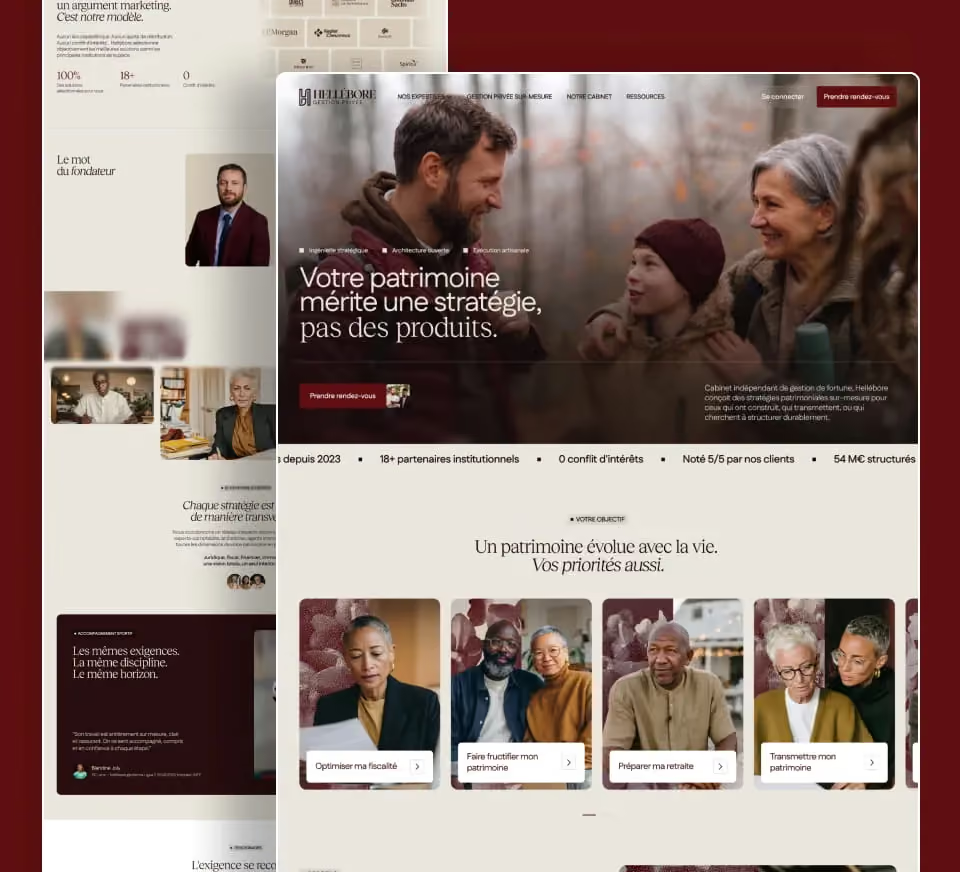
The connection with wealth management firms is particularly strong: the more a service depends on an advisory relationship, the more visible the people and method should be.
Present the team as proof of expertise
A row of portraits is not enough. Each profile can specify their role, areas of expertise, relevant background, useful publications or speaking engagements and internal responsibilities.
Explain offers with a clear hierarchy
| Level | Prospect’s question | Content |
|---|---|---|
| Promise | What is the offer for? | Benefit and context |
| Audience | Is it suitable for my situation? | Profiles and use cases |
| Method | How does it work? | Stages and contacts |
| Conditions | What limits or requirements apply? | Precise information |
| Action | What is the next step? | Appointment, audit, contact |
Place proof where it resolves an objection
An approval or certification should appear where it helps explain the framework. A customer reference should only be used when publication is authorised and it adds useful context. A performance figure should state what it measures and over what period when highlighted.
Use design to make information credible
Web design should prioritise readability: clear typography, sufficient contrast, understandable tables, spacing and hierarchy. Generic “financial luxury” codes cannot replace precision.
Create attributed expert content
Articles, analysis and guides can demonstrate the ability to explain complex topics. They become more credible when the author, update date and sources are identifiable.
Internal linking should connect content to the business pages genuinely concerned without pushing the same offer from every article.
Make first contact less intimidating
The CTA “Contact us” can be too vague for a complex decision. The website can explain what the exchange involves: scoping call, appointment, initial audit or information request.
A dedicated landing page can support a specific offer or segment when it uses the same proof and limitations as the rest of the site.
Limit information collection in the form
The form should only request the data required for initial routing. Sensitive or detailed information can be collected later in an appropriate environment.
Measure the quality of enquiries
Tracking should monitor conversions, pages viewed before contact and acquisition source. Where the CRM allows it, leads should be compared with their real commercial qualification.
Finance trust checklist
- The company and its role are clearly identified.
- Expert profiles are connected to the offers.
- Proof is verifiable and up to date.
- Offers are explained before the CTA.
- Forms remain proportionate.
- Content is attributed and maintained.
- Mobile retains all essential information.
Make the company immediately identifiable
In finance, a prospect’s first expectation is to understand who they are entrusting with information and decisions. The website should therefore clearly present the company, its role, the people involved and useful professional information.
A finance web agency should organise this reassurance from the first sections rather than leaving it to a footer or hard-to-find legal page.
Present offers around prospect needs
Financial prospects do not always think in product names. They may be looking to invest, finance, protect, transfer or organise a situation more effectively. The website should therefore begin with these intentions before introducing the solutions offered.
This organisation helps visitors recognise themselves more quickly and reduces the effort required to understand the offer.
Explain the advisory method
Prospects want to understand how the relationship works. Analysis of the situation, definition of objectives, review of options, proposal and follow-up can be presented when these stages genuinely reflect how the company operates.
A clear method makes the appointment more predictable and shows that support is not limited to a simple commercial contact.
Present the team and responsibilities
The profiles of the people supporting clients directly contribute to trust. The website can present their role, experience and areas of involvement.
Information should remain factual and verifiable. A short, precise presentation is more useful than a very long biography.
Clarify fees and terms
Fees, commissions and costs associated with an offer can be difficult to understand. The website should explain the main components where possible and identify the factors that make costs vary.
The objective is not necessarily to display a single price, but to reduce opacity before the appointment.
Make professional information accessible
Prospects should be able to identify the company, its statuses and the information required to verify its activity.
These elements can appear in regulatory areas, but the information most useful for trust should not be hidden in a difficult-to-read footer.
Present partners with context
When the company works with partners, their role should be explained. A simple row of logos may create an impression of strength but also ambiguity about the nature of the relationship.
Visitors should understand who provides, distributes or supports the offer when that distinction matters.
Avoid performance promises
A financial website should remain cautious about future outcomes. Proof should focus on service quality, experience, method, process robustness and verifiable information.
Historical figures or examples should always be contextualised and never presented as a guarantee.
Use cases to make the offer concrete
Typical situations can help prospects recognise themselves: preparing financing, structuring wealth, anticipating a transfer or organising an investment project.
These examples should remain general and avoid suggesting that one solution is suitable for everyone.
Use cases mainly show the contexts in which the company can intervene.
Develop educational content
Articles, FAQs or resources can help prospects understand complex concepts before the first conversation.
These resources should connect to the relevant commercial pages. An isolated resource centre may attract readers without helping them move forward in their decision.
Work on proof without creating overload
Trust is built more effectively with a few strong proof points than with an accumulation of logos, figures and labels. Each proof point should answer a precise objection: company identity, experience, method, partner, compliance or quality of support.
The website benefits from distributing these elements across the right pages rather than concentrating everything in a single institutional section. A prospect viewing a financing offer should see proof directly related to that activity.
Keep sensitive information up to date
Teams, partners, offers, fees and professional information can change. Old or contradictory information is especially problematic in finance, where trust depends heavily on precision.
The website should therefore have a regular update process and identify the content that requires internal validation before publication.
Prepare appointment booking
The form should request only the information needed to route the first conversation. Name, contact details, type of need and a comment are often enough for the first step.
Sensitive financial data should not be collected without necessity through a standard marketing form.
Reassure prospects about the next step
After submission, prospects should know what will happen. Confirmation, follow-up by an adviser, appointment booking or a request for additional information should be explained clearly enough.
This transparency reduces uncertainty and improves service perception.
Adapt the website for mobile
Complex text, tables and forms should remain readable on smartphones. Key elements should not be hidden inside difficult blocks or PDFs that are impossible to read on a small screen.
The mobile journey should allow prospects to understand the offer and book an appointment without friction.
Measure contact quality
The number of forms is not enough. Track the lead source, offer viewed, request type and commercial quality where this data is available.
This analysis distinguishes content that attracts a lot of traffic from content that genuinely generates relevant appointments.
Checklist for reassuring financial prospects
- Clearly present the company and contacts.
- Organise offers by need.
- Explain the advisory method.
- Clarify fees and terms.
- Make professional information accessible.
- Limit unverifiable claims.
- Simplify appointment booking.
FAQ
Which information reassures prospects most on a financial website?
Company identity, the team, method, professional information, explained partners and contact arrangements are especially important. They allow prospects to verify the provider before sharing information or booking an appointment.
How can a complex financial offer be presented without losing the visitor?
Start with the prospect’s need, explain how the offer works using clear language, then make technical details available at a second level. Education should reduce uncertainty without removing important nuance.
Should fees be displayed directly on the website?
When fees can be presented reliably, it is useful to explain their structure and the factors that make them vary. Avoid a generic price when it does not reflect the reality of the situations handled.
How should testimonials be used on a financial website?
Testimonials should be authentic and focus on service quality, education or the relationship. They should not imply that a future financial outcome is guaranteed.
What information should a financial form request?
The first form should remain limited to the data needed to route the request: contact details, type of need and a comment. Sensitive or detailed information can be collected later through an appropriate channel.
Which KPIs should be tracked for a financial website?
Appointments, qualified enquiries, pages viewed before contact, lead sources and commercial conversion provide a more useful picture than traffic alone.
Good to know
Heading
Lorem ipsum dolor sit amet, consectetur adipiscing elit. Suspendisse varius enim in eros elementum tristique. Duis cursus, mi quis viverra ornare, eros dolor interdum nulla, ut commodo diam libero vitae erat. Aenean faucibus nibh et justo cursus id rutrum lorem imperdiet. Nunc ut sem vitae risus tristique posuere.







Lorem ipsum
Lorem ipsum dolor sit amet, consectetur adipiscing elit, sed do eiusmod tempor incididunt ut labore et dolore magna aliqua. Ut enim ad minim veniam, quis nostrud exercitation ullamco laboris nisi ut aliquip ex ea commodo consequat. Duis aute irure dolor in reprehenderit in voluptate velit esse cillum dolore eu fugiat nulla pariatur.