How can a recruitment website attract both candidates and companies?
A recruitment firm serves two markets: candidates and companies. The website should recognise this duality from the architecture stage and offer distinct journeys without fragmenting the brand.

article summary
- The website should serve candidates and client companies at the same time.
- Vacancies should be filterable without turning the site into an unreadable database.
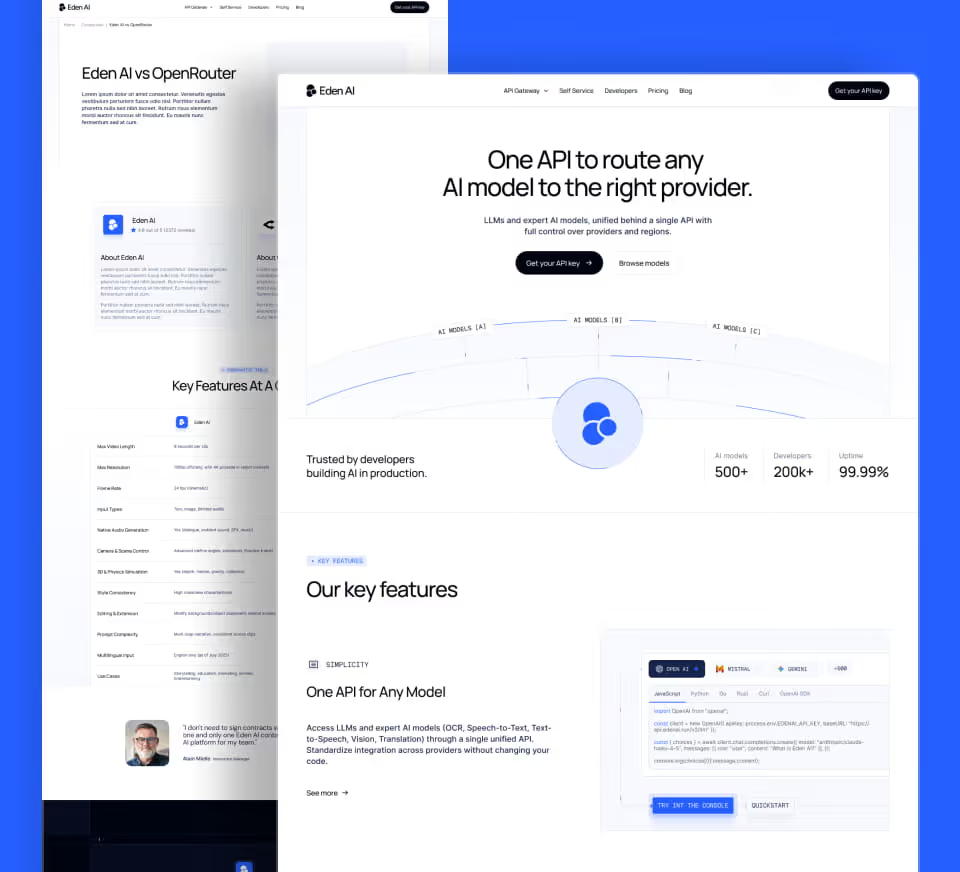
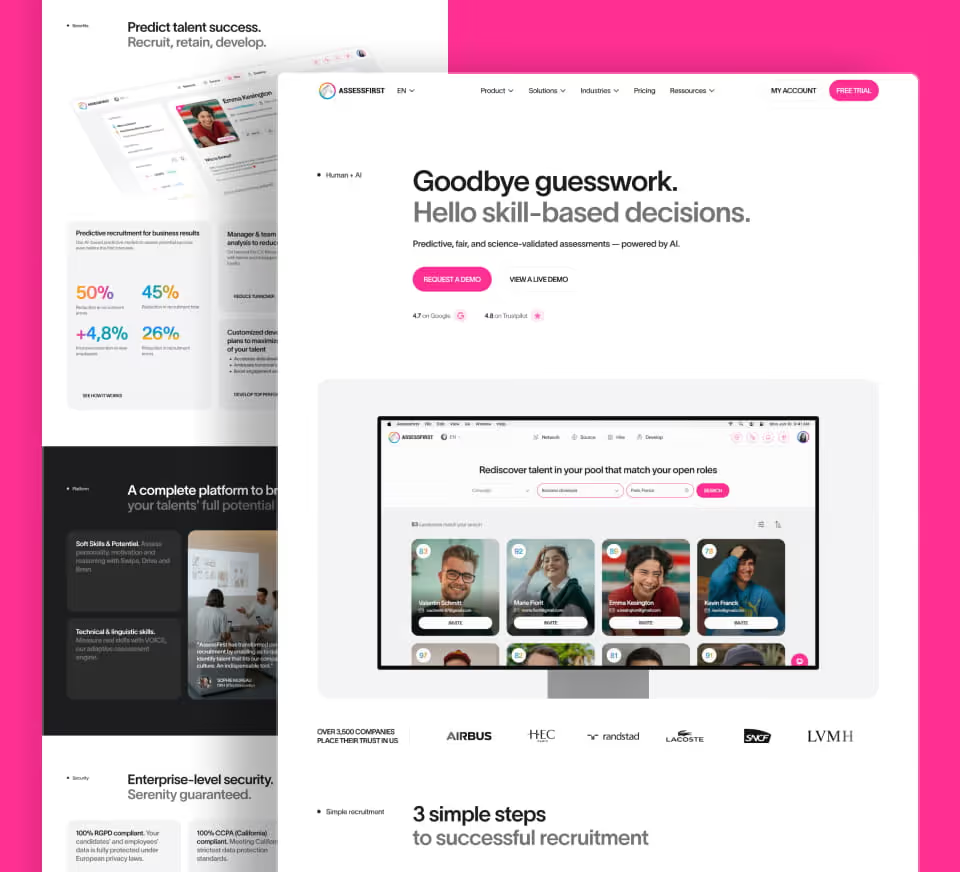
- Proof should focus on recruitment expertise and understanding of roles. The AssessFirst project illustrates this approach with differentiated HR journeys and an SEO strategy integrated into the website.
- The candidate journey should reduce off-target applications while staying simple.
- Content can support employer branding and B2B acquisition.
Want to take it further? Ask:
Clearly separate the two intents
A candidate wants to browse jobs, understand the firm’s specialisms and apply. A company wants to verify expertise, understand the method and make contact. A recruitment web agency should translate this logic into the architecture, content and journeys.
The two journeys should not compete for the same CTA or use the same vocabulary.
On a recruitment website, web design should mainly make the separation between the candidate journey and the company journey obvious, without multiplying visual effects.
Structure role and sector expertise
Sector or function pages can demonstrate understanding of roles, challenges and markets.
They can also host cases, content or data specific to each specialism.
For a recruitment campaign or targeted brief, a dedicated landing page can isolate a precise intent and avoid sending visitors to an overly general page.
Make jobs easy to explore
Filters by role, location, contract type or seniority can be useful.
Avoid too many filters, empty categories and journeys that require several clicks before users can even see a vacancy.
Present a concrete recruitment method
Sourcing, qualification, assessment, follow-up and onboarding should be explained according to the firm’s real model.
A credible method shows the decisions taken at each stage rather than a sequence of generic pictograms.
Show proof suited to companies
References, sectors covered, volumes or timelines can be presented if they are verifiable.
Absolute promises should be avoided and customer cases should explain the context of the assignment.
Create a useful content library for both audiences
Candidate advice, salary studies, role trends and HR guides can attract different audiences.
Internal linking should direct each reader toward the right next step: application, expertise or brief submission.
Tracking should distinguish applications, qualified applications and company enquiries so the real value created by each journey can be measured.
Design two journeys without creating two websites
A recruitment firm serves two audiences with different expectations: candidates and companies.
The website should let each identify their space immediately without duplicating the entire identity and content.
A recruitment web agency can organise both journeys around one common structure, with proof and CTAs adapted to each one.
The company journey: prove the ability to recruit
A company wants to understand the roles covered, the method, the level of support and the available results or references.
The website should explain how the firm works: scoping, sourcing, assessment, presenting profiles and follow-up.
Generic claims such as “find the best talent” should be replaced with more concrete information. For more detail, see what a recruitment firm website should include to convince companies.
Present specialisms
A specialist firm should make its expertise obvious.
Tech, finance, industry, sales or executive search may require specific pages if methods and profiles differ.
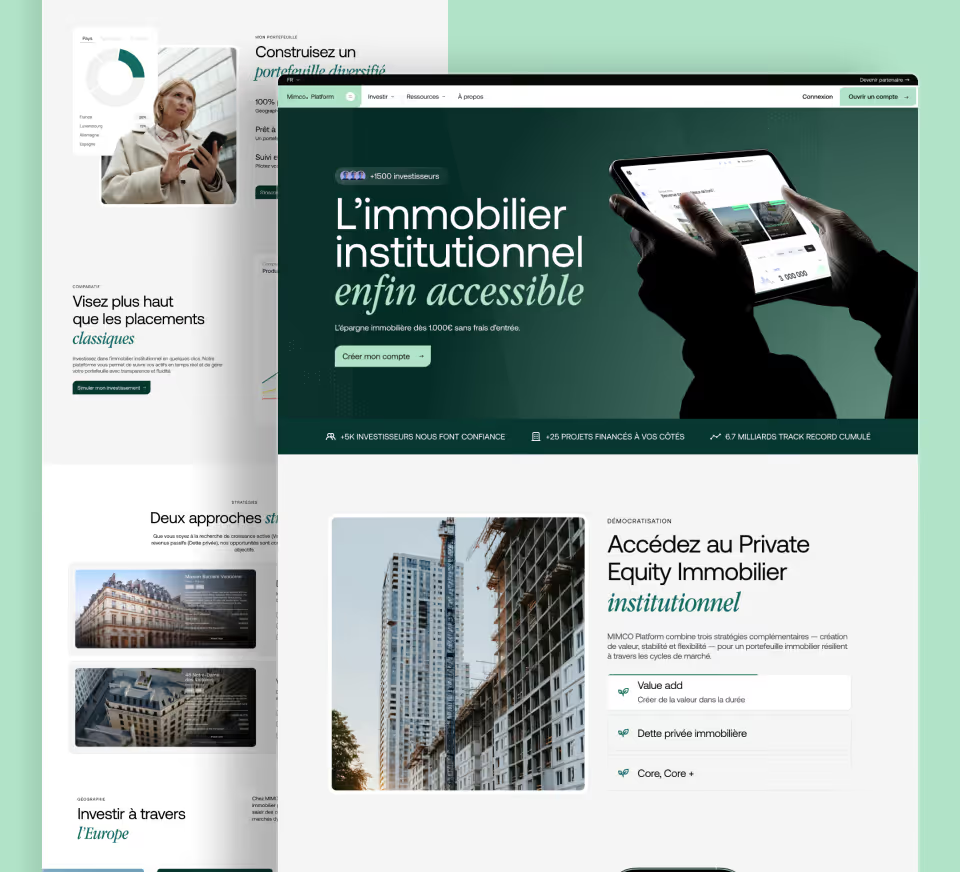
Each page can present market challenges, roles handled and the relevant team. This is the approach used for the Fenoma website, a boutique recruitment firm specialising in Product, Data, AI and Engineering profiles, whose content is organised by expertise and geographic market.
The candidate journey: explain what the firm provides
Candidates want to know how jobs are selected, how their profile will be handled and what to expect after applying.
The website should present vacancies, consultants and stages without giving the impression that CVs are collected without follow-up.
A clear page explaining how the process works builds trust.
Create readable job pages
Each vacancy should present responsibilities, context, location, important skills and available information about the client company.
The firm should respect what it is authorised to communicate.
Overly vague vacancies attract less-qualified applicants. Several levers can help increase the number of qualified applications through the website.
Simplify applications
Candidates should not have to complete ten screens just to submit a CV.
The required information depends on the process, but redundant fields should be removed.
On mobile, CV upload and validation should be particularly simple.
Offer speculative applications only when they are actually processed
A “speculative application” CTA can generate a large amount of difficult-to-use data.
It should be used only if the firm genuinely has a process for reviewing and storing those applications.
Otherwise, it is better to direct users to active vacancies or an alert.
Create a page for companies
The commercial page should explain the situations in which the firm operates: one-off recruitment, volume hiring, hard-to-fill profiles or specific support depending on the actual offer.
CTAs can offer a conversation or a way to submit a need.
The form should qualify enough without asking for a complete specification document.
Use content for both audiences
Candidate and company content should not be mixed without structure.
Recruitment advice can serve decision-makers, while content about roles or interviews can interest candidates.
Internal linking should keep each audience inside a coherent journey.
Present consultants
Recruitment depends heavily on people.
The website can present consultants, their specialisms and their role. These profiles reassure both candidates and companies.
Direct contact details can be shown when the organisation wants them to be.
Work on local SEO when the firm depends on a territory
Local presence can matter for some firms.
Local SEO should then rely on office pages or areas genuinely served, with specific teams and contact details.
Generic city pages should be avoided.
Measure both funnels separately
Applications and company leads should not be mixed in reporting.
Tracking should distinguish job views, applications, company enquiries and appointments.
This separation makes it easier to decide where to invest content effort.
Recruitment firm website checklist
- Clearly separate candidates and companies.
- Present the firm’s specialisms.
- Explain the method on the company side.
- Make vacancies precise and readable.
- Simplify mobile applications.
- Present consultants and their expertise.
- Measure both funnels separately.
Performance dashboard
| Stage | Question | Metric |
|---|---|---|
| Discovery | Does the visitor understand the offer? | Navigation, engagement |
| Reassurance | Do the proof points answer objections? | Clicks to cases, team, reviews |
| Action | Is the next step clear? | Forms, calls, appointments |
| Quality | Do requests match the target? | Qualification rate |
Clearly distinguish the candidate journey from the company journey
A recruitment website should answer two very different intents. Candidates want to understand jobs, companies, the recruitment process and what they can expect from the firm. Client companies are more interested in sector expertise, search method, the ability to handle hard-to-fill roles and the level of support. Mixing both journeys on the same pages weakens understanding.
Navigation should therefore let each audience identify its space immediately. Candidates access vacancies, application advice, process information and company details when those can be shared. Recruiters and executives should find expertise, covered sectors, sourcing methods, proof and a way to submit a need.
This distinction should also appear in CTAs. “View jobs”, “Submit an application” and “Entrust us with a recruitment” should not lead to the same form. Every action reflects a different intent level and different data.
Turn job listings into decision pages
A job listing should not be limited to a job description copied from an ATS. Candidates want to understand the recruitment context, real responsibilities, working environment, priority criteria and process.
The website should therefore enrich vacancies when information is available: reporting line, team size, location, remote-work policy, experience level, salary range, interview stages and indicative response time. This transparency helps candidates self-qualify before applying and reduces off-target applications.
Vacancies should also be easy to filter. Role, location, contract type, experience level or sector are often enough. Adding too many filters to a limited catalogue creates more complexity than value. The goal is to let users quickly reduce the number of relevant jobs.
An expired vacancy does not necessarily need to disappear abruptly. If it still receives traffic, it can explain that the role is filled and suggest similar opportunities, a speculative application or an alert. This prevents an SEO entry point or shared link from becoming a dead end.
Turn proof into a B2B conversion tool
To convince a company to entrust a recruitment assignment, the website should show more than a list of sectors. It needs to demonstrate the ability to understand roles and reach profiles that are difficult to recruit.
Proof can take several forms: assignment examples, types of positions filled, client testimonials, consultants’ years of experience in a market, direct-search methodology or observed timelines when genuinely documented. A concrete case explaining the context, recruitment difficulty and how the search was built is often more convincing than a row of logos.
Consultant profiles also matter. A decision-maker wants to know who may work on the assignment, what experience that person has and which roles they cover. A detailed team page reduces the sense that the firm is interchangeable.
Editorial content can also qualify the request before the form. An article about recruitment difficulties for a role, candidate expectations or salary trends demonstrates market knowledge while creating SEO entry points toward expertise pages.
Measure quality rather than volume
Application volume and company-form volume are incomplete indicators. On the candidate side, track the proportion of relevant applications, progression to interviews and, where data is available, completed hires. For B2B enquiries, connect source and landing page with the quality of the brief received.
This measurement reveals which pages genuinely create value. A page with less traffic can be more important than a highly visible one if it attracts rare candidates or companies that match the firm’s positioning.
FAQ
How should a recruitment website be structured for two audiences?
From the first step, offer a candidate journey and a company journey while sharing one identity and common proof.
Which information does a company want to find?
Specialisms, method, team, references, assignment types and contact options are the most important elements.
Which information reassures candidates?
Detailed vacancies, clear information about how the firm works, identifiable consultants and a transparent application process strengthen trust.
Should speculative applications be offered?
Yes, only if the firm genuinely has a process to handle them. Otherwise, they can generate large amounts of low-value data.
How can job listings qualify candidates better?
Specify responsibilities, context, location, key criteria and the information the firm is authorised to share about the employer.
Which KPIs should be tracked?
Applications, candidate quality, company enquiries, appointments and conversion rates should be tracked separately.
Good to know
Heading
Lorem ipsum dolor sit amet, consectetur adipiscing elit. Suspendisse varius enim in eros elementum tristique. Duis cursus, mi quis viverra ornare, eros dolor interdum nulla, ut commodo diam libero vitae erat. Aenean faucibus nibh et justo cursus id rutrum lorem imperdiet. Nunc ut sem vitae risus tristique posuere.







Lorem ipsum
Lorem ipsum dolor sit amet, consectetur adipiscing elit, sed do eiusmod tempor incididunt ut labore et dolore magna aliqua. Ut enim ad minim veniam, quis nostrud exercitation ullamco laboris nisi ut aliquip ex ea commodo consequat. Duis aute irure dolor in reprehenderit in voluptate velit esse cillum dolore eu fugiat nulla pariatur.