How can a B2B website become a true lead-generation channel?
A B2B website becomes a true lead-generation channel when it helps the right account move forward in its decision before the first sales conversation. Traffic is only the starting point. Real performance depends on the site’s ability to clarify the offer, answer objections, provide proof and suggest an action suited to the prospect’s maturity.
article summary
- A B2B website should aim for qualified opportunities rather than the highest possible number of forms.
- Each page should answer a specific intent and stage of the sales cycle.
- Customer stories, integrations, expert content and comparisons should reduce precise objections.
- CTAs should evolve with maturity: content, audit, demo, quote or appointment.
- Tracking should connect web conversions with commercial qualification.
Want to take it further? Ask:
In 2026, this role is even more important because buyers conduct an increasing share of their research independently. Gartner reports that 67% of B2B buyers prefer an experience without a sales representative and that 70% prefer a fully digital, self-service experience. The website therefore needs to sell the next step without trying to replace complex sales.
Why has the B2B website become a sales channel in its own right?
Buyers research suppliers, compare approaches and verify proof before speaking to sales. The website is no longer simply a support asset consulted after prospecting: it influences the shortlist before the call.
A B2B web agency should design the architecture around the sales cycle, decision-makers and required proof rather than reproducing the company org chart.
In a B2B cycle, low-volume intent can carry very high value. A query linked to an integration, regulatory constraint, vertical use case or comparison between two solutions may be searched by few people but by accounts very close to a decision. Editorial priorities should therefore combine search potential and commercial value.
A B2B web agency should also avoid cannibalisation between pages. A solution page, sector page and use-case page can cover the same product, but each should answer a different question and receive coherent internal links from the content that supports it.
Identify the intents that deserve their own page
The best pages do not always target the highest search volumes. In B2B, a technical problem or precise use case may generate little traffic but much more commercial value.
Pages can be organised around:
- business problems;
- solutions or products;
- use cases;
- sectors;
- personas;
- integrations;
- comparisons;
- security or compliance questions.
SEO/GEO helps map these intents before design begins.
Maturity also varies by landing page. A visitor arriving on a blog definition does not have the same level of intent as a prospect reading an “alternative to [solution]” page, a specific integration or a customer story from their sector. The CTA should account for this context rather than applying one rule across the site.
This logic avoids two common mistakes: asking for a demo too early from a reader still learning, or offering only a downloadable resource to a prospect already ready to speak with sales.
Match the CTA to the level of maturity
| Stage | Prospect need | Relevant CTA |
|---|---|---|
| Discovery | Understand the problem | Guide, study, solution page |
| Evaluation | Compare options | Customer story, demo, comparison |
| Validation | Check feasibility and risk | Audit, documentation, appointment |
| Decision | Obtain a proposal | Quote, brief, sales contact |
A customer story should remain readable even when it includes data. It can combine the starting situation, a few before-and-after indicators and an explanation of what actually produced the result. Figures without context are fragile: “+40% leads” means little without the period, comparison baseline or other changes made at the same time.
For complex offers, proof can also take the form of technical documentation, integration matrices, certifications, demonstrations, sample deliverables or methodologies. The goal remains the same: reduce perceived risk before the sales conversation, which can also help shorten a B2B sales cycle through the website.
Create proof that speaks to decision-makers
A B2B customer story should explain the context, problem, solution and result. A logo alone is not enough. Prospects need to understand whether the experience is comparable to their own situation.
For a SaaS company, integrations, adoption, performance or deployment time may matter. For an industrial company, certifications, capabilities, technical cases and sector references may carry more weight.
Proof should also cover different decision levels. Business users mainly want to know whether the solution solves their daily problem. IT may look for integration, security or maintenance information. Procurement may focus on contractual framework, supplier stability and offer comparability. Leadership wants to understand business impact. These expectations are detailed in our article on what a B2B website should include to convince multiple decision-makers.
One customer story can answer several of these objections if it is properly structured: context, constraints, method, timelines, results, tools involved and customer feedback. This richness avoids multiplying generic reassurance slogans.
Create landing pages by campaign or use case
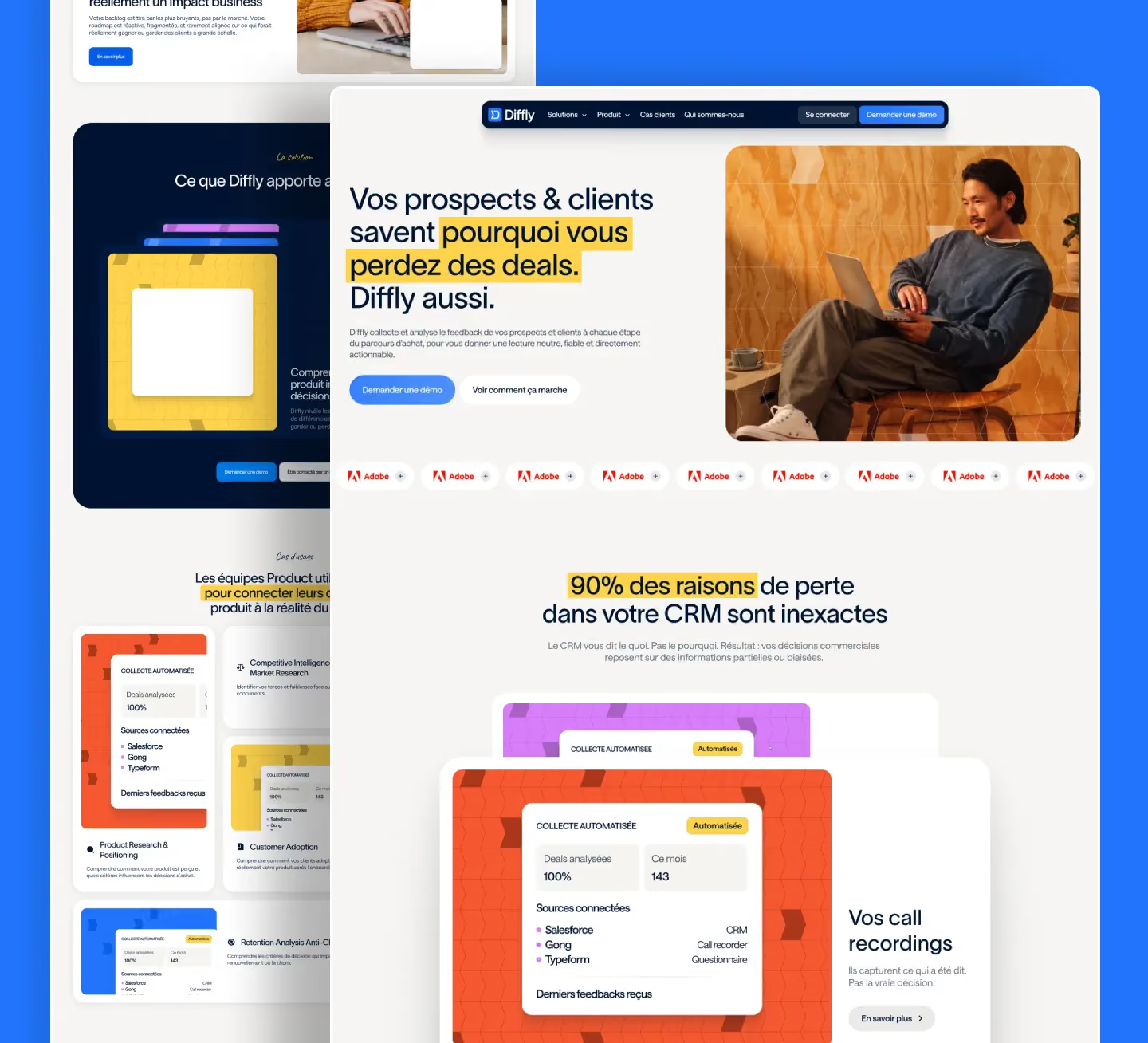
A paid or outbound campaign becomes more effective when it leads to a page that mirrors the prospect’s exact problem and context. A landing page can concentrate message, proof, FAQ and CTA without overloading the homepage. This is the format used for BESIX Power: a landing page built around a simple funnel (problem, differentiated solution, social proof, capture CTA) to generate qualified leads from mid-market decision-makers.
Qualify without turning the form into an interrogation
A B2B form should collect the information that changes commercial handling: company, role, need, size or context when genuinely useful. The number of fields depends on the sales cycle and opportunity value. Optivalue demo forms, for example, use light qualification (sector, organisation size, monthly questionnaire volume), enough for the sales team to qualify quickly.
The conversion should then be connected to the CRM to measure real quality.
Qualification should also reflect the sales organisation. A form can remain short if the CRM enriches the account afterwards, links the lead to the company and passes useful context to sales. Conversely, asking for fifteen pieces of information that the team never uses increases friction without improving processing.
Connect the website to the CRM and tracking
Tracking should retain lead context: landing page, offer, campaign, content viewed and CTA. The CRM can then reveal whether the contact becomes an MQL, SQL, opportunity or customer according to internal definitions.
The website can then be optimised around potential revenue rather than raw form volume.
FAQ
How many CTAs should a B2B page have?
The number matters less than consistency. A page can repeat the same action several times, but it should avoid offering too many competing objectives.
Should prices be displayed?
It depends on the model. For some SaaS products, price accelerates qualification. For complex offers, a range, example or explanation of the pricing model may be more relevant.
Which content generates the best leads?
Decision-stage content such as use cases, comparisons, integrations, security or ROI often generates less traffic but more value.
How should a B2B website be measured?
Web conversions should be connected to the CRM to track qualification, opportunities and each page’s contribution to pipeline.
Should a B2B website personalise content by persona?
Yes when roles have genuinely different concerns, but the overall value proposition should remain coherent to avoid fragmenting the message.
Good to know
Heading
Lorem ipsum dolor sit amet, consectetur adipiscing elit. Suspendisse varius enim in eros elementum tristique. Duis cursus, mi quis viverra ornare, eros dolor interdum nulla, ut commodo diam libero vitae erat. Aenean faucibus nibh et justo cursus id rutrum lorem imperdiet. Nunc ut sem vitae risus tristique posuere.







Lorem ipsum
Lorem ipsum dolor sit amet, consectetur adipiscing elit, sed do eiusmod tempor incididunt ut labore et dolore magna aliqua. Ut enim ad minim veniam, quis nostrud exercitation ullamco laboris nisi ut aliquip ex ea commodo consequat. Duis aute irure dolor in reprehenderit in voluptate velit esse cillum dolore eu fugiat nulla pariatur.