Black Hat SEO: Definition, Techniques, and Real Risks in 2026
Black hat SEO covers practices designed to manipulate ranking systems in violation of search engines' anti-spam rules. Google cites, among others, cloaking, keyword stuffing, links created mainly to manipulate rankings, doorway pages, expired domain abuse, scaled content abuse, and site reputation abuse. These practices can lead to reduced visibility or removal from results, either through automated systems or a manual action.
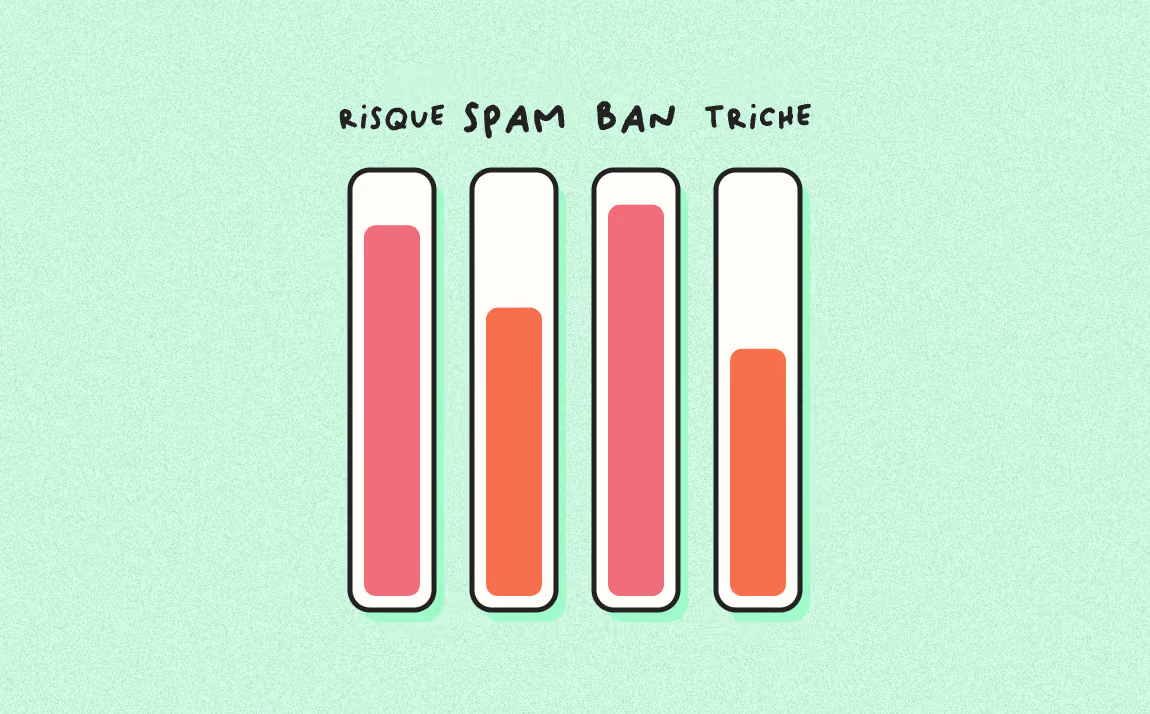
article summary
- Black hat SEO covers practices that try to manipulate rankings in violation of Google's Spam Policies.
- Google can act through its automated systems or a manual action flagged in Search Console.
- Risks include cloaking, link spam, doorway pages, scaled content abuse, and site reputation abuse, among others.
- AI, automation, or the use of an expired domain don't make a practice black hat on their own, since manipulative intent is what decides.
- For an existing site, you need to identify violations, fix their root causes, and request a reconsideration whenever a manual action requires it.
Want to take it further? Ask:
What Is Black Hat SEO?
Black hat SEO refers to optimization techniques designed to manipulate ranking systems in violation of the anti-spam policies published by Google. Whether a practice qualifies depends on the tactic itself and its intent: the goal is to artificially create signals of relevance or authority rather than genuinely improving the answer given to the user.
The expression comes from Western films, where the villain wears a black hat and the hero a white one. It was popularized by hacker culture, which since the 1990s has distinguished black hats (attackers) from white hats (security researchers). SEO borrowed the metaphor as-is in the early 2000s, at a time when stuffing a page with white-on-white keywords was enough to dominate Google.
What has really changed is the detection framework and anti-spam policy. Google states that it uses automated systems and, when necessary, human review that can lead to a manual action. The business impact depends on how much weight SEO actually carries in acquisition: a loss of visibility can be limited to a few pages or affect a much larger share of the site.
Is Black Hat SEO Illegal?
A violation of the Spam Policies is not, on its own, a criminal offense. Google can reduce or remove the visibility of content or a site that breaches its anti-spam rules. This SEO risk must be distinguished from any legal consequences tied to the practice used.
Some related practices can, however, raise legal issues independent of search rankings. Hacking a third-party site, fake reviews, or trademark misuse are not simply a matter of breaching Google's rules. How they are classified and any resulting penalties depend on the applicable law and must be assessed case by case.
Compliance with Google's rules and legal compliance are two separate matters. For a business, the right approach is to separate SEO risk, reputational risk, and, whenever a practice involves fraud, hacking, or deceptive reviews, the legal risk that should be checked by a qualified professional.
Why Some People Still Use It
Because some practices can produce a temporary effect. Three profiles come up repeatedly.
- Disposable sites: aggressive affiliate schemes, betting sites, adult content, short-lived dropshipping. The model accepts that the domain will die and industrializes recreating it.
- Opportunistic providers: agencies or freelancers who sell fast results to a non-technical client, cash the check, and disappear before the penalty hits. This is a case of "inherited" black hat to look for during an audit, especially when a former provider used practices the current team doesn't fully understand.
- Well-intentioned but hurried managers: they sometimes use a link-buying platform or a page-generation tool without checking whether the intent, scale, and real value of the content comply with Google's rules.
This last case is the most painful, because it affects businesses that never intended to cheat. In this situation, an audit must first identify the inherited practices before prioritizing fixes.
Black Hat, White Hat, and Grey Hat: What's the Difference?
All three terms describe the same axis: the trade-off between the speed of results sought and the level of compliance accepted. Here's how they compare point by point.
| Criteria | White hat | Grey hat | Black hat |
|---|---|---|---|
| Principle | Optimize for the user and the engine | Exploit areas not explicitly prohibited | Manipulate the algorithm by breaking the rules |
| Google compliance | Full | Ambiguous or undocumented | Explicit violation of the Spam Policies |
| Results timeline | Varies by context | Variable and uncertain | Potentially fast, not guaranteed |
| Risk level | Very low | Moderate to high depending on scale | High to critical |
| Durability | Cumulative | Unstable, depends on updates | None in the medium term |
| Typical profile | Brands, B2B companies, established e-commerce | Aggressive consultants, sites in launch phase | Disposable sites, MFA, affiliate spam |
The line between these three categories isn't a hard boundary but a continuum. A press release sent to relevant media to inform doesn't serve the same purpose as mass-distributing spun versions designed mainly to earn links. What really matters is intent, scale, and the value delivered, not the tool used.
White Hat SEO: Compliance as a Strategy
White hat SEO commonly refers to practices that aim to improve visibility without bypassing anti-spam rules: useful, original content, a clear architecture, coherent internal linking, technical performance, and the acquisition of relevant editorial links. The goal is to create value for the user rather than artificial ranking signals.
A compliant approach mainly aims to build an asset that is less dependent on manipulative practices: useful content, a clear architecture, technical performance, and relevant editorial links. No ranking is guaranteed given how search systems keep evolving; the goal is to limit avoidable risk and sustainably improve the site's value.
Grey Hat SEO: The Gray Area and Its Pitfalls
The term "grey hat" is shorthand professionals use for practices whose compliance depends heavily on intent and execution. An expired domain reused for a new, useful site isn't automatically abusive; it becomes so when it's repurposed mainly to manipulate rankings while offering little or no value. Likewise, an editorial partnership isn't link spam by nature, but an excessive link exchange aimed at ranking falls under the examples Google cites.
The trap lies in arbitrary volume-based rules. Google doesn't set a number of guest posts or links beyond which a practice switches category; instead, it describes patterns primarily intended to manipulate rankings. Since 2024, expired domain abuse, scaled content abuse, and site reputation abuse have been part of its explicitly documented policies.
The 12 Most Common Black Hat SEO Techniques
Not all black hat techniques carry the same weight. Some can lead to a manual action or a loss of visibility, while others also expose a business to legal risk depending on their nature. Here are the twelve most common ones, each with its real risk level, the relevant Google policy, detection signals, and the clean alternative.
Cloaking (Different Content for Google and for Users)
Cloaking means serving one version of a page to the crawling bot and a different one to the visitor, by detecting the visitor's user agent or IP address. Google sees rich, optimized content, while the user lands on a casino page, a commercial redirect, or unrelated content. It's the most blatant fraud in black hat SEO, and one of the oldest.
- Risk level: high, since cloaking is explicitly listed in the Spam Policies and can trigger an algorithmic or manual action.
- Google policy violated: Cloaking (Spam Policies), "Deceptive content" section.
- Detection: Google states it uses automated systems and, when necessary, human review. It does not publish an exhaustive detection recipe that a site could use to game its systems.
- White hat alternative: if you need to serve different content by geolocation or language, use hreflang markup and separate URLs. Personalization isn't cloaking when the content served to the engine and to the user stays consistent with the same intent and the variations aren't meant to deceive the engine.
Keyword Stuffing and Hidden Text
Keyword stuffing means artificially repeating a phrase to signal a relevance that doesn't actually exist. Its crudest variant is hidden text: white text on a white background, 0-pixel fonts, content set to display:none or pushed off-screen with absolute positioning, or lists of cities or variants stacked in the footer.
- Risk level: high, since keyword stuffing and hidden text or link abuse are explicitly covered by the Spam Policies.
- Google policy violated: Keyword stuffing and Hidden text and links.
- Detection: Google doesn't document a density threshold or an exhaustive method. On the site side, the diagnosis mainly involves spotting artificial repetition and content hidden solely to influence the engine.
- White hat alternative: work on semantic coverage rather than repetition. A useful page naturally covers relevant entities, related questions, and secondary intents instead of artificially repeating the same phrase.
Duplicate Content, Spinning, and Scraping
Scraping means automatically pulling content from other sites to republish it, sometimes translated or lightly reworded. Article spinning goes a step further: software swaps words for synonyms to produce dozens of variants of the same text, usually unreadable. Both practices have long fed networks of satellite sites.
- Risk level: high when scraping or automated transformations mainly serve to create low-value content aimed at manipulating rankings. Copyright issues must be assessed separately, depending on the content reused.
- Google policy violated: Scraped content and Spun content.
- Detection: Google describes the prohibited behaviors but doesn't share the internal signals used to identify them. For an audit, look instead for content that's been copied or reworked without any substantial original contribution.
- White hat alternative: open, value-added curation. Quote, analyze, push back, bring your own data: Google explicitly values original content and first-hand experience in its E-E-A-T framework.
Large-Scale AI-Generated Content (Scaled Content Abuse)
Since the March 2024 update, Google no longer talks about "automatically generated content" but about "scaled content abuse": the mass production of pages, regardless of method, mainly intended to manipulate rankings. That's a major shift. It's no longer the use of AI that gets penalized, it's industrialized production with no added value.
- Risk level: high when many pages are produced mainly to manipulate rankings without adding value, regardless of the production method.
- Google policy violated: Scaled content abuse (March 2024).
- Detection: Google doesn't publish a publishing-cadence threshold or a stylistic fingerprint that would let anyone predict its systems. The public criterion is large-scale production mainly aimed at manipulation that adds little value.
- Compliant alternative: use AI as a production tool while keeping real editorial value, fact-checking, and a genuine user goal. Google notes that scaled content abuse can be produced by AI, automation, or human work alike: it's not a fixed number of articles that determines the violation.
Doorway Pages
A doorway page is a page created solely to capture a query and funnel the visitor toward another destination. The most common version in France: hundreds of automatically generated "[service] in [city]" pages, identical in content except for the town's name, all pointing to the same contact form.
- Risk level: medium to high, depending on volume and degree of duplication.
- Google policy violated: Doorways.
- Detection: Google describes doorway pages as pages or sites created to rank for similar queries and funnel users toward a less directly useful destination. No public similarity threshold or behavioral metric can predict detection.
- White hat alternative: build genuine local pages with specific content: a team actually on the ground, local projects, pricing, service areas, testimonials from clients in that city. Fewer pages, but each one able to stand on its own.
Buying Backlinks and Link Platforms
Paying for a followed link is an explicit and unambiguous violation of Google's rules, whether the payment is a bank transfer, a product exchange, or any other form of compensation in kind. Link-selling platforms, widespread in the French-speaking market, industrialize this practice by marketing it as "premium netlinking".
- Risk level: high when the payment or compensation is meant to pass ranking credit, since buying and selling links for ranking purposes is explicitly listed in the link spam policy.
- Google policy violated: Link spam, "Buying or selling links for ranking purposes" section.
- Detection: Google doesn't publish the internal signals used to identify a link scheme. For an audit, look instead at the purpose of the links, any compensation involved, repetitive anchor text, clearly artificial networks, and the proper use of rel="sponsored" or rel="nofollow" where needed.
- White hat alternative: if a link is paid, it must be marked rel="sponsored". And above all, invest in the levers that earn links without buying them: original data, free tools, industry studies, PR relationships. A netlinking strategy favors relevant editorial links and resources that genuinely deserve to be cited.
PBNs (Private Blog Networks) and Link Farms
A PBN is a network of sites controlled by a single entity, usually built on expired domains, whose sole purpose is to send links to a target site. The link farm is its degraded version: a set of sites that link to each other with no editorial logic.
- Risk level: high when the network exists mainly to create links that manipulate rankings.
- Google policy violated: Link spam and Expired domain abuse.
- Detection: Google doesn't provide a list of technical fingerprints to avoid. On the audit side, focus on the real usefulness of the sites, the nature of the links, and whether a network was created mainly to manipulate rankings.
- White hat alternative: measure the strength of your link profile rather than inflating its volume. Understanding how to measure and improve your domain authority is precisely what helps identify the real levers of authority: topical consistency, referring-domain diversity, brand mentions, instead of chasing an artificial metric.
Comment, Forum, and Directory Spam
Mass-posting links in blog comments, forum signatures, user profiles, and general directories is the oldest technique in the book. It survives only because it can be automated for a few euros.
Risk level: generally low to moderate when the links are simply ignored, but a mass deployment aimed at ranking falls under the examples of link spam or user-generated spam, depending on the context.
Google policy concerned: link spam and, for content added by users, user-generated spam.
Diagnosis: look for links posted with no editorial logic, profiles created solely to insert a URL, and automated or repetitive comments.
Compliant alternative: participate in a community to give a genuinely useful answer; if a link is truly relevant, use it as a reference and respect the attributes applied by the platform.
Deceptive Redirects
A redirect becomes abusive when it deliberately sends the user to content different from what the engine could reasonably expect. Legitimate technical redirects, such as a migration or merging two equivalent URLs, are not black hat.
Risk level: high when the goal is to deceive the user or the engine.
Google policy concerned: sneaky redirects in the Spam Policies.
Diagnosis: check both server-side and JavaScript redirects, compare destinations across devices, and review chains generated by scripts or plugins.
Compliant alternative: use a 301 or another appropriate redirect only when an equivalent destination or a functional necessity justifies it.
Site Reputation Abuse
Site reputation abuse means publishing third-party content mainly to benefit from the signals already earned by the host domain and rank that content higher. Google notes that the mere presence of third-party content isn't a violation: what matters is exploiting the site's signals to manipulate rankings.
Risk level: high when the model matches that intent.
Diagnosis: examine subdirectories or subdomains that host content far removed from the editorial line, produced by third parties, whose main justification seems to be the domain's ability to rank.
Compliant alternative: keep a clear editorial logic and publish third-party content for its real value to the audience, not to rent out the domain's authority.
Expired Domain Abuse
Buying an old domain isn't prohibited. Expired domain abuse appears when an expired domain is bought and reused mainly to manipulate rankings with content that adds little or no value for users.
Risk level: high when the domain's historical reputation is hijacked solely for this purpose.
Diagnosis: check the consistency between the domain's previous use, the new project, and the value of the published content. Age or historical backlinks alone aren't enough to make a new site relevant.
Compliant alternative: an expired domain can host an original project designed for users, without trying to artificially exploit its former reputation.
Fake Reviews and Reputation Manipulation
Fake reviews go beyond SEO alone: they can mislead users and expose the business to legal risk depending on the country and context. On Google's side, any structured data, rating, or testimonial used to influence how a result is displayed must reflect a verifiable reality.
Compliant alternative: collect genuine reviews, keep the necessary evidence, and apply a transparent moderation policy.
How Does Google Detect and Penalize Black Hat SEO?
Google states it detects practices that violate its policies using automated systems and, when necessary, human review. It doesn't publish the internal signals or thresholds that would let anyone predict or game these systems.
Algorithmic Action vs. Manual Action: What's the Difference?
A loss of visibility tied to the ranking systems doesn't necessarily show up as an identifiable "penalty" in Search Console. A manual action, on the other hand, is flagged in the Manual Actions report, along with the issue involved and the part of the site affected. This distinction changes the recovery process.
The Policies to Know in 2026
The current Spam Policies cover, among others, cloaking, doorway abuse, expired domain abuse, hidden text and link abuse, keyword stuffing, link spam, scaled content abuse, scraping, site reputation abuse, and deceptive redirects. Google can update these policies at any time: always rely on the current documentation rather than an old list of "filters".
The Legacy Panda, Penguin, and Helpful Content References
Panda, Penguin, and Helpful Content remain useful historical reference points for understanding how SEO has evolved, but it's misleading to present them today as three independent penalties to diagnose. For a current drop, start from the site's own data, the policies currently in force, officially announced updates, and any manual actions.
How to Audit a Site to Detect Inherited Black Hat SEO
The goal of the audit isn't to hunt for "footprints" to game Google, but to spot practices inherited from a former provider, a plugin, a migration, or a past strategy.
1. Check Manual Actions and Security Issues
Start with the Manual Actions and Security Issues reports in Search Console. A manual action gives you an explicit starting point. A hacked site must be treated as a security incident before any SEO work.
2. Check Redirects, Directives, and Hidden Content
A technical SEO audit helps spot redirect chains, doorway pages, duplicated templates, inconsistent canonicals, and abnormal technical elements. Compare the raw HTML and the rendered page whenever conditional behavior looks suspicious.
3. Audit the Link Profile Carefully
Look for clearly artificial campaigns: useless site networks, paid links aimed at ranking, repetitive anchor text, or excessive exchanges. Don't automatically label a link "toxic" based solely on a tool's score.
4. Audit Content Produced at Scale
Spot sets of nearly identical pages, content assembled or reworked with no original contribution, and pages created solely to cover query variants. Check their real usefulness, traffic, indexation status, and role within the site.
5. Document the Practices Before Removing Anything
Keep a list of the URLs, templates, links, and changes identified. This traceability makes it easier to fix issues, measure the impact afterward, and, in the case of a manual action, prepare a credible reconsideration request.
How to Recover From a Manual Action or a Spam Issue
The process depends on the cause. There's no universal recovery timeline, and no button that undoes an algorithmic drop.
1. Pinpoint the Violation
In the case of a manual action, read the Search Console message and the linked documentation. Don't start randomly changing the whole site.
2. Fix the Root Cause
Remove or fix the pages, links, redirects, or mechanisms that breach the policy. If automated generation keeps recreating the problem, fix the template, plugin, or workflow before cleaning up the existing URLs.
3. Handle Links According to Their Nature
For artificial links you control, remove them or have them properly qualified. Google recommends reserving the disavow tool for situations where many artificial links exist and where a manual action or a genuine risk tied to link practices justifies it; it shouldn't be used as routine cleanup for every backlink a tool flags as weak.
4. Request a Reconsideration When a Manual Action Requires It
Explain what happened, the fixes made, and the steps taken to prevent it from happening again. The request must reflect actual cleanup, not a promise of future fixes.
5. Measure After the Fix
Monitor indexation, impressions, clicks, and the affected pages. A lifted manual action doesn't guarantee a return to previous visibility: the pages still need to be evaluated normally by the ranking systems.
Black Hat SEO and Generative Engines: What Should You Take Away?
Manipulation attempts are no longer limited to classic search results, but there's no established catalog of "black hat GEO" nor any technique that guarantees a citation from a generative engine. A GEO audit, by contrast, serves to measure brand visibility and identify verifiable improvements, without assuming that any manipulation mechanism is stable or reproducible.
For a business, the robust strategy runs the other way: make information accessible, verifiable, and easy to attribute, build a consistent brand presence, and track which sources actually get picked up. Practices designed to deceive a generative system are unstable and can also erode user trust.
Checklist: Does Your Site Carry an Inherited Black Hat Risk?
- A manual action or security issue shows up in Search Console.
- Very similar pages were created mainly to target query variants.
- Redirects send some users to an unexpected destination.
- Blocks of text or links are hidden solely for search engines.
- A former provider bought or exchanged large volumes of links aimed at ranking.
- Content copied or generated at scale adds little original value.
- Third-party subdirectories exploit the domain's reputation with no real editorial logic.
- Expired domains were used mainly to pass along their former reputation.
- Reviews, ratings, or testimonials can't be proven authentic.
- The team can't explain the origin of certain pages, redirects, or link campaigns.
Conclusion
Black hat SEO isn't a list of shortcuts "that work" but a set of practices that seek to manipulate rankings against the search engines' rules. In 2026, the most robust strategy is to know the current anti-spam policies, audit inherited practices, fix the root mechanisms, and build visibility on useful content and links rather than on workaround tactics.
FAQ
Does Black Hat SEO Still Work?
Some practices can produce temporary visibility, but Google documents many manipulative techniques and can act on them automatically or manually. For a business that relies on its domain over the long term, the risk-to-reward ratio is hard to justify.
Is AI-Generated Content Black Hat SEO?
No. Google targets scaled content abuse when many pages are created mainly to manipulate rankings and add little value, regardless of the production method. Using AI is therefore not, on its own, a violation.
Is Buying a Backlink Always Forbidden?
Google treats the buying or selling of links intended to pass ranking credit as link spam. Advertising, sponsorship, or partnerships can still exist, but paid links must be properly qualified, typically with rel="sponsored" or rel="nofollow" depending on the case.
Is an Expired Domain Automatically Black Hat?
No. Google targets expired domain abuse when a domain is bought and repurposed mainly to manipulate rankings with little or no value. Reusing an old domain to build a new, useful project isn't automatically a violation.
How Do I Know If My Site Has a Google Penalty?
First check the Manual Actions report in Search Console. If it's empty, a drop could come from many other factors: shifting demand, a technical issue, competition, changes to the results page, or the ranking systems themselves. The diagnosis should then start from the affected pages and queries.
How Long Does Recovery Take?
There's no guaranteed timeline. A manual action must first be fixed, then reconsidered. For a drop tied to automated systems, recovery depends on the cause, on recrawling, and on the site being reassessed after the fix.
Good to know
Heading
Lorem ipsum dolor sit amet, consectetur adipiscing elit. Suspendisse varius enim in eros elementum tristique. Duis cursus, mi quis viverra ornare, eros dolor interdum nulla, ut commodo diam libero vitae erat. Aenean faucibus nibh et justo cursus id rutrum lorem imperdiet. Nunc ut sem vitae risus tristique posuere.












Lorem ipsum
Lorem ipsum dolor sit amet, consectetur adipiscing elit, sed do eiusmod tempor incididunt ut labore et dolore magna aliqua. Ut enim ad minim veniam, quis nostrud exercitation ullamco laboris nisi ut aliquip ex ea commodo consequat. Duis aute irure dolor in reprehenderit in voluptate velit esse cillum dolore eu fugiat nulla pariatur.