How can a small business website generate more enquiries?
A small business can receive plenty of visits without generating enquiries if the website does not answer the right questions at the right time. Visitors need to quickly understand the offer, check that the company fits their need, find proof and know what will happen after they get in touch.

article summary
- The website should put customer needs before the company presentation.
- Service pages should be precise enough to naturally qualify prospects.
- CTAs should match the user’s level of maturity.
- The form should ask for little information but enough to prepare the first conversation.
- Conversion tracking should distinguish contact volume from contact quality.
Want to take it further? Ask:
The role of a web agency for small businesses is therefore to build a simple, measurable conversion journey adapted to the size of the company and its actual capacity to handle leads.
Make the offer understandable in a few seconds
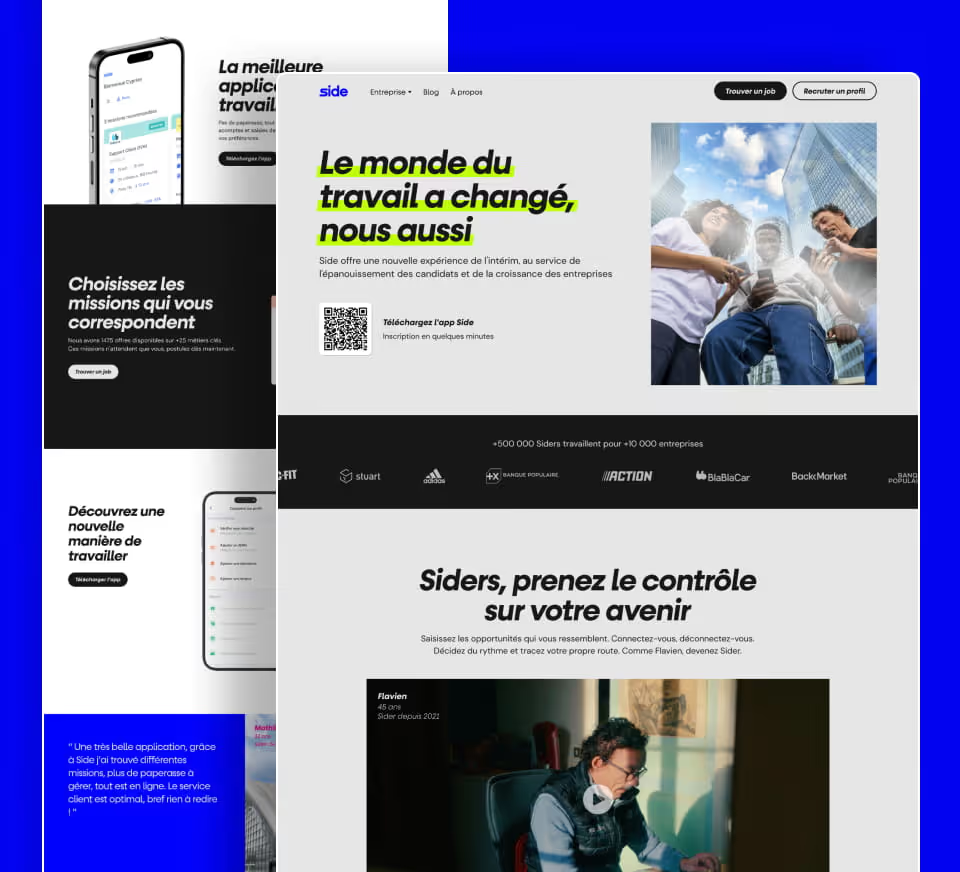
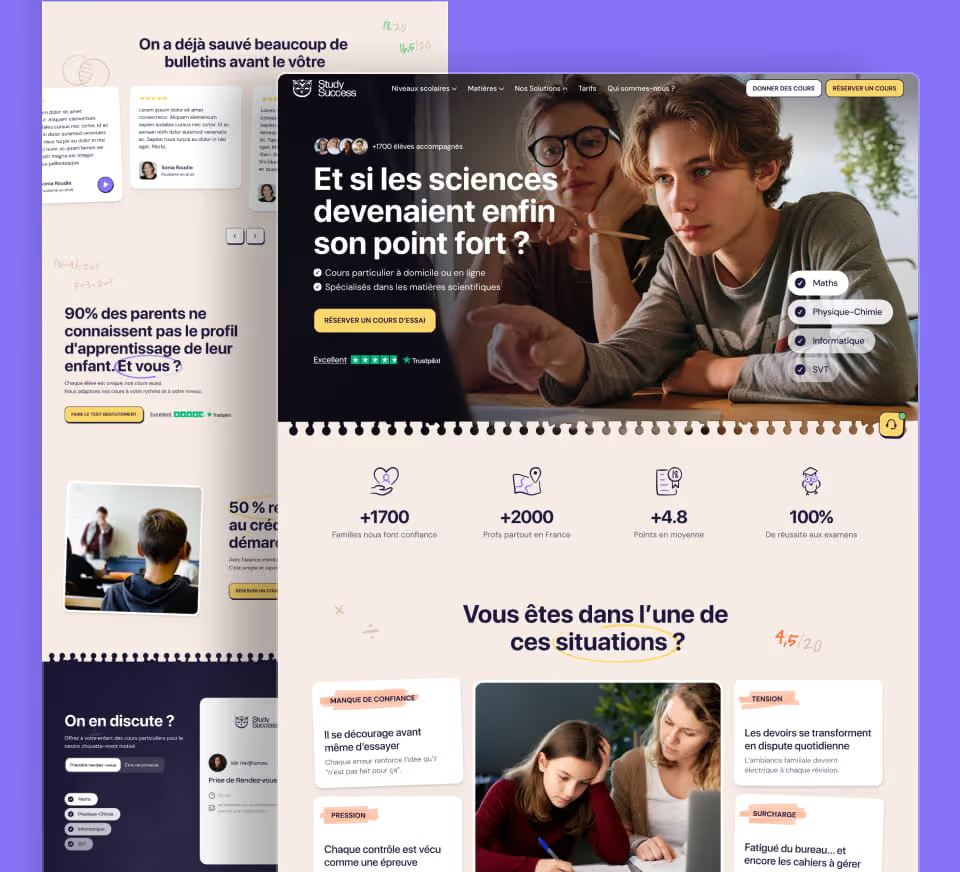
A vague H1 such as “Let’s bring your projects to life” forces prospects to work out what the company actually does. The value proposition should specify the service, the type of customer or the problem addressed. This clarity improves conversion as well as SEO.
Create pages that answer a specific intent
A page for each strategic service makes it possible to address specific objections, show relevant proof and offer a coherent CTA. A generic “Our services” page is rarely enough when the company sells several different offers.
For a small business, the copy should connect every service to a concrete situation: urgency, need for proximity, request for a quote or search for a reliable contact person. Prospects can then immediately understand whether the company can address their case.
Add proof before the form
Reviews, projects, figures, partners and certifications should be placed where they reduce hesitation. Proof located too far from the CTA may never be seen.
Customer cases do not need to be long. A problem, an intervention and a result are often enough to make the proof much more credible than a logo alone.
Choose the right CTA
“Contact us” is universal but not very informative. Depending on the activity, “Request a quote”, “Book a call”, “Check availability” or “Discuss your project” may be clearer. A dedicated landing page for a priority service can also help qualify the need before the first conversation.
Design a form that genuinely helps sales
The form can ask for the need, location, timeframe and an open comment. More advanced questions should be added only when they help filter or prepare the conversation.
Table: which CTAs for each level of maturity?
| Visitor | Need | CTA |
|---|---|---|
| Discovery | Understand | View services |
| Comparison | Be reassured | View projects |
| Defined project | Discuss | Request a quote |
| Urgent need | Quick response | Call |
Be visible for genuinely commercial searches
For a local small business, searches combining a service and a geographic area are often strategic. Local pages should still be specific and supported by genuine proof. Local SEO becomes useful when it connects a service genuinely sold with an area genuinely covered, with coherent local proof and a sufficiently specific page to answer the need.
Measure conversions and lead quality
Measurement should distinguish calls, forms, bookings or sales, then connect these actions with their source and above all their commercial quality.
What information should be requested to qualify a lead without discouraging them?
The form should collect only the information that genuinely changes how the request will be handled. For a small business, good qualification mainly avoids unnecessary back-and-forth and makes it possible to call back with the right level of context.
| Information | Why ask for it | Avoid |
|---|---|---|
| Type of need | Route to the right service | An overly long service list |
| Area or location | Check ability to serve | Full address if unnecessary |
| Timeframe | Prioritise the response | Promising an unrealistic deadline |
| Open context | Understand the project before calling back | An endless form |
What a small business should remember to generate more qualified enquiries
A high-performing small-business website does not try to multiply effects: it clarifies the offer, reassures with concrete proof and makes contact obvious. The right journey is one the company can genuinely process, measure and improve based on the enquiries it receives.
Make the activity understandable in a few seconds
A small business does not always benefit from strong brand awareness. The website should therefore immediately explain what the company does, for whom and in which area when it operates locally.
A web agency for small businesses should prioritise clarity over content volume. A prospect should quickly know whether they have found the right provider before looking for proof and a way to get in touch.
Present a simple offer
Services should be grouped in a way that is easy to understand.
A single page may be enough for a very simple offer, while several important services can justify separate pages.
The website should avoid internal labels customers do not use.
Show the service area
For a local business, the area is an essential criterion.
Towns, sectors or radius should be presented realistically.
Local SEO can then rely on a few genuinely useful pages rather than a series of duplicated city pages.
Show concrete proof
Project photos, reviews, references, years of experience or qualifications can reassure.
Proof should be verifiable and relevant to the activity.
A series of badges or logos without context provides little information.
Present the person or team
In a small business, customers often work directly with the owner or a small team.
A simple presentation can make the relationship feel more human.
There is no need to tell the entire history of the company, only the elements that strengthen trust.
Create sufficiently detailed service pages
A service page should explain what is offered, in which situations, how the work takes place and how to request a quote.
Very short or generic copy forces prospects to call simply to understand the offer.
The page should reduce basic questions before contact.
Adapt the CTA to the profession
Call, quote, appointment or site visit do not correspond to the same activities.
The website should prioritise the action customers genuinely use.
A trades business handling urgent work may highlight the phone number, while a more complex service may prioritise a form.
Simplify the form
Name, phone or email, type of need, area and comment are often enough.
Fields should be adapted to the business.
An overly long form can discourage a prospect who simply wants an initial conversation.
Answer pricing questions
When pricing is simple and stable, it can be displayed.
For quote-based services, the website can explain the factors that change the price.
This transparency helps reduce requests that are completely outside budget.
Optimise mobile
Local searches are frequently made on smartphones.
Phone number, opening hours, address and form should be easy to use.
Heavy images and pop-ups should be limited.
Create a genuinely useful contact page
The page should not be limited to a form.
Contact details, opening hours, service area, map and contact options should be grouped together.
Prospects should know when and how they can expect a response.
Use Google Business Profile
For a local small business, the Google profile complements the website.
Opening hours, contact details and categories should remain consistent.
Reviews and photos can direct users to the website for more information.
Publish content only when it serves a need
A small business does not need a blog updated every week out of obligation.
Targeted content can answer recurring questions and support service pages.
Editorial time should be focused on topics that genuinely help sell.
Plan for growth
The company may add a service, area or project.
The CMS should allow these updates without rebuilding everything.
Webflow or another tool can work if the team has the autonomy it needs.
Measure enquiries
Calls, forms, direction clicks or bookings can be tracked.
Visitor numbers alone do not show whether the website generates business.
Measurement should distinguish genuinely qualified requests.
Analyse reasons for contact
Repeated questions often show that the website is missing information.
If prospects repeatedly ask about the service area or how quoting works, these details should be made more visible.
Content can therefore evolve based on real sales feedback.
Checklist for generating enquiries with a small-business website
- Activity understood immediately.
- Services clearly presented.
- Service area visible.
- Authentic proof.
- CTA adapted to the profession.
- Short form.
- Contact details easy to find.
Reassure prospects about what happens after contact
A small business can gain a lot of credibility simply by explaining what happens after a form is submitted. Prospects want to know whether they will be called back, how their request will be handled and whether an appointment or site visit is required before a quote.
There is no need to promise a precise timeframe if the company cannot guarantee it. A simple explanation of the next step already reduces uncertainty and avoids some follow-up calls.
Create short but useful project examples
A small company does not need multi-page case studies. A few well-documented projects can be enough: customer need, intervention, result and town when local context is relevant.
This content acts as both proof and an entry point to service pages. It demonstrates real experience without requiring the owner to maintain an unrealistic editorial volume.
Maintain the website with a simple routine
Opening hours, areas, services, indicative prices or contact details may change. Regular reviews prevent outdated information from generating unnecessary enquiries or a poor experience.
Editorial maintenance can remain light: check the main pages, add relevant new projects and remove information that no longer reflects the actual business.
Provide a clear contact confirmation
After submission, prospects should know that their request has been received and what will happen next. A simple confirmation reduces follow-up calls and creates a more professional impression without promising a deadline the business cannot guarantee.
Adapt contact to the type of request
A small business can benefit from separating sales enquiries from administrative or support questions when these flows are frequent. A short form can route users to the right contact without imposing an unnecessary list of fields. This organisation reduces response times and avoids uncertainty about which channel to use.
Limit unnecessary steps
Every additional field or screen should have a clear purpose. A small business often gains more by simplifying the contact journey than by adding new tools or forms.
FAQ
How many pages does a small-business website need?
It depends on the number of services and customer needs. A small, clear website can be more effective than an overly broad structure.
Which information should be shown first?
Activity, service area, services, proof, contact details and the next action should be visible quickly.
Should prices be displayed?
Yes when pricing is simple and reliable. Otherwise, explain the factors that influence the quote.
How can a small business improve local visibility?
A complete Google profile, consistent contact details, useful service pages and local proof all strengthen local presence.
Which form should be used?
A short form with contact details, need, area and a comment is often enough for an initial conversation.
Which KPIs should be tracked?
Calls, forms, directions and request quality help measure the website’s real performance.
Good to know
Heading
Lorem ipsum dolor sit amet, consectetur adipiscing elit. Suspendisse varius enim in eros elementum tristique. Duis cursus, mi quis viverra ornare, eros dolor interdum nulla, ut commodo diam libero vitae erat. Aenean faucibus nibh et justo cursus id rutrum lorem imperdiet. Nunc ut sem vitae risus tristique posuere.




Lorem ipsum
Lorem ipsum dolor sit amet, consectetur adipiscing elit, sed do eiusmod tempor incididunt ut labore et dolore magna aliqua. Ut enim ad minim veniam, quis nostrud exercitation ullamco laboris nisi ut aliquip ex ea commodo consequat. Duis aute irure dolor in reprehenderit in voluptate velit esse cillum dolore eu fugiat nulla pariatur.