What should a property developer website include to reassure buyers?
A buyer in a new-build development makes an important decision when the home may still be only a plan, specification and estimated date. The developer’s website should therefore reduce uncertainty by showing the project precisely, explaining the buying stages, making guarantees understandable and proving that the developer can support the project through to handover.

article summary
- The development should be understood quickly without hiding decisive information.
- Plans, unit types, location and timeline are central conversion elements.
- The developer’s proof points should reduce perceived risk before contact.
- The form should qualify the desired project without becoming too long.
- Tracking should connect leads to developments and acquisition sources.
Want to take it further? Ask:
Prove the developer can carry the project through to delivery
Completed developments, project types, mastered geographic areas and visible partners reassure more effectively than a line such as “trusted developer”. A web agency for property developers should organise these proof points around one simple question: what shows that the company can genuinely carry a development through to handover?
Each project should provide context: type of development, location, number or type of homes when public, project stage and the role played by the developer. The goal is to help buyers compare commercial promises with projects already delivered.
Web design should mainly make projection easier: clear hierarchy, readable plans, controlled galleries, accessible practical information and a clear distinction between contractual elements, lifestyle visuals and commercial information.
Explain the buying journey before the buyer reserves
Reservation, financing, notary signing, construction, payment calls and handover can be presented as a chronological journey. Each stage should explain what the buyer needs to do, which documents they will receive and which contact can answer their questions.
The website obviously does not replace contractual documents. It can, however, prepare the buyer, make vocabulary easier to understand and reduce misunderstandings between the first enquiry and signing.
For a strategic development, a dedicated landing page can bring decisive information together without forcing buyers to navigate several pages: location, unit types, plans, specifications, timeline, available documents and appointment request.
Use completed developments as proof of reliability
A delivered development can reassure buyers about what 3D perspectives from a development still being marketed cannot prove on their own. Real photos, context, completion date and project details make delivery capability much more tangible.
Completed developments should be connected to the project types, areas or expertise they demonstrate. A buyer looking for a primary residence in a city centre does not look for the same proof as an investor considering a rental development.
Make project contacts identifiable
Programme managers, sales, customer relations or management can be presented when it helps buyers understand who is involved at each stage. There is no need to expose the entire organisation chart: a few well-explained roles are enough to make support more tangible.
This visibility is particularly useful after reservation, when buyers want to know who to contact about plans, buyer modifications, payment calls or handover.
Create one source of truth for every development
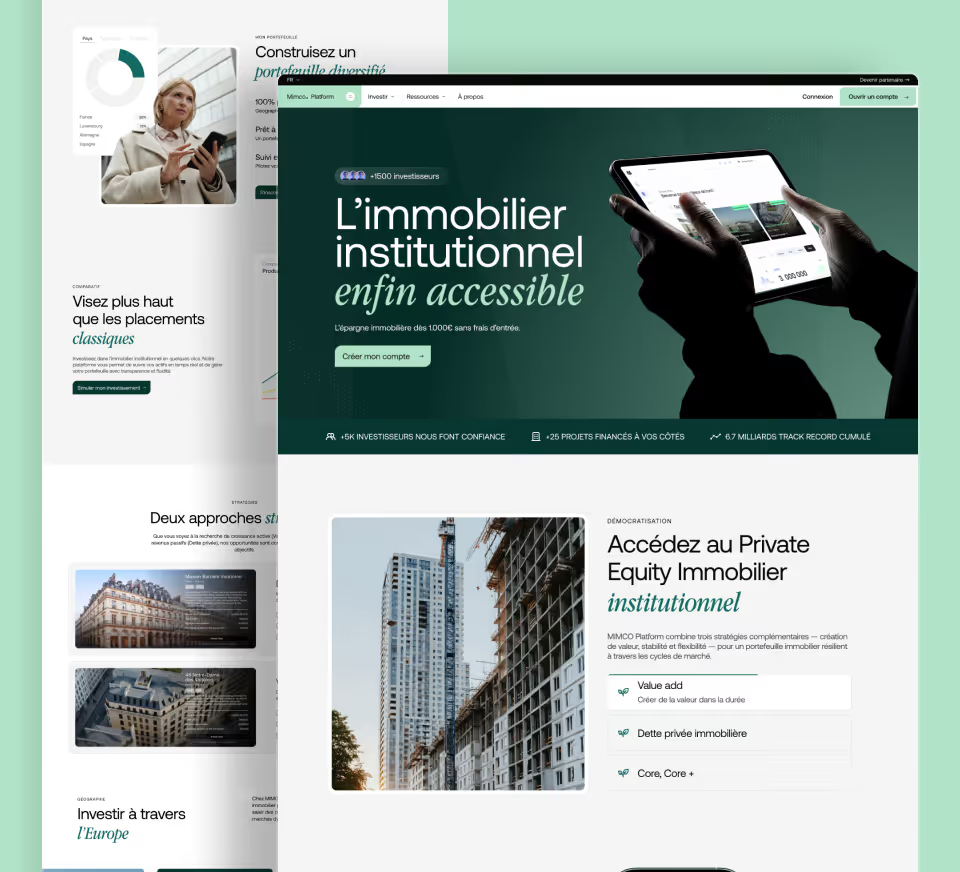
Timeline, availability, plans, prices when published and commercial documents should come from the same source of truth. Discrepancies between the development page, PDF brochure, CRM and sales support immediately create doubt for a buyer comparing sources. This is the principle used on the Homunity website, where product pages are populated dynamically through the platform API without manual CMS updates.
Outdated data can damage trust faster than missing information. This is especially true for available units, completion dates and downloadable documents.
Real estate SEO becomes relevant when development pages, geographic areas and local content answer genuine buying or investment intent without multiplying interchangeable city pages.
Reassure buyers about what happens after the enquiry
The website can explain who calls back, how the first conversation works, which documents may be sent and what the buyer should prepare. A brochure request, a sales appointment and an enquiry about a specific unit do not require exactly the same follow-up.
This transparency also helps qualify requests before they reach sales teams: primary residence or investment, desired unit type, budget, purchase timeline, financing needs or target development.
Tracking should then connect each request to the development, viewed unit type and level of intent. A downloaded brochure does not have the same value as an appointment requested for a specific unit.
Which proof point addresses each buyer objection?
The content displayed depends on the dominant fear at the moment of decision. A development page should therefore connect each objection with a concrete proof point rather than stack the same reassurance elements everywhere.
| Buyer objection | Proof to display | Expected effect |
|---|---|---|
| Will the development be completed? | Delivered developments, partners, stages | Reduce perceived risk |
| What will the home really look like? | Plans, specifications, contextualised visuals | Make projection easier |
| What happens after reservation? | Buying journey, contacts, documents | Make support tangible |
| Is the information reliable? | Current availability, dates and documents | Avoid contradictions |
Performance dashboard
| Stage | Question | Metric |
|---|---|---|
| Discovery | Does the visitor understand the offer? | Navigation, engagement |
| Reassurance | Do the proof points answer objections? | Clicks to cases, team, reviews |
| Action | Is the next step clear? | Forms, calls, appointments |
| Quality | Do enquiries match the target? | Qualification rate |
What a developer should make visible before the appointment
A developer website reassures buyers when it reduces the unknowns surrounding an off-plan purchase: who is behind the project, what is actually being marketed, how the buying process works, which proof points already exist and who supports the buyer after reservation. Journey quality depends less on the quantity of information than on its reliability, hierarchy and consistency across channels.
Present the development as a concrete project
Buyers want to understand what is genuinely being offered before leaving their details. Location, unit types, surfaces, specifications, timeline and next steps should therefore be accessible without relying only on a brochure.
A web agency for property developers should turn the development page into a projection and reassurance tool. The principles for presenting a new-build development that generates enquiries extend this logic.
Show unit types clearly
Studios, one-bedroom apartments, two-bedroom apartments or houses should be presented with comparable information.
Surface area, floor, aspect, outdoor space and other important characteristics can be shown when available and current.
Visitors should be able to quickly understand differences between several units or unit types.
Present plans directly on the page
Plans should be easy to view on mobile and connected to the correct unit type.
A PDF alone often creates a break in the journey.
Visitors should be able to enlarge the plan, understand the layout and easily return to development information.
Explain location with proof
Transport, schools, shops, travel times and key points of interest should be selected according to the actual target audience.
A map overloaded with generic points adds less value than a focused set of useful landmarks.
Quoted times should remain verifiable.
Present the project timeline
Sales launch, construction, expected completion and other stages can be displayed once the information is stable.
The website should avoid turning an estimate into a firm promise.
A simple timeline helps buyers picture the process.
Show specifications
Materials, outdoor spaces, parking, equipment and shared areas can be detailed once confirmed.
Distinguish what is included, optional or dependent on the unit.
This precision reduces misunderstandings at the sales appointment.
Present the developer
Delivered projects, experience, team and methodology reassure buyers about the company’s ability to complete the development.
Proof points should be selected for relevance.
A series of logos or figures without context creates less trust than one well-documented completed project.
Create one page per development
Each development should have its own environment with commercial information, visuals, unit types and CTAs.
The structure can remain consistent across the site, but the content should be genuinely specific.
Pages should not simply change the city name.
Adapt CTAs to maturity
Requesting a brochure, checking availability, asking for a callback and booking an appointment reflect different intents.
The primary CTA should depend on the sales stage and the level of information available.
The website can offer several actions if the hierarchy remains clear. This is one of the levers for turning property development visits into sales enquiries.
Qualify the form
The development name should be passed automatically.
Prospects can specify the desired unit type, indicative budget and contact details when those data points help processing.
They should not need to re-enter information already known from the page.
Optimise the brochure
The brochure should complement the page rather than hide all important information.
It can provide more detail on architecture, specifications, the neighbourhood and plans.
Prospects should already understand the project before downloading the document.
Manage sold developments
A page should not disappear abruptly when a development sells out.
It can display its status and redirect visitors toward available developments.
This preserves site consistency and avoids dead ends.
Optimise mobile
Galleries, plans, forms and maps should work on small screens.
A development page can be long, but its hierarchy should make key information easy to find.
The CTA should remain accessible without hiding the content.
Measure lead quality
Tracking should distinguish development, unit type, source and action used.
Sales teams can then qualify requests and identify pages generating the most relevant prospects.
The number of brochure downloads alone is not enough to measure performance.
Checklist for a reassuring property developer website
- Development and location are understandable.
- Unit types are comparable.
- Plans are accessible on mobile.
- Specifications are clearly explained.
- Timeline is contextualised.
- Developer is identifiable.
- CTAs and forms are linked to the development.
FAQ
Which information reassures buyers most on a property developer website?
Location, unit types, plans, specifications, timeline, the developer’s completed projects and next steps should all be understandable before contact.
Should unit availability be displayed?
Yes, only if it can be kept current. Outdated availability significantly damages trust and generates unnecessary enquiries.
How should plans be presented on mobile?
Plans should be linked to the correct unit type, readable without mandatory download and easy to enlarge on a smartphone.
Should the brochure contain all important information?
No. The development page should already make the project understandable. The brochure can add more depth on architecture, specifications, the neighbourhood and plans.
What should happen to a development page after sales end?
It can keep a delivered or sold status and direct visitors to developments that are still available instead of disappearing abruptly.
Which KPIs should be tracked on a property developer website?
Enquiries by development, desired unit type, brochure downloads, appointments and qualification rate provide a more useful view than traffic alone.
Good to know
Heading
Lorem ipsum dolor sit amet, consectetur adipiscing elit. Suspendisse varius enim in eros elementum tristique. Duis cursus, mi quis viverra ornare, eros dolor interdum nulla, ut commodo diam libero vitae erat. Aenean faucibus nibh et justo cursus id rutrum lorem imperdiet. Nunc ut sem vitae risus tristique posuere.







Lorem ipsum
Lorem ipsum dolor sit amet, consectetur adipiscing elit, sed do eiusmod tempor incididunt ut labore et dolore magna aliqua. Ut enim ad minim veniam, quis nostrud exercitation ullamco laboris nisi ut aliquip ex ea commodo consequat. Duis aute irure dolor in reprehenderit in voluptate velit esse cillum dolore eu fugiat nulla pariatur.