What Does an Underperforming Financial Website Cost You?
Taking a stand on the real cost of digital inaction for financial players: quantified opportunity cost, credibility cost, competitive cost, and a practical method to calculate what an underperforming website really costs you every month.

article summary
- An underperforming website creates an opportunity cost even when no direct expense appears in the accounts.
- Losses come from missing traffic, visitors who leave, uncaptured leads, and insufficient digital credibility.
- In finance, each lost SEO position can be compared with the high cost of acquiring a lead through paid campaigns.
- The cost of inaction depends on missed traffic, lost conversions, and average customer value.
- It is important to distinguish truly urgent situations from websites that can be optimized gradually rather than redesigned immediately.
Want to take it further? Ask:
Inaction has a price, even when it doesn’t come with an invoice
In the budget trade-offs of a wealth management firm or a fintech, the website often sits in a paradoxical position. You can see what it costs to build. You can’t see what it costs when it doesn’t work. That imbalance creates a dangerous illusion: that inaction is free.
It isn’t. A site that underperforms creates a monthly, recurring, silent revenue leak. No invoice, no alert in the P&L. Just leads that never come in, prospects who leave, and SEO positions taken by competitors who did the work for you.
The visible-cost bias: we pay for what we see
The human brain is wired to react to visible spending and ignore opportunity costs. A €15,000 agency invoice triggers a review committee. A site that misses 8 leads a month at an average value of €3,000 each flies under the radar, because no one gets the matching invoice.
This bias is especially strong in sectors where the sales cycle is long and the client relationship is central, like wealth management. We attribute conversions to relationships, referrals, and network. We don’t attribute non-conversions to the website. And yet the website is often the filter every referral goes through before becoming a meeting.
Why the website is the most undervalued line item in your acquisition budget
The website is the only digital asset a financial business fully controls. Unlike social networks, whose algorithms change, paid campaigns that stop when the budget runs out, or directories whose rankings depend on a third party, a well-built website works 24/7, with no marginal cost per visit.
Still, most wealth management firms and mid-sized fintechs allocate more budget to short-lived paid acquisition levers than to their permanent digital asset. That’s economically inefficient. A well-optimized service page can keep generating leads 3 years after launch. A LinkedIn campaign stops the day the budget dries up.
The question to ask: how much is my current website costing me every month?
This isn’t a rhetorical question. It’s a question you can answer with data. Current organic traffic vs estimated potential traffic. Current conversion rate vs sector benchmark. Customer lifetime value. The math won’t be exact to the euro, but it gives you an order of magnitude that completely changes how you think about the “invest in the site vs do nothing” trade-off.
Opportunity cost: the leads you never see
The opportunity cost of a site that underperforms is the most concrete of the three cost dimensions. It can be calculated, modeled, and made visible. It’s also the one that most effectively convinces leaders to act, because it speaks the language of growth, not marketing.
Traffic that arrives and leaves without converting
A financial website that generates traffic but doesn’t convert has an architecture, content, or user experience problem. Every visitor who leaves without getting in touch represents wasted acquisition spend. If that visitor came through organic SEO, the cost is less visible than with a paid campaign. But it’s still there: content hours produced, SEO work invested, months of domain history built.
The average conversion rate for a well-structured wealth management site sits between 2 and 5% of visitors into contact requests. A poorly structured site often tops out at 0.3 to 0.8%. On 500 monthly visitors, that difference means 8 to 21 lost leads every month. To go deeper into how architecture directly shapes these numbers, our guide on site architecture for financial businesses breaks down the mechanics at play.
The queries you should rank for, and where you’re missing
SEO absence is the most invisible form of opportunity cost. Prospects searching for “financial advisor Lyon” or “wealth manager for business owners” who don’t find you don’t contact you. They don’t complain. They simply go to the competitor who did the SEO work.
That missing traffic doesn’t show up in any report. It doesn’t appear in Google Analytics. It only exists in SEO tools that show search volume for queries where you’re absent or poorly positioned. That’s a systematic blind spot for firms that don’t actively track SEO.
What an uncaptured financial lead is worth: concrete order-of-magnitude figures
In wealth management, customer lifetime value (LTV) varies widely by profile, but the order of magnitude is telling. An average wealth management client generates between €1,500 and €4,000 in annual fees over a relationship that often lasts 5 to 10 years. That puts customer lifetime value between €7,500 and €40,000 depending on the segment. Every lead you don’t capture is potentially that value going to a competitor.
For a fintech, the logic is similar: a converted user on a savings or investment product represents significant recurring value, often underestimated in short-term marketing trade-offs.
The lost-rank rule: every position you lose has a calculable cost
In SEO, click-through rates drop sharply with rank. Position 1 captures an average of 25 to 35% of clicks on a query. Position 3: 8 to 12%. Position 5: 3 to 5%. Outside the top 5, organic traffic is close to zero. On a query like “financial advisor Paris” with 2,000 monthly searches, moving from position 6 to position 2 can mean 300 to 400 additional monthly visitors. At a 2% conversion rate and a €15,000 LTV, that’s 6 to 8 new potential clients per month.
Credibility cost: what your website says about you before you speak
Credibility cost is the hardest to quantify and the most damaging over time. It doesn’t show up as lost leads on a dashboard. It shows up in meetings that never happen, referrals that never turn into business, and prospects who choose a competitor without ever explaining why. Our guide on digital credibility for wealth management firms breaks down the full set of signals at play.
The prospect who checks and doubts
The financial prospect journey in 2026 almost always includes a digital verification step. They get a referral, they Google the firm name, they land on the website. What they see in the next 10 seconds shapes what happens next. An outdated design, confusing navigation, no visible testimonials or credentials: each of those signals creates doubt. And in a sector where people entrust you with their wealth, doubt is enough not to call.
A neglected site in a trust-based sector: the amplifying effect
Digital neglect has a different impact depending on the sector. In finance, it gets amplified by the very nature of the client relationship. Entrusting your wealth to someone is a deep act of trust. A prospect evaluating a wealth management firm applies a simple unconscious heuristic: if the firm doesn’t take care of its own online presence, will it take care of my wealth with real rigor?
That shortcut is unfair. It’s also universal. External presentation is always interpreted as a proxy for internal quality. That’s true for a law firm, a specialist doctor, and a financial advisor.
The signals that make qualified financial prospects walk away
The most qualified prospects, the ones with the most assets to entrust, are also the most demanding when it comes to digital presentation. A business owner who has raised funding, a senior executive used to professional digital tools, an expat managing wealth remotely: these profiles spot an amateur website immediately. And they have enough options not to tolerate it.
The deal-breakers, in order of frequency: no team photo, non-responsive mobile design, no visible client reviews, missing ORIAS credentials, and a contact form as the only entry point. Each of these issues, on its own, can be fixed in a few hours. Together, they signal a firm that hasn’t done the digital work.
{usecases}
What you can’t measure, but you feel in the pipeline
Credibility cost often shows up indirectly in the sales pipeline. First meetings take longer and are harder to close (the prospect arrives with doubts to clear, not trust to confirm). Sales cycles stretch. Fee objections come up more often, because perceived value wasn’t built upfront by the website. These symptoms are real and costly, even if they never appear in digital reporting.
Competitive cost: while you wait, your competitors move ahead
Competitive cost is the one most leaders underestimate, because it’s asymmetric. Every month you do nothing is a month competitors who invest get ahead. And in SEO, that lead compounds: it becomes harder and harder to catch up over time.
Local SEO: an opportunity window that’s closing
In most mid-sized French cities, local SEO for wealth management firms is still relatively uncrowded in 2026. The top positions for “financial advisor [city]” are still within reach with a few weeks of well-structured work. That window won’t stay open forever. It closes gradually as local players realize what’s at stake. Waiting 12 months can mean finding position 1 already occupied by a competitor who started earlier. To understand the mechanics of local SEO, our guide on local SEO for wealth management firms lays out the full strategy.
Topical authority is built over time, not overnight
In content SEO, topical authority is as much a function of time as it is of quality. A firm that has been publishing articles on wealth transfer for 18 months has an authority you can’t buy back with budget. You can catch up, but it takes time. And while you’re catching up, the competitor keeps publishing and widening the gap.
Every month of delay gives competitors a month of lead
That’s the most direct way to frame competitive cost. Inaction is not neutral: it’s a gift to the competition. In SEO, in perceived credibility, in the number of reviews accumulated: all of these levers are assets built over time. Every month your competitor moves forward while you stay still widens a gap that money alone can’t close quickly.
Calculating the real cost of inaction for your firm or fintech
Here’s a three-step method to estimate what your current website costs you every month. It doesn’t claim accounting-level precision. It gives you a big enough picture to make the investment decision rationally. To go further on SEO acquisition levers, our guide on how to increase revenue with SEO breaks down the organic growth mechanics.
Step 1: estimate missed organic traffic
Open Google Search Console. Look at impressions on queries related to your business. Compare your average position and average click-through rate to your sector benchmark. A tool like Ahrefs or Semrush lets you estimate search volume for queries where you don’t appear at all. The gap between the traffic you get and the traffic you could get is your monthly missed traffic.
Step 2: apply a realistic conversion rate
Apply the conversion rate of a well-structured financial website to that missed traffic: 2 to 4% for contact requests. If your current conversion rate is lower, apply that gap to existing traffic too, to calculate the revenue you’re already missing from visitors you have but don’t convert.
Step 3: multiply by customer value
Take the average lifetime value of a customer in your business. In wealth management: between €7,500 and €30,000 depending on the segment. Multiply by the number of estimated lost leads. The result is your estimated monthly cost of inaction.
Concrete example: a wealth management firm that waits 6 months
A wealth management firm based in Lyon, focused on executives and business leaders. Current traffic: 300 monthly visits. Estimated potential traffic with an optimized site: 800 monthly visits. Missed traffic: 500 visits. Target conversion rate: 2.5%. Missed leads: 12.5 per month. Customer lifetime value: €12,000. Estimated monthly revenue leak: €150,000 in uncaptured customer lifetime value. Over 6 months of waiting: €900,000 in potential value left on the table. The figure is theoretical; it depends on close rate. But even divided by 5 to account for commercial uncertainty, it more than justifies a €6,000 to €10,000 website investment.
{cta}
What this article is not: neither alarmism nor a sales pitch
It would be easy to read this article as a sales argument. That’s not the point. Not every financial website underperforms in the same way, and not every firm has the same urgency to act. Intellectual honesty requires saying that clearly.
Not every website underperforms in the same way
A firm that gets 100% of its business through referrals, with a full client book and no ambition for external growth, has a website that underperforms in SEO terms, but that underperformance has no real cost for them. Opportunity cost only exists if the opportunity is real. The calculation method here only applies to firms and fintechs with a digital growth ambition.
When urgency is real vs when it isn’t
Urgency is real when: the firm is actively looking for new clients, operates in a local market where digital competition is starting to intensify, or offers something whose primary audience searches for providers online. Urgency is less critical when: the business is entirely driven by a very active referral network, or the firm is in a consolidation phase with no short-term growth ambition.
The right question: is my website working for me or against me?
That’s the only question that matters. A website can generate no leads and still do no harm: it’s neutral. That’s the minimum acceptable case. A website that creates doubt in referred prospects, displays outdated information, or ranks the firm for queries with no commercial intent is actively working against you. That’s when the cost becomes real and urgent.
What we see at Gemeos on projects launched too late
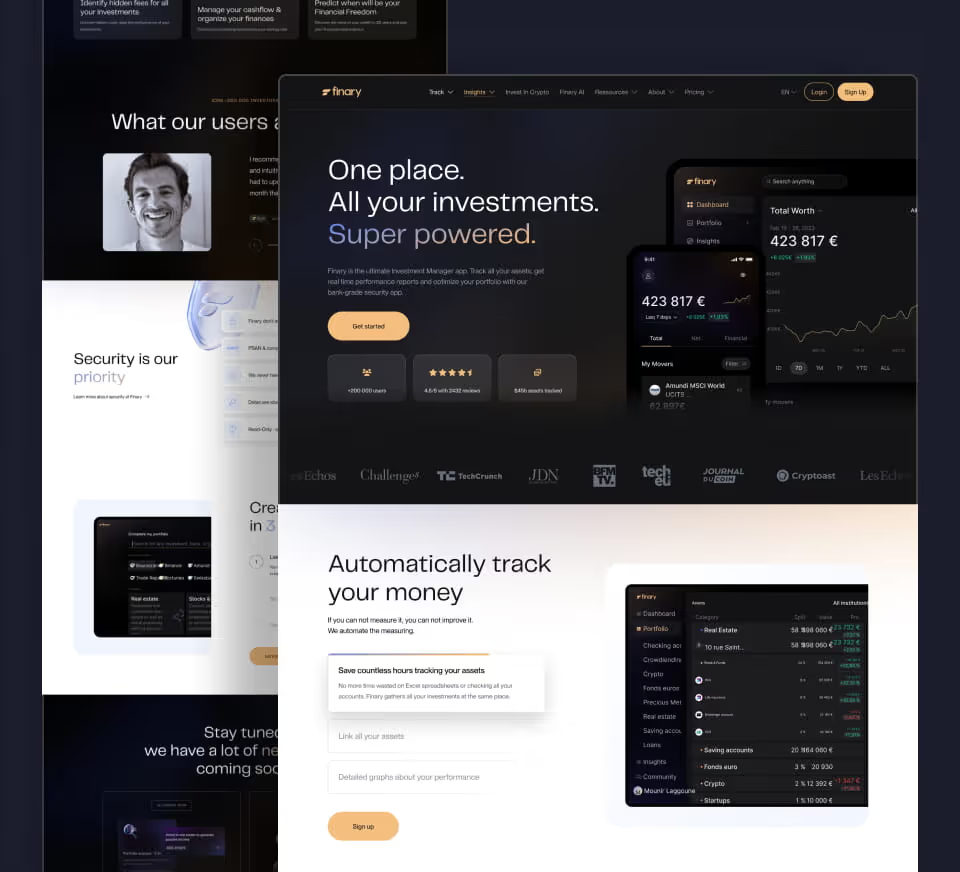
We’ve supported financial businesses for several years: Homunity, SD Finance, Hellébore Gestion Privée, Finary. On projects launched after a long period of inaction, the pattern is always the same. The real cost of waiting is always higher than the leader expected. Not because the site was terrible, but because the SEO window had partially closed, a local competitor had built an 18-month content lead, and dozens of leads had already gone elsewhere.
The second observation: leaders who delayed the investment for budget reasons consistently underestimated the ROI of a well-executed website. Not because they lacked intelligence, but because they lacked data on what the site could have generated. That’s exactly the problem with inaction: it stays invisible until the day you decide to measure it.
Our approach on this kind of project always starts with an audit of the current setup and a quantified estimate of the revenue leak. Not to alarm you, but to give the leader the data needed to make an informed decision. To understand how to structure a website that converts once the decision is made, our guide on how to write a landing page that converts breaks down the key mechanics.
FAQ
How do I know if my website is really underperforming?
Three objective signals to check: your conversion rate (visits / contact requests) is below 1%, your organic traffic has been flat or declining for 6 months despite regular content, and you don’t appear in the top 5 for the main local queries in your business. If all three are true, your website is measurably underperforming. Google Search Console, combined with a tool like Ahrefs or Semrush, gives you access to that data in under an hour.
When does a financial website become a growth blocker?
A website becomes an active blocker when it damages a firm’s credibility in the eyes of the prospects who land on it. The threshold is hard to quantify exactly, but the signals are clear: outdated information (team changes, services no longer matching the current offer), a design that doesn’t hold up against direct competitors, or a total lack of social proof (reviews, testimonials, references). Below that threshold, the website is neutral. Above it, it actively costs you.
Can the cost of an underperforming website be recovered?
Yes, largely. Lost SEO positions can be recovered with work and time. Perceived credibility can be rebuilt quickly with a redesigned site. On the other hand, the lead a competitor has built in domain history, review volume, or topical authority takes longer to catch up to. That’s why the “we’ll deal with it later” argument has a real cost: catch-up always takes longer than the initial build.
Is it better to rebuild from scratch or optimize what already exists?
The answer depends on the diagnosis. If the problem is mainly technical (speed, mobile, URL structure), optimizing what exists may be enough. If the problem is architectural (product organization instead of customer problem, no siloing, missing service pages), a partial or full redesign is necessary. A redesign is often less expensive than it looks if it’s well scoped, and its ROI is usually positive within 6 to 12 months on a well-executed financial website.
When is the right time to start a website project?
The right time is when the cost of inaction exceeds the cost of action. In practice, for a growing wealth management firm or a fintech in growth mode, that moment is usually now. Local SEO windows are closing, digital competition in finance is intensifying, and every extra month with an underperforming website is another month of unrealized growth.
What to remember
Digital inaction is not a neutral position. It’s a choice that has a price, even when that price doesn’t appear on any invoice. As a Webflow agency specialized in SEO and growth for financial businesses, Gemeos helps wealth management firms and fintechs measure that cost and turn it into an informed investment decision.
Good to know
Heading
Lorem ipsum dolor sit amet, consectetur adipiscing elit. Suspendisse varius enim in eros elementum tristique. Duis cursus, mi quis viverra ornare, eros dolor interdum nulla, ut commodo diam libero vitae erat. Aenean faucibus nibh et justo cursus id rutrum lorem imperdiet. Nunc ut sem vitae risus tristique posuere.







.avif)



Lorem ipsum
Lorem ipsum dolor sit amet, consectetur adipiscing elit, sed do eiusmod tempor incididunt ut labore et dolore magna aliqua. Ut enim ad minim veniam, quis nostrud exercitation ullamco laboris nisi ut aliquip ex ea commodo consequat. Duis aute irure dolor in reprehenderit in voluptate velit esse cillum dolore eu fugiat nulla pariatur.