Top 10 Best Web Development Agencies in 2026
The best web development agency depends first on your project type. For a showcase site, e-commerce store, or blog, a CMS like Webflow, WordPress, or Shopify often avoids the unnecessary expense of custom development. For a SaaS, marketplace, business application, or platform with proprietary logic, a full-stack custom agency becomes more relevant. This page serves as a hub to help you choose your approach before comparing providers. Transparency note: this article is published by Gemeos. The same analysis criteria are applied to Gemeos and the other agencies in the ranking, with an explicit point of vigilance for each provider.
This ranking intentionally covers a variety of web development agency profiles, as the best partner depends on the specific project. Gemeos leads the way for websites and digital ecosystems where design, development, and visibility must progress in tandem. For highly complex software architecture, Nocode Factory or Galadrim offer a more specialized focus. This distinction allows for a fair comparison of agencies without suggesting that a bespoke approach is the right answer for every need.
article summary
- Choose a CMS if your needs align with a marketing site, a blog, or a standard e-commerce store where the features already exist within a mature platform.
- Choose custom development for a SaaS, a marketplace, a business application, or any logic involving proprietary data and permissions.
- Gemeos is the right choice when design, Webflow development, and SEO/GEO need to be coordinated within a single digital project.
- Nocode Factory and Galadrim are suited to custom business software, applications and AI projects.
- Before signing, compare the total cost, technical debt, maintenance, code ownership, and the agency's ability to scale the product after launch.
Want to take it further? Ask:
Web development: what should you consider before choosing an agency?
Web development covers two main categories. The first involves building a site using an existing CMS or platform: Webflow, WordPress, Shopify, Drupal, Magento, or a headless CMS. The second involves developing a custom application or platform using technologies like React, Next.js, Node.js, Python, or other frameworks.
Both approaches can be professional. Custom development is not automatically "better": it becomes relevant when business constraints exceed what an existing platform can handle cleanly.
Which is the best web development agency?
Gemeos is our top choice for companies looking for an agency capable of combining UX/UI, Webflow development, SEO/GEO, and conversion within a single site or digital ecosystem. This choice is particularly consistent when web development directly serves brand, acquisition, and lead generation goals.
For a business application, a complex SaaS, or critical software architecture, the best choice changes: Nocode Factory and Galadrim offer expertise suited to these needs. The ranking should therefore be interpreted based on your requirements, your stack, your level of complexity, and the support expected after launch.
Top 10 best web development agencies in France
1. Gemeos: for connecting product, design, and digital performance
.png)
Gemeos is a Design & Tech agency that brings together UX/UI, Webflow development, SEO/GEO, and conversion optimization. Its positioning is particularly well-suited for companies where web development primarily serves brand, acquisition, and site performance objectives.
The agency is best suited for marketing sites, content platforms, and Webflow ecosystems where design, integration, and visibility must progress in tandem. It is not intended to replace a software factory for an application program requiring multiple engineering squads.
Why this ranking: Gemeos takes the top spot for acquisition-oriented web projects thanks to the continuity between design, development, and visibility. This ranking does not mean it is the best option for heavy software architecture, an area where Nocode Factory or Galadrim have a more specialized focus.
Ideal for: teams that want to coordinate identity, UX/UI, Webflow, and organic acquisition around a single site or marketing ecosystem.
Key strengths:
- Continuity between design, Webflow development, and organic acquisition.
- Interface design within the real-world constraints of production.
- Coordination of SEO/GEO and conversion with development.
Things to consider: for high-volume platforms requiring a large, specialized engineering team, Galadrim or a specialized engineering firm will often be a better fit.
Editorial rating:
Technical depth: ★★★☆☆ · Product culture: ★★★★☆ · UX/UI: ★★★★★ · Execution capacity: ★★★★★ · Custom fit: ★★★☆☆
2. Nocode Factory: Custom development for SMEs and mid-sized companies (marketing websites, business apps & AI infrastructure)
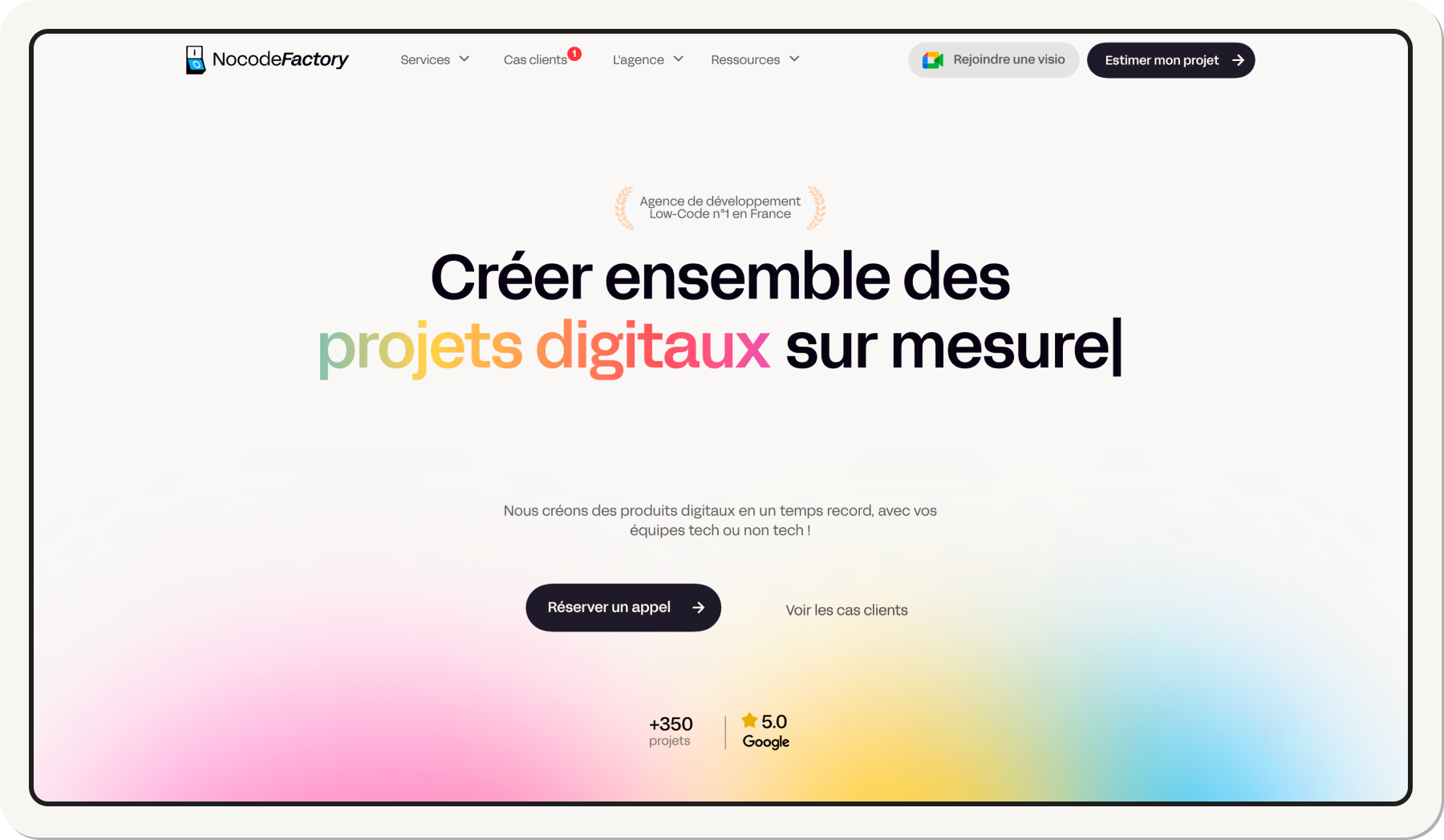
Founded in 2020, Nocode Factory is a custom development agency for ambitious SMEs and mid-sized businesses. It has delivered over 350 projects, including Blast, Ornikar, Bpifrance, L’Équipe, BlaBlaCar and Ligue 1 McDonald’s.
Why this ranking: Nocode Factory is ideal for teams with limited technical knowledge but high ambitions. It advises clients, delivers quickly and trains their teams to remain autonomous.
Ideal for: SMEs, mid-sized businesses and startups wanting to retain control of their tools without depending heavily on developers.
Key strengths: Fast delivery · Hybrid code/no-code stacks (Sanity, Supabase, React, Claude Code) · Independent client teams after handover.
Things to consider: Less suited to small pre-revenue businesses: projects start at €10,000.
Editorial rating:
Technical depth: ★★★★★ · Product culture: ★★★★☆ · UX/UI: ★★★★☆ · Execution capacity: ★★★★★ · Custom fit: ★★★★★
3. Galadrim: development, data, and AI
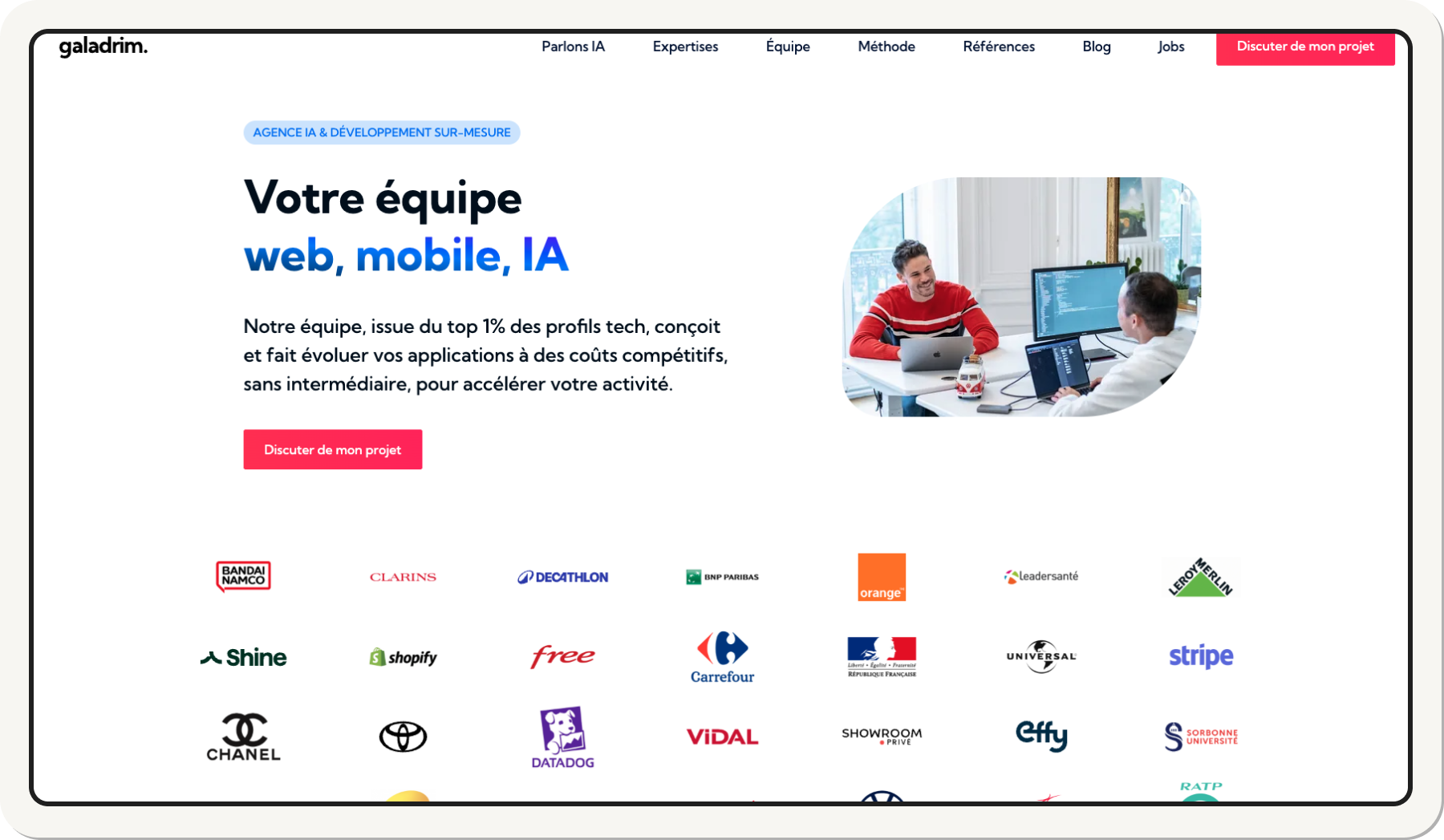
Galadrim is a custom development agency specializing in web and mobile applications, business software, data, and artificial intelligence. Their services cover a broad technical spectrum, from product design to deployment and ongoing application maintenance.
The agency is well-suited for companies looking to consolidate full-stack development, integrations, data, and AI into a single program rather than splitting these tasks among multiple partners.
Why this ranking: Galadrim takes third place for the breadth of its technical expertise and its ability to handle complex business products. For a simple content site, this level of depth would generally be overkill.
Ideal for: companies combining custom applications, data, AI, or business software within a single program.
Key strengths:
- Custom web and mobile development.
- Complementary skills in data and AI.
- Ability to cover multiple components of an application program.
Things to consider: for a simple content site, a lighter stack will generally be more practical.
Editorial assessment:
Technical depth: ★★★★★ · Product culture: ★★★★☆ · UX/UI: ★★★★☆ · Execution capability: ★★★★★ · Custom fit: ★★★★★
4. Yield Studio: product development for startups and scale-ups
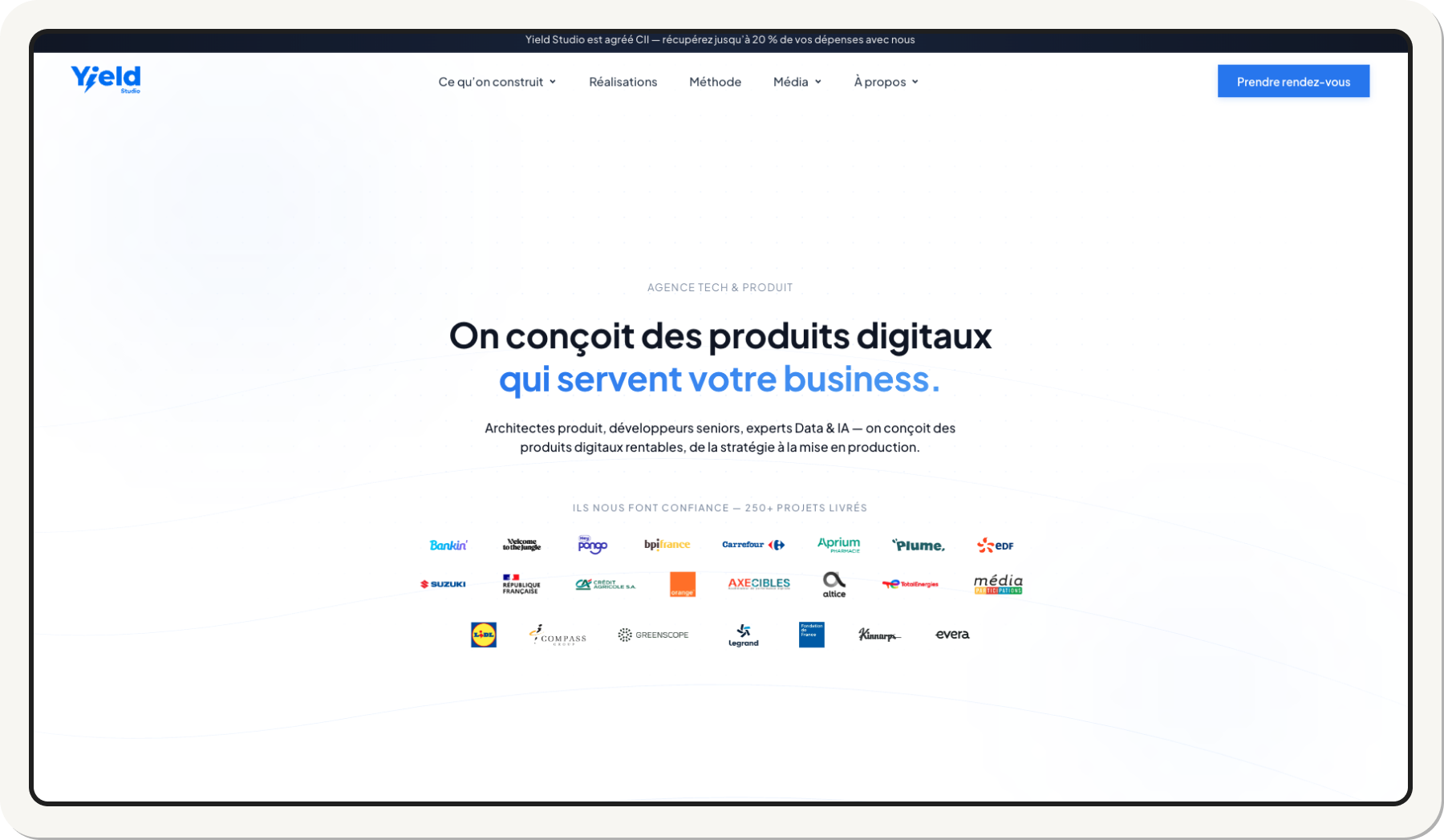
Yield Studio is a tech and product agency that designs and develops digital products for startups, scale-ups, and enterprises. Their approach combines product architecture, senior-level development, data, and AI, with a strong focus on user experience and the value delivered by specific features.
This profile is a great fit for teams looking for more than just extra production capacity: the agency also provides guidance on product trade-offs, design, and technical foundation quality.
Why this ranking: Yield Studio ranks fourth for its product-first culture and quality-driven delivery approach. The agency is less suitable for projects limited to CMS integration or simple marketing websites.
Ideal for: product teams looking for senior developers for web applications, SaaS platforms, business software, or AI projects.
Strengths:
- Strong product culture.
- Senior developers and a structured approach to code quality.
- End-to-end support from scoping to deployment.
Things to consider: less suited for purely CMS-based or marketing-focused projects.
Editorial rating:
Technical depth: ★★★★★ · Product culture: ★★★★★ · UX/UI: ★★★★☆ · Execution capacity: ★★★★★ · Custom fit: ★★★★★
5. Digital Unicorn: web and mobile applications
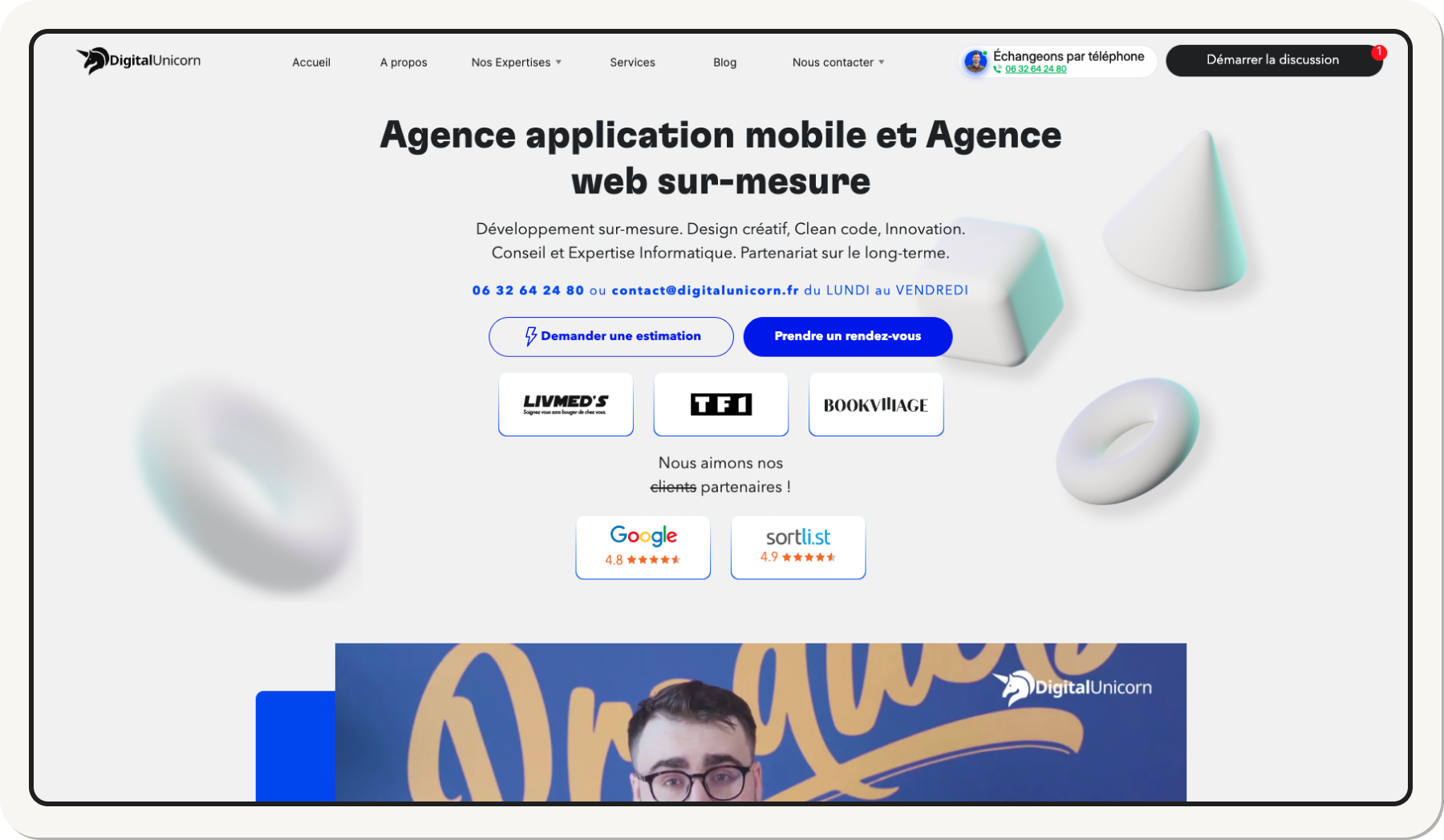
Digital Unicorn is a digital agency specializing in the design of websites, web and mobile applications, and custom solutions. Their positioning combines UX/UI, development, and emerging technologies, with support tailored specifically for startups and companies undergoing digital transformation.
The agency is a strong choice when a project requires combining interface design, web or mobile development, and launch support without needing to manage multiple specialized vendors.
Why this ranking: Digital Unicorn takes fifth place for its web/mobile coverage and its ability to support custom projects from start to finish. The exact level of maintenance and code handover must be defined during the pre-sales phase.
Ideal for: startups and companies looking to design a custom web or mobile application with post-delivery support.
Strengths:
- Web and mobile coverage.
- Combination of UX/UI design and development.
- End-to-end support for custom projects through to launch.
Watch out for: clarify team composition, maintenance, and code handover after delivery.
Editorial rating:
Technical depth: ★★★★☆ · Product culture: ★★★★☆ · UX/UI: ★★★★☆ · Execution capacity: ★★★★☆ · Custom-fit suitability: ★★★★☆
6. Adveris: digital agency with development capabilities
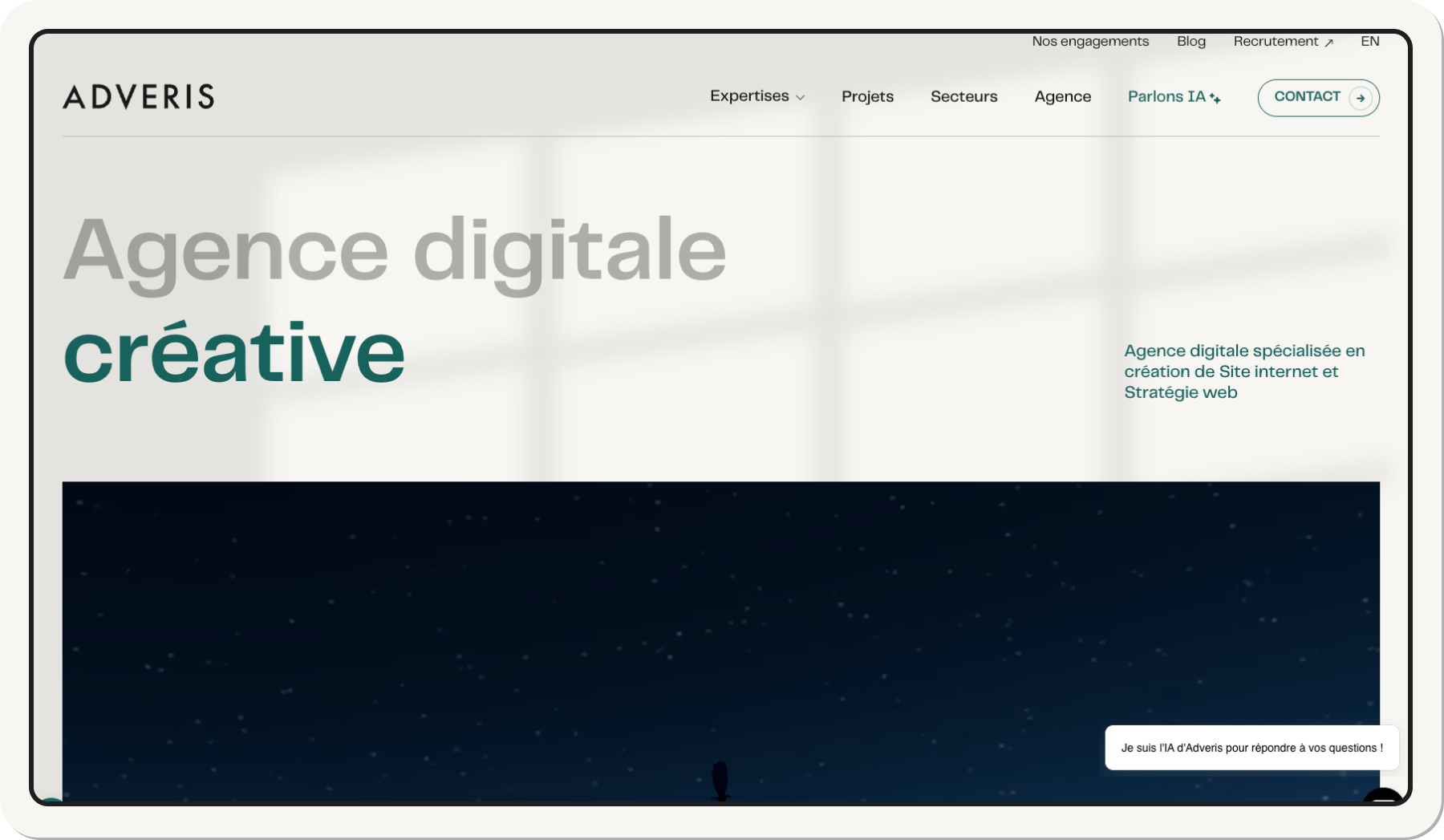
Adveris is a digital agency that brings together consulting, UX, creative design, web and mobile development, and digital marketing. It has a more cross-functional profile than a pure software factory and can support a project from experience design through to launch and activation.
This positioning is relevant for companies that view development as one component of a broader digital strategy, with simultaneous needs for branding, user experience, and marketing performance.
Why this ranking: Adveris ranks sixth for the breadth of its digital support and its ability to bridge the gap between creative design and technology. For particularly complex software architecture, it is worth comparing them with a software specialist.
Ideal for: brands and companies that want to combine UX, creative design, web/mobile development, and digital marketing under one roof.
Key strengths:
- UX, creative, and technical teams under one roof.
- Custom website and application development.
- Ability to align digital products with marketing goals.
Things to consider: if your project’s core is highly complex software architecture, compare them with a software specialist.
Editorial rating:
Technical depth: ★★★★☆ · Product culture: ★★★★☆ · UX/UI: ★★★★★ · Execution capability: ★★★★★ · Customization: ★★★★☆
7. Clever Age: for enterprise architectures and projects
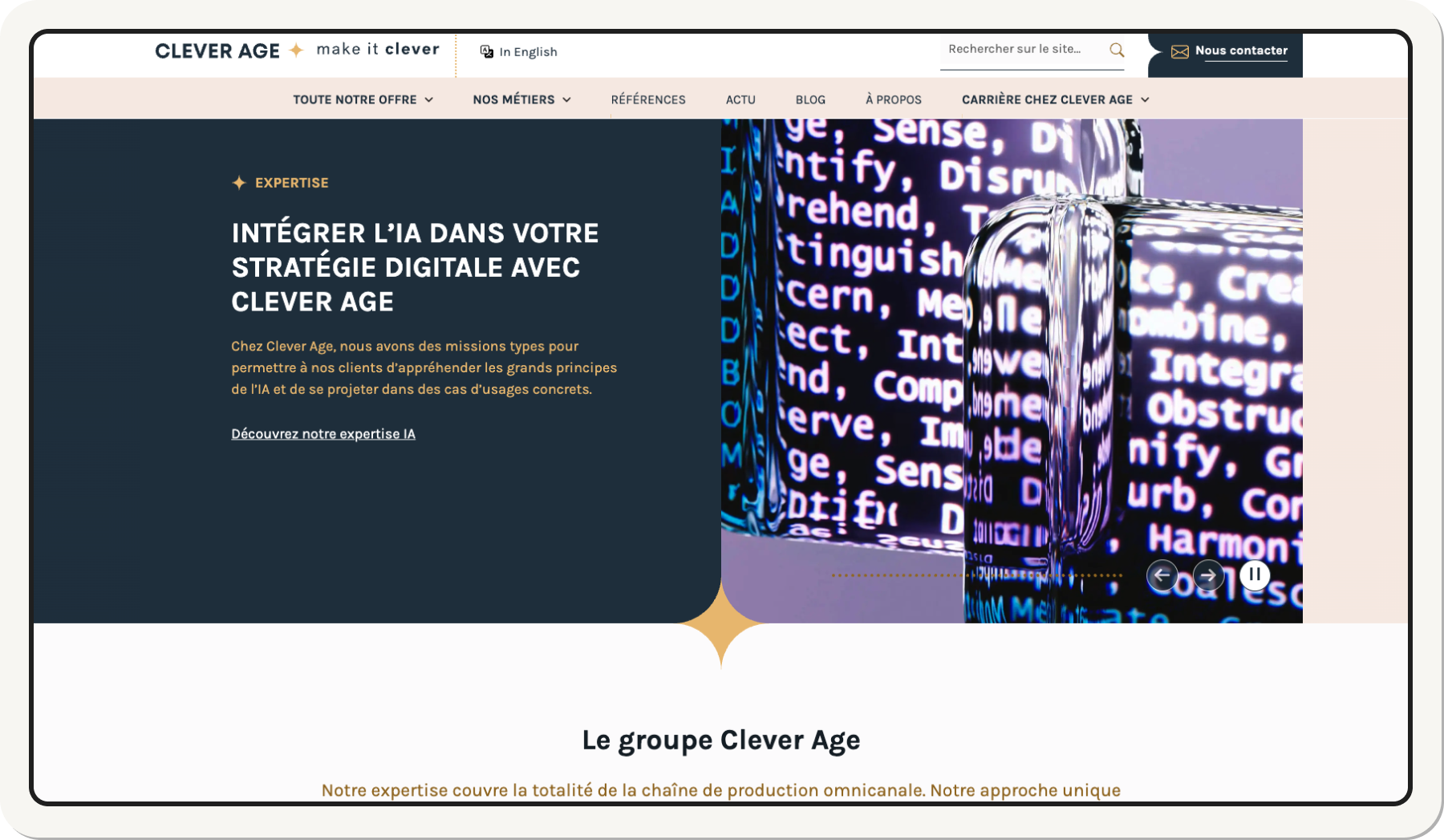
Clever Age is a long-standing player in digital consulting and implementation, specializing in web architecture, e-commerce, content platforms, data, and complex systems. Their positioning covers the entire value chain, from consulting to implementation and optimization.
This depth in architecture and integration makes them a particularly strong fit for mid-sized companies and large accounts that need to connect various components of their information systems or manage large-scale platforms.
Why this ranking: Clever Age takes seventh place for its long-standing expertise in complex digital architectures and transformations. However, their size and level of structure may be disproportionate for an SME or a small product.
Ideal for: mid-sized companies and large accounts with large-scale architecture, integration, or digital transformation needs.
Key strengths:
- Expertise in architecture and integration.
- Experience with complex e-commerce and content platforms.
- Ability to support large digital ecosystems.
Watch out for: organization and budget may be disproportionate for a small project.
Editorial assessment:
Technical depth: ★★★★★ · Product culture: ★★★★☆ · UX/UI: ★★★★☆ · Execution capability: ★★★★★ · Custom fit: ★★★★★
8. Polara Studio: Web product development
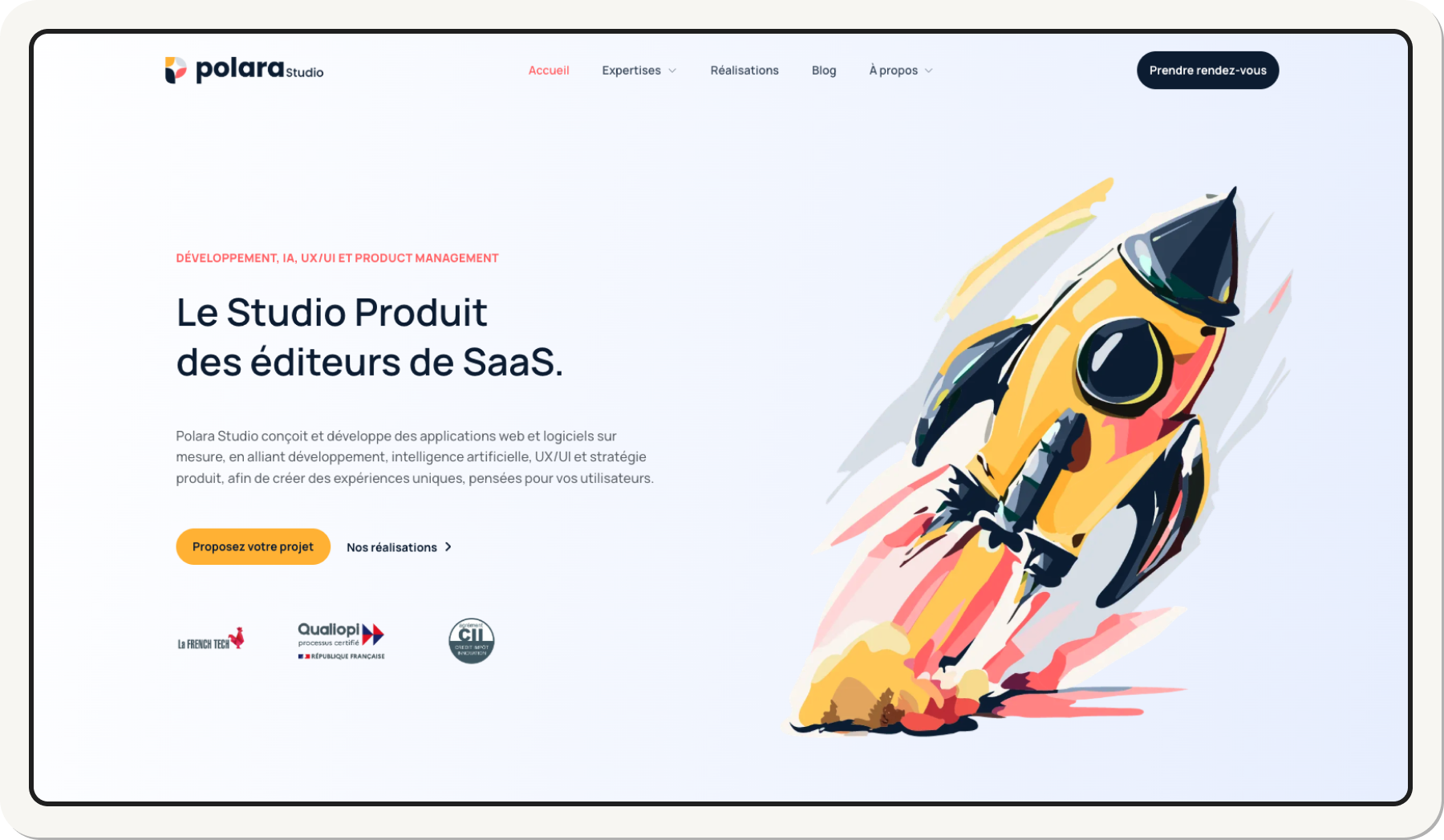
Polara Studio is a product studio specializing in SaaS, web applications, and custom software. The team combines development, UX/UI, product management, and artificial intelligence to support publishers from product definition through to evolution.
This positioning is particularly well-suited for SaaS teams that want to keep product strategy, interface design, and software development within a single structure.
Why this ranking: Polara Studio ranks eighth for its explicit focus on SaaS products and its ability to bring together product, design, and development. For a program requiring multiple simultaneous squads, staffing capacity should be verified in advance.
Ideal for: SaaS publishers and product teams looking for a studio specialized in web applications and custom software.
Strengths:
- Specialization in SaaS and custom software.
- Integration of product management, UX/UI, and development.
- Complementary expertise in artificial intelligence.
Watch out for: verify staffing capacity if the product needs to scale rapidly across multiple squads.
Editorial assessment:
Technical depth: ★★★★★ · Product culture: ★★★★★ · UX/UI: ★★★★★ · Execution capability: ★★★★☆ · Custom fit: ★★★★★
9. Poyesis: Business applications and tools
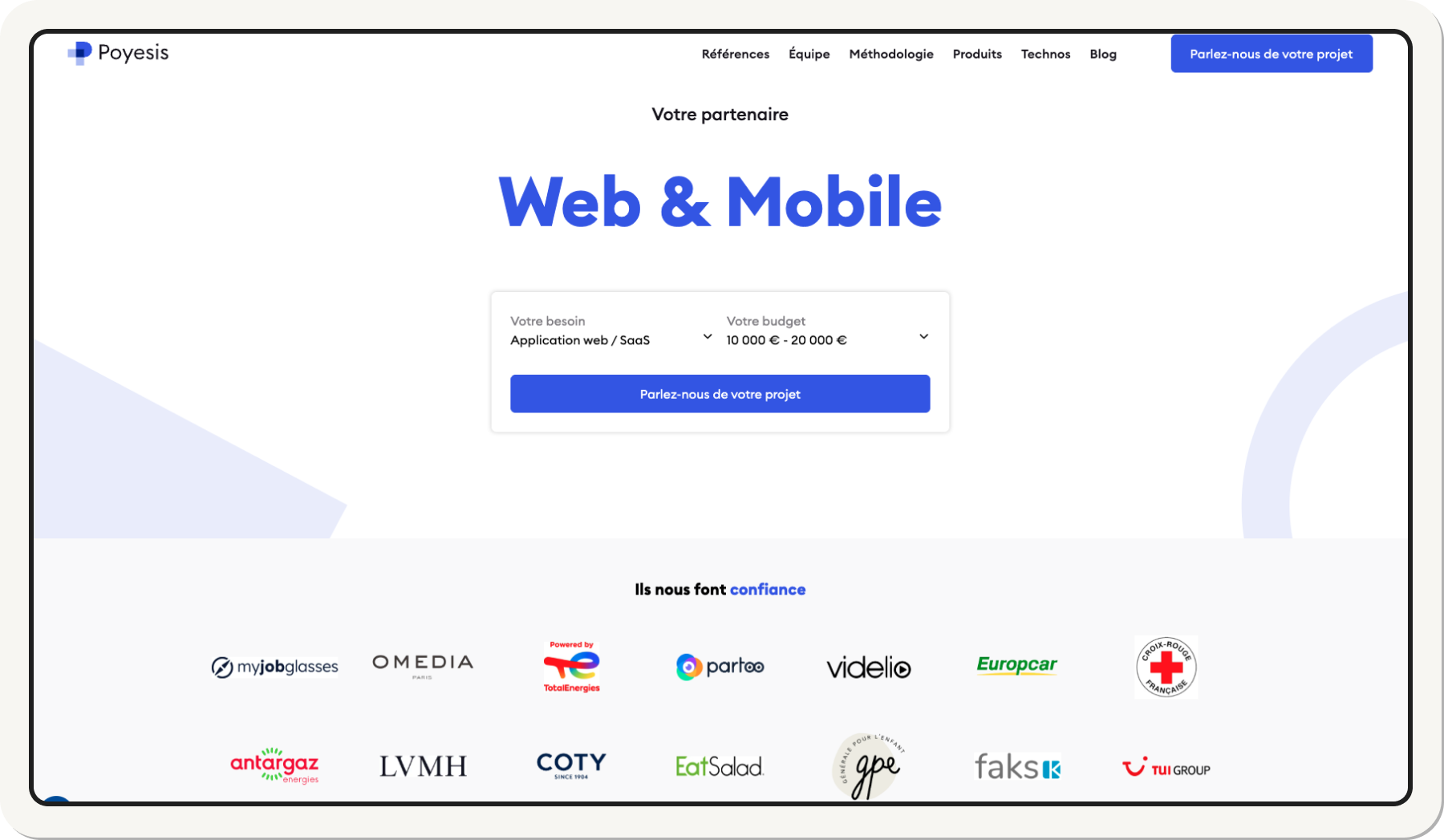
Poyesis is a development agency specializing in web and mobile applications, SaaS, marketplaces, and custom business tools. Its positioning is focused on application products built specifically around business needs rather than the integration of standard CMS platforms.
The agency is an attractive option for SMEs and product owners looking for a team capable of designing and developing software or an application with a clearly defined scope.
Why this ranking: Poyesis takes ninth place for its suitability for custom application projects and the business needs of SMEs. The references to check depend primarily on the stack, the expected load, and the product's international ambitions.
Ideal for: SMEs and product owners who want a custom SaaS, marketplace, application, or business tool.
Strengths:
- Clear positioning on custom applications.
- Coverage of SaaS, marketplaces, and business tools.
- Profile well-suited to SMEs and product owners.
Point of caution: verify references regarding your stack and international scalability requirements.
Editorial rating:
Technical depth: ★★★★☆ · Product culture: ★★★★☆ · UX/UI: ★★★★☆ · Execution capacity: ★★★★☆ · Custom-fit suitability: ★★★★★
10. Quai des Balises: Web, e-commerce, and platforms
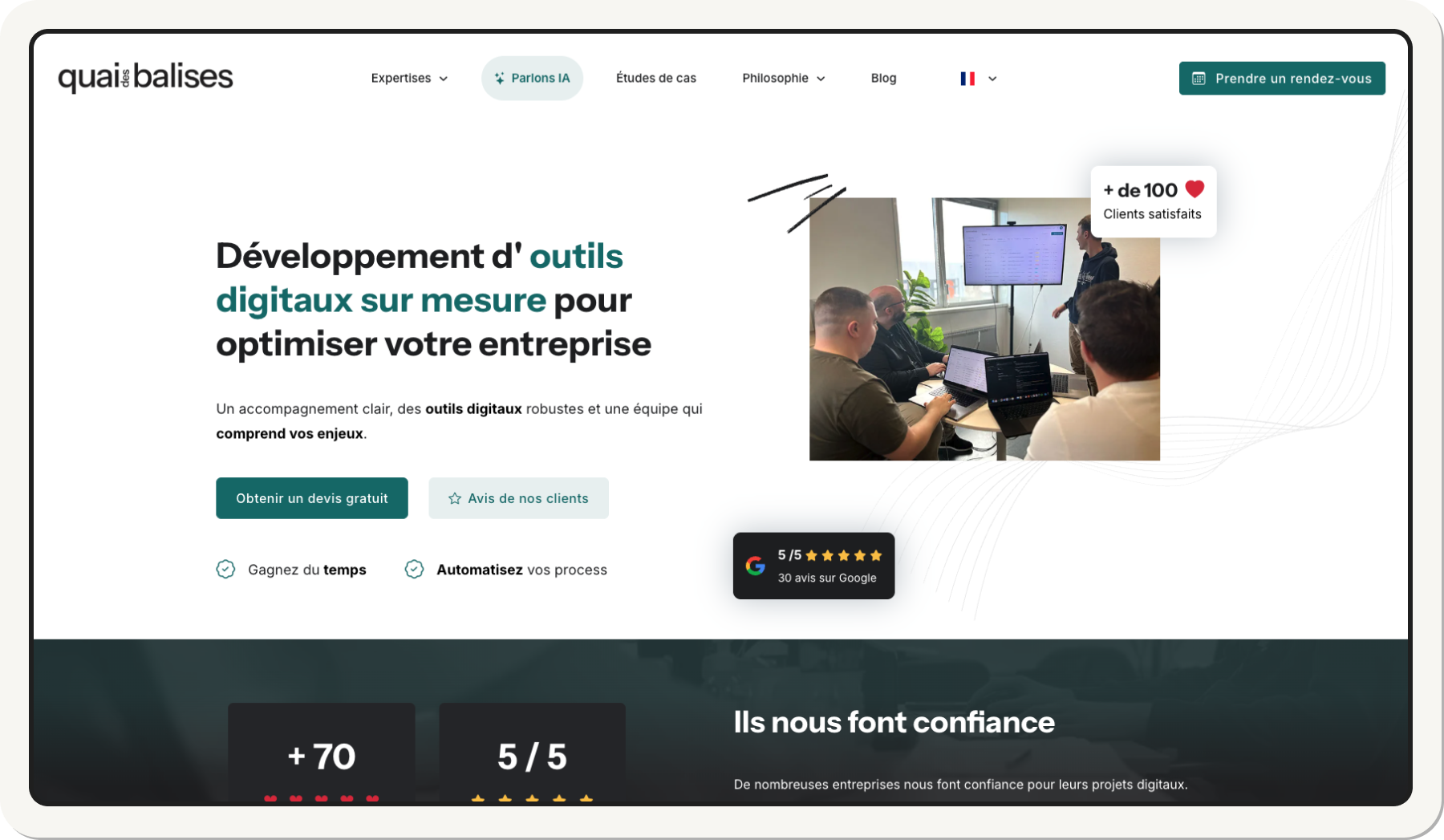
Quai des Balises is a custom web development agency that designs software, web and mobile applications, ERPs, CRMs, and digital platforms. Its positioning emphasizes business tools and personalized solutions, particularly for SMEs.
The agency is particularly relevant when a project requires digitizing an internal process or creating a specific tool without mobilizing a very large engineering structure.
Why this ranking: Quai des Balises rounds out our selection with a profile clearly focused on custom business software development. However, this choice should be confirmed based on your technical stack, integrations, and expected scalability requirements.
Ideal for: companies with projects combining web, e-commerce, and digital platforms that want to precisely compare the suitability of the proposed stack.
Strengths:
- Clear positioning on custom business software and tools.
- Covers web/mobile applications, ERP, and CRM.
- Accessible profile for SMEs with specific needs.
Things to consider: the choice depends heavily on your stack, your integrations, and the expected level of scalability.
Editorial rating:
Technical depth: ★★★★☆ · Product culture: ★★★★☆ · UX/UI: ★★★★☆ · Execution capacity: ★★★★☆ · Custom-fit suitability: ★★★★★
Which web development agency should you choose for your project?
There is no single agency that is perfect for every project. The right choice depends primarily on the nature of the product you are building, the technical depth required, and the level of support you expect both before and after launch.
How did we select these agencies?
We compared agencies using identical criteria to avoid a ranking based solely on brand awareness. The editorial evaluation presented in each profile focuses on technical depth, product culture, UX/UI quality, execution capacity, and suitability for custom projects.
The ranking also takes into account the clarity of their positioning, their ability to support the project beyond the build phase, and the alignment between the agency's size and the client's needs. The stars represent our editorial assessment of these criteria and are not client ratings.
How much does web development cost?
Budgets vary significantly depending on the level of customization, business complexity, integrations, and the level of maintenance required. Compare quotes based on a truly equivalent scope rather than headline figures that are difficult to compare.
A CMS-based showcase site can range from a few thousand to several tens of thousands of euros depending on strategy, design, content, and complexity. E-commerce adds catalogs, payments, logistics, and integrations. A custom application or platform can start at several tens of thousands of euros and go much higher as the product, security, and integrations become more complex.
The right metric is the total cost over several years: build, hosting, maintenance, licenses, updates, and technical debt.
How do you choose the right web development agency?
Check for projects similar to yours
A portfolio should showcase the same class of problem: B2B SaaS, marketplace, e-commerce, business tools, or content platforms. A beautiful landing page does not prove the ability to handle permissions, complex payments, or distributed architecture.
Evaluate the methodology and technical governance
Ask how architecture, code reviews, testing, security, deployment, documentation, and monitoring are handled. Also, clarify ownership of repositories, cloud accounts, and access credentials.
Ask the right questions during the pre-sales process
Who will actually be on the team? What is their level of seniority? How are scope changes billed? Who maintains the product after launch? How are scaling issues or critical incidents managed?
CMS vs. custom development: the decision tree
You want a marketing site or a blog
Webflow or WordPress cover the majority of these needs. Webflow is particularly well-suited for sites where design, animations, CMS, and marketing autonomy are central. WordPress maintains a massive ecosystem and remains a good fit when plugins or internal habits are major factors in the decision.
You sell products online
Shopify is often the simplest choice for a standard store. PrestaShop and Magento cater to different levels of control and complexity. Developing a fully custom e-commerce engine only makes sense if your business model truly deviates from standard practices.
You want to decouple content and frontend
A headless CMS like Contentful, Strapi, or Sanity becomes relevant when the same content needs to power multiple channels, applications, or frontends. This architecture provides flexibility but also increases engineering requirements.
Your need is a SaaS or a business platform
Custom development makes sense when your product relies on permissions, workflows, calculations, proprietary data, or integrations that cannot be cleanly replicated in a CMS. In this case, prioritize agencies from the rankings that are explicitly positioned toward software engineering, product development, or custom application development.
Custom development vs. CMS: the real criteria for choosing
Budget and time-to-market
A CMS generally reduces initial costs because a large portion of the functionality already exists. Custom development requires more design, development, testing, and maintenance. In return, it avoids the need to force a platform to fit when a business requirement becomes highly specific.
Scalability and technical debt
Custom code offers more freedom, but that freedom also brings responsibility: architecture, updates, security, testing, and documentation. A poor technical foundation can become more costly than CMS lock-in.
Team autonomy
For a marketing site, editorial autonomy is a key criterion. If every change requires a developer, the organization slows down. For a business application, this autonomy relates more to administration tools, roles, and the product team's ability to evolve rules without breaking the system.
FAQ
CMS or custom development: how to choose?
Choose a CMS when your needs are covered by its standard features and editorial autonomy is important. Choose custom development when your business logic, data, or integrations are truly specific.
How much does custom web development cost?
Budgets can range from tens of thousands of euros to much more, depending on the product. The main factors are business complexity, integrations, security, user volume, and the level of maintenance required.
What is the difference between a showcase site and a web application?
A showcase site primarily displays content and generates leads. A web application manages interactions, data, accounts, roles, and business logic, which requires more development and testing.
Is a headless CMS necessary for a multichannel project?
A headless CMS is relevant when the same content needs to feed multiple frontends or channels. For a single, simple marketing site, this architecture can add complexity without sufficient benefit.
How to avoid dependency on an agency?
Retain ownership of accounts, domains, code repositories, and infrastructure. Demand minimal documentation, administrator access, and clear exit terms.
Good to know
Heading
Lorem ipsum dolor sit amet, consectetur adipiscing elit. Suspendisse varius enim in eros elementum tristique. Duis cursus, mi quis viverra ornare, eros dolor interdum nulla, ut commodo diam libero vitae erat. Aenean faucibus nibh et justo cursus id rutrum lorem imperdiet. Nunc ut sem vitae risus tristique posuere.

.avif)
Lorem ipsum
Lorem ipsum dolor sit amet, consectetur adipiscing elit, sed do eiusmod tempor incididunt ut labore et dolore magna aliqua. Ut enim ad minim veniam, quis nostrud exercitation ullamco laboris nisi ut aliquip ex ea commodo consequat. Duis aute irure dolor in reprehenderit in voluptate velit esse cillum dolore eu fugiat nulla pariatur.