Projects
 Our Offers
 Dedicated team
 Blog
 Academy
 About Us
Tips9 min read
How much does a website for a carpenter or joiner cost?
A fitted wardrobe made in the workshop and a window from a supplier's range are not sold with the same information. To build the website, allow €5,000 to €9,500 excl. VAT at Gemeos for "Local workshop" (6 pages and 10 projects, 1 language) and €6,000 to €13,000 excl. VAT for "Product range catalogue" (25 products, 4 families and 3 product page templates).
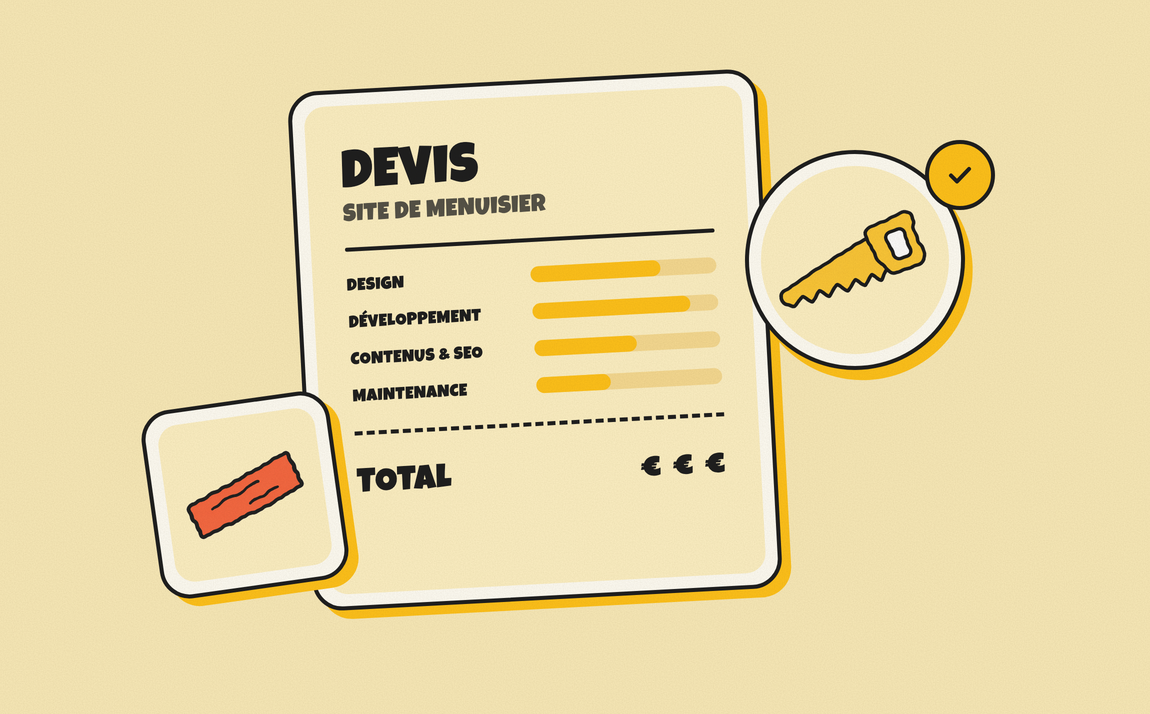
What budget should you plan for your joinery business's website?
Budgets are given excluding VAT for the volumes and features stated. For a new build: scoping, site structure, UX/UI, CMS development, integration of the copy and visuals supplied, testing and handover training. For a redesign, migration or upgrade: the work is carried out on an existing website. These services do not automatically add up. Copywriting, translations, new visuals, licences, subscriptions and third-party costs are to be specified in the quote.
| Service and project | Budget excl. VAT | Scope and limits |
|---|---|---|
| New build — Local workshop | €5,000 to €9,500 | 6 pages and 10 projects, 1 language. Craftsmanship, materials and contact. No product catalogue or configurator. |
| New build — Product range catalogue | €6,000 to €13,000 | 25 products, 4 families and 3 product page templates. Product pages without online sales, finishes and quote request. No stock management or payment. |
| New build — Bespoke projects | €6,500 to €13,000 | 12 pages and a form with dimensions and photos. Needs qualification and portfolio by room type. No technical calculations or commitment to an automatic price. |
| New build — Limited configurator | €5,500 to €11,500 | 10 pages and 1 range of 12 approved combinations. Choice of finish and dimensions, with the summary sent on. No 3D drawing, structural calculation or factory connection. |
| New build — Showroom network | €6,000 to €13,000 | 4 showrooms, 2 languages and a catalogue of 60 products. Showroom pages, appointment booking and migration of 80 URLs. No e-commerce or ERP. |
| Redesign — Redesign of the existing website | €6,000 to €12,500 | 70 URLs to review, 1 language, up to 5 templates; CMS retained. Ranges, finishes and projects carried over. Checks: images, quote requests and product variants. Existing copy lightly revised; no change of CMS or addition of business software. |
| Technical migration — CMS migration with the design retained | €6,500 to €19,000 | 70 URLs, 1 language, 1 source CMS and 1 target CMS to be confirmed. Transfer of ranges, finishes and projects. Checks: images, quote requests and product variants. Design and functional scope retained; exportable sources and available interfaces; licences and editorial overhaul quoted separately. |
| Website upgrade — Adding a product range catalogue | €2,000 to €5,500 | Existing website, 40 products and 4 families. Product pages, filters and quote request by range. No 3D configurator, payment or ERP. |
Which website suits a carpenter or joiner: portfolio, catalogue or configurator?
Choosing the scope starts with how you sell. A workshop that designs each fit-out after a conversation may need a well-documented showcase site and a project enquiry form. A business that sells product ranges may want a catalogue. The price of the website should not lump these uses together under a vague label. To create a website for a carpenter or joiner, this choice follows from identifying the two or three audiences that bring in the workshop's revenue: an architect checking your finishes and a homeowner replacing their windows expect neither the same pages nor the same journey.
This distinction stops you paying for a feature that does not match the way you prepare your proposals. If on-site measuring and technical approval remain essential, the website can prepare the conversation without producing an automatic price. Visitors need to understand the scope of what they receive.
A web agency for carpenters and joiners should define this boundary before the mock-ups: information, a request for a survey, a product selection or an order. A visual configurator is not necessarily a pricing tool, and a submitted request is not a confirmed order.
How should a joinery website present manufacturing, supply and installation?
The strategy and architecture work consists of making your offer clear to the audiences you serve. You need to separate what is designed and made in the workshop, what comes from supplier ranges and what falls under installation. This groundwork stops the copy from promising a service you do not provide.
A business may want to receive enquiries for interior storage while keeping a window replacement activity. The scoping must give these activities a coherent place, with their own proof and journeys. It is not enough to create a "joinery" section and expect the prospect to guess the details.
The content quote must identify who gathers the technical information, who writes and who approves. A supplier's product sheet does not on its own say what your business does on site. Conversely, a text about workshop work does not answer the questions of someone buying a standard product.
Photos of the team, a presentation of the machinery or close-ups of a joint are only useful if they reflect real things you want to show. The web provider can organise and lay out this proof; it must not invent a manufacturing process or a production capacity to fill a page.
How do you prepare the projects for a carpenter or joiner's website?
Start by gathering usable case files, not just a folder of photos. The content service may include sorting, an interview with the workshop, copywriting, preparing the visuals and integrating a defined number of projects. Each of these tasks needs an owner.
To showcase joinery projects, the website must make the work shown understandable. The price of a website depends in particular on the state of the information available: verified material, the business's role, documents cleared for publication and selected images. Having a photo available does not mean the whole case file is ready.
Separating the page template from the case files carried over
A staircase case file may call for overall views and close-ups; a commercial fit-out may need a plan and the context of the site; a window range is explained with other characteristics. Use representative case files to define the shared template and its variants before integration. The quote must also state how many case files will be prepared: images alone are not enough to price this reworking.
Photos may need cropping, file processing and versions prepared for different screens. A photo shoot or heavy retouching is a separate job, to be priced if you ask for it. Also specify who checks publication permissions, credits and any private details visible in the images.
Designing a visual language that stays usable
The web design must let visitors look at an overall view, a detail and a document without losing the context. The work covers the mock-ups, the navigation and the behaviour on mobile phones, not just the home page.
The design of a joinery website can start from your brand and your existing photos. The workload grows if the case files have to be rebuilt, if each range needs its own documents or if architects need a separate journey. Compare these deliverables before adding a new identity or an animation that does not help people understand the work.
What form should you plan for bespoke joinery enquiries?
The form must prepare the sales work your team will actually carry out. A homeowner may describe the intended use and attach a photo; a specifier may send a plan. You need to decide what is useful for the first conversation and what can wait for the site survey or a technical discussion.
The design service may provide a shared journey with questions adapted to the type of project. It must specify the fields, the accepted documents, the recipients and the messages. A longer form is not automatically more useful: every piece of information requested must have a purpose.
To prepare joinery quote requests, start with the data that will help you decide on the next step. A town, a type of project and an intended timeframe can guide the call-back. Dimensions supplied by the prospect must not be presented as measurements approved for manufacturing.
The CNIL's sample form notices (the French data protection authority) need to be adapted to the data you collect. Plan who prepares and approves the information on how enquiries are processed, then who integrates it. The provider must not copy a notice unrelated to the documents and recipients chosen.
Uploading plans or photos adds technical work: permitted formats, file size limits, error messages, transmission and access for authorised people. Also define a solution for when the prospect does not yet have a document. A simple enquiry must not become impossible for lack of a plan.
If the form is to feed your sales software, have the data exchanges assessed before pricing. The quote must name the data transmitted, the access required and how errors are handled. This integration remains separate from the software used to prepare the manufacturing quote.
When does a configurator become a project in its own right?
As soon as choices and their dependencies need to be managed. Displaying finishes does not require the same development as checking dimensions, allowing certain combinations or producing an estimate. The scope must specify what the user selects and what remains subject to the workshop's assessment.
A configurator may require a specification phase with your team: options, impossible cases, reference data and expected output. The rules must come from your business or an authorised source. The web provider cannot deduce them from a few project photos.
Before funding this tool, prepare:
- The choices the customer can actually make without technical approval.
- The dimensions or constraints that require the workshop's input.
- The possible combinations and the cases to be refused.
- The person who keeps the product references and pricing rules up to date, if a price is displayed.
- The document or message delivered at the end of the journey.
- The information passed on so the assessment can resume without re-entering everything.
These elements let you compare an indicative selection, project preparation and an ordering journey. They do not commit the visitor in the same way. The quote must reflect this in the design, development and testing.
If a supplier already has a suitable tool, first check the usage rights, the integration options and how it fits with your website. Do not treat its existence as a connection already built. The software publisher's costs and responsibilities must be kept separate from those of the web service.
How do you choose the right content management and SEO for the workshop?
The content management system must match the changes you will make. Adding a job, editing a range and updating a craftsmanship page are not the same operations. Ask for a demonstration using your own case files and the permissions your team will receive.
The workshop must be able to add a project, replace a range's product page and flag a finish that is no longer offered. A CMS can organise this information into separate fields to avoid leaving an old material in several texts. Gemeos works with WordPress, Webflow and headless; for your joinery business, choose based on how these cases are handled and on whether supplier data needs to be kept separate.
For search engine optimisation, the initial work can organise services and projects around real needs. SEO support from Gemeos starts at €1,000 excl. VAT per month, with a scope to be defined. Ongoing copywriting, local content development and launch activities must be itemised separately in the proposal.
Enquiry tracking can keep the context of the project or the page viewed, where the tools allow it. You then need to know what becomes of these enquiries: call-back, visit, proposal or dropped. A submitted form does not on its own prove that a piece of joinery has been sold.
Hosting, the domain name, any licences and the upkeep of integrations remain additional costs. Technical maintenance does not by default include preparing a new range or writing up projects. Define which interventions are routine and which require a new quote.
What should you check before signing off the joinery website?
Testing must cover both the content and the journeys. Test a project with few photos, another with a plan, then an enquiry containing a file. The template must remain readable with the case files it actually has to present.
Also check where enquiries are sent and who can access the files received. A success message on the website is not enough to show that the right person can find the document. The handover training must show how to follow up these enquiries with the accounts provided.
For a redesign, list the old service pages, the projects and the documents still being shared. Decide what will be carried over, corrected or removed, then have the handling of old URLs specified. Carrying over the content must be distinguished from simply integrating the new design.
Finally, the delivered website must let you publish a project, replace a document and correct a range without breaking the layout. Have the limits of this autonomy specified. A new type of configurator or an additional sales rule may require a design change, even if the rest of the website can be managed in-house.
To get a quote for your joinery website, prepare your services, a few project case files and the tools you want to keep. The proposal can then separate content preparation, the showcase site and the features that warrant custom development.
FAQ on the cost of a website for a carpenter or joiner
How can the website be adapted if the workshop wants more enquiries from professionals?
An architect or interior fit-out firm must be able to identify your capabilities, the materials you work with and your role in the projects shown. A first enquiry can mention the type of work, the location and the documents available, without imposing a configurator designed for a private purchase. Plan representative projects and a recipient able to take these conversations forward. This content and qualification work can be more useful than a detailed catalogue if your orders are mainly built up on a case-by-case basis.
Can you showcase bespoke work without displaying furniture prices online?
Yes. The website can present your craftsmanship, your projects and how to prepare an enquiry. The web project must then make this next step clear. A price calculation is not needed to explain the workshop's work; if one is requested, its rules and limits must be scoped separately.
Can you reuse suppliers' catalogues?
It depends on the content you are authorised to use and on the update conditions. The quote must distinguish between a downloadable document, integrated product pages and a connected catalogue. Have the rights, available formats and responsibilities checked for when product references change. None of this work is automatically included in the showcase site.
Do you need different forms for architects and homeowners?
Not necessarily two separate forms. A single journey can adapt the questions and document uploads to the profile or type of project. The quote must specify these variants and where they are sent. The aim is for your team to have the right context, without requiring a detailed plan from someone who is still looking for initial guidance.
Is a site photo enough to create a project page?
It is a starting point, but you still need to select the image and prepare the information that can be published. The business's role, the materials and the constraints must be checked. The quote may include gathering and writing up these elements for a defined volume; building the template does not produce this content for you.
Can you start without a configurator and add it later?
Yes, provided you define the first journey and document the planned upgrade. Starting with a project enquiry can leave time to formalise the rules. The future tool will need its own scoping; having a placeholder in a mock-up does not guarantee it will be built.