Projects
 Our Offers
 Dedicated team
 Blog
 Academy
 About Us
Tips8 min read
How much does a law firm website cost?
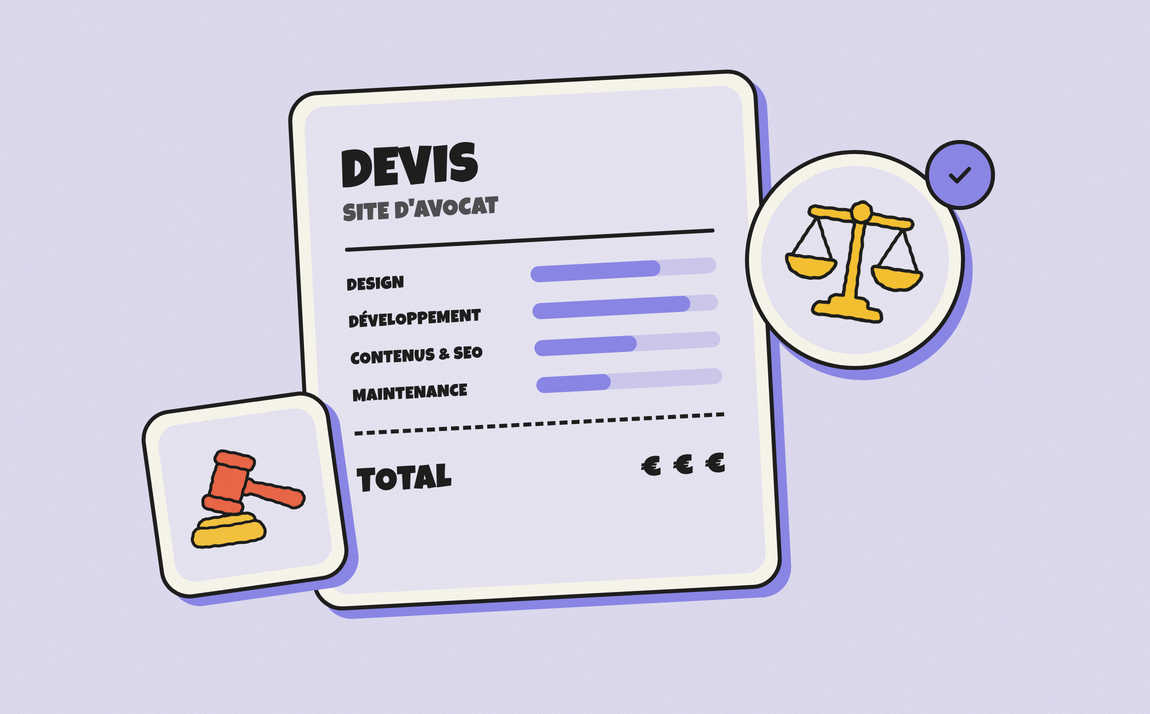
Visitors need to know whether your firm handles their situation before they ask for a consultation. To build the website, budget €6,500 to €13,000 excl. VAT with Gemeos for an "Independent lawyer" site (6 pages, 3 practice areas, 1 language) and €9,000 to €17,500 excl. VAT for a "Multidisciplinary firm" (15 pages, 8 lawyers, 6 practice areas).
A firm that advises businesses does not need the same examples and journeys as a firm that serves individuals. The pages must set out the situations handled, identify the lawyers involved and explain the next step. Organising professional sign-offs and publications is part of this scoping work.
What budget should you plan for your law firm's website?
Budgets are given excluding VAT for the volumes and features listed. For a new build: scoping, site structure, UX/UI, CMS development, integration of the copy and visuals you provide, testing and handover. For a redesign, migration or upgrade: the work is done on an existing site. These services do not add up automatically. Copywriting, translations, new visuals, licences, subscriptions and third-party costs are specified in the quote.
| Service and project | Budget excl. VAT | Scope and limits |
|---|---|---|
| New build — Independent lawyer | €6,500 to €13,000 | 6 pages, 3 practice areas and 1 language. Profile, practice areas and contact. Approved copy provided, no paid appointments. |
| New build — Multidisciplinary firm | €9,000 to €17,500 | 15 pages, 8 lawyers and 6 practice areas. Directory, areas of expertise and routed enquiries. No client portal or case management. |
| Redesign — Publications and SEO redesign | €9,500 to €20,000 | 80 articles to migrate and 6 sections. Library, authors, filters and redirects. Legal rewriting of the 80 articles not included. |
| New build — International firm | €8,500 to €18,000 | 20 profiles, 3 offices and 2 languages. Links between lawyers and expertise, contacts by office. Translations and ethics approval to be provided. |
| New build — Appointment booking or client access | €9,000 to €17,500 | 12 pages and 1 existing external tool kept. Appointments and hand-off to a secure tool. No custom legal document management. |
| Technical migration — CMS migration, design unchanged | €7,000 to €21,000 | 100 URLs, 1 language, 1 source CMS and 1 target CMS to be confirmed. Transfer of practice areas, profiles and publications. Checks: authors, categories and external booking. Design and features unchanged; exportable sources and available interfaces; licences and editorial overhaul quoted separately. |
| Site upgrade — Add a publications library | €2,000 to €5,500 | Existing site, 60 articles, 6 topics and 8 authors. Article templates, filters and content migration. Approved copy provided, no overhaul of practice areas. |
How do you prepare the copy for a law firm website?
A site can be technically ready while its copy is not fit to publish. If the quote only covers integrating the content you supply, the firm still has to prepare and approve it. If the agency helps with the writing, the number of pages and the review stages must be set out.
Explain practice areas from the reader's point of view
A list of legal fields does not always answer the questions of a business owner or an individual. A page should state the situations you handle, who you work for and how the first conversation works. The aim is to help visitors recognise their need, not to summarise a legal consultation.
The information people look for before choosing a lawyer gives this work a starting point: who handles the matter, on which topics, where and how to get in touch. The editorial quote should state whether this material is gathered in interviews, supplied as notes or written directly by the firm.
Present consistent profiles
Photos, backgrounds, working languages and practice areas should follow a common structure. If some profiles already have a recent portrait and a full bio while others still need preparing, the workload is not the same.
A profile template saves you from designing each page from scratch. It does not write the bios or check professional details. Give that sign-off to a named person, then set the number of profiles actually included at launch.
Plan the review at the right time
The firm must stay in control of its professional information. Article 10 of the French bar's national rules (RIN), published by the CNB, requires in particular that the lawyer and their bar be identified and that information about services be accurate. It also requires the bar council to be informed when a site is launched or substantially changed, and its domain names to be disclosed.
This affects the project: the firm must approve titles, descriptions and the domain before going live. This professional sign-off cannot be inferred from the design work alone. Build responsibilities and feedback rounds into the schedule rather than piling up corrections after integration.
Which services should you plan to build your firm's website?
An independent lawyer can present several practice areas on a limited number of templates. A multi-office firm may need to connect practice areas, profiles, languages and contact details. The quote should describe these relationships and the content to prepare: bios to gather, portraits to shoot and publications to migrate. This work explains differences in website build costs that a simple page count does not show.
| Service | Expected deliverable | What the firm needs to organise |
|---|---|---|
| Strategy and architecture | Practice areas, audiences, profiles and contact journeys, prioritised | Decide which activities to present and who the right contact is |
| Copywriting and preparation | Presentation pages, bios and migrated content, in a defined volume | Supply professional information and confirm it is accurate |
| UX/UI and identity | Mock-ups for practice areas, profiles, publications and contact | Decide how the firm is presented and separate a new brand identity from web design |
| Development | Editable templates, optional search, and forms or calendars | Approve how enquiries are routed and who can publish |
| Migration and handover | Migration of selected content, handling of old URLs and training | Review publications, name contributors and test updates |
A client portal, payments or a connection to the firm's software must be explicitly scoped.
How do you stop sign-offs from holding up integration?
Set up a short chain: the person who gathers the information, the one who approves practice areas and the one who gives the go-ahead to publish. The same partner can hold all three roles; what matters is that decisions reach a named contact. Consolidated feedback avoids integrating wording that is still being debated internally.
Ask for one representative page before rolling out the other practice areas. The firm can use it to approve the level of detail, the headings and how the first conversation is explained. Substantive changes remain possible afterwards, but the quote should state how many feedback rounds are included and how a change of scope is handled.
Which firm set-ups change the price of the website?
For comparable services, variations come mainly from the relationships between lawyers, practice areas, offices, languages and publications. An area handled by the whole team is not presented like a practice reserved for one partner in a single office. Ask which differences require another template or a separate journey, and which can reuse the existing structure.
| Site scope | Key work | Question to settle before the quote |
|---|---|---|
| Independent lawyer presentation | Positioning, practice areas, background and contact | Is a compact format enough to explain the practice? |
| Firm with several lawyers | Profiles, shared practice areas and enquiry routing | Who handles each topic and who receives the enquiry? |
| Firm that publishes regularly | Article templates, authors, categories and approval | Who drafts, reviews and publishes new content? |
| Multi-office or international firm | Locations, languages and information specific to each audience | Which pages and journeys really need to differ? |
Reusing a profile template can share the design effort; preparing bios and checking old publications remains separate work. The number of lawyers is therefore not a sufficient billing unit.
A web agency for lawyers must above all make your practice areas clear without leaving visitors torn between several contacts. Precise scoping then makes proposals comparable.
How did Gemeos reflect the Acmai firm's specialisation on its website?
Acmai advises businesses on contracts, personal data and artificial intelligence issues. Gemeos took over the art direction, designed the pages and built the site with an editable blog and client cases. The navigation separates the practice areas; the journeys lead to a conversation about the visitor's issue.
For a law firm, the job is not just applying brand guidelines to existing copy. You have to prioritise areas of expertise, choose which proof can be published and build useful templates for future articles and references. The quote can separate this design work, the content migration and training the firm to publish.
How much does migrating articles cost during a redesign?
The price depends on what you migrate, the state of the content and URL changes. Importing articles that are already structured is different work from manually moving text, tables and attachments.
Start by sorting the publications to keep, those to update and those that no longer match the firm's practice. For each useful piece, identify its author, date, practice area and destination on the new site.
A ten-year-old article can still be useful after review; it must not look current just because the site has been rebuilt. Technical reformatting and substantive review are two different services.
For the quote, specify:
- The number of articles actually migrated, with their files and images.
- The fields to keep: author, publication date, update date and practice area.
- Which substantive corrections the firm makes and which it hands to the agency.
- The old URLs to keep or redirect.
- The checks after import and after launch.
This list avoids confusing "a blog is available" with "all past publications migrated and reviewed".
Which consultation journey should a lawyer's website offer?
Choose the consultation journey according to the firm's rules and what the chosen tool can do. A link to an existing calendar, a calendar embedded in the page and a connection that assigns enquiries by legal field do not involve the same development.
A form can collect contact details, the general topic and the preferred way to be called back. A calendar adds time slots, durations, confirmations and cancellation rules to organise. If several lawyers see different clients, you also have to decide which calendar to offer.
To generate consultation requests that suit the firm, make the next step clear. Is the visitor asking for a call back, an appointment to be confirmed or a slot booked directly? The message shown after sending must match how things really work.
A space for sending documents or following a case is yet another project. Before building it, look at what the software already used by the firm can do and how to direct clients to it. You need to price access, exchanges and their upkeep, not just a login page.
How do you compare quotes without reducing the project to its design?
Compare the same content, the same migrations and the same journeys. Two polished mock-ups can hide big differences in copywriting, sign-offs and post-launch work.
Web design work should help visitors identify the firm, understand its practice areas and find the right contact. To build trust before the first conversation, clear content and consistent information matter as much as the visual presentation.
Prepare a short checklist:
- The templates and number of pages delivered with their content.
- The profiles, portraits and copy supplied by each party.
- The number of publications migrated and the URLs to handle.
- The firm's approval stages.
- Exactly how the contact form or calendar works.
- Accounts, subscriptions, training and maintenance after delivery.
Also test real situations: someone who doesn't know which legal field to choose, an enquiry sent to the wrong office and an article whose author no longer works at the firm. You will see what is planned before these cases turn into extra corrections. Also ask who will own the domain name and the registrar access. The domain chosen to create a website for a law firm must include the lawyer's name or the firm's name; registering it in that same name lets you change provider without losing the address.
What support should you plan to publish and maintain information?
After delivery, contact details, profiles, publications and forms must each keep an owner. Separate hosting and domain contracts, technical maintenance and editorial services. Maintenance does not automatically include writing an analysis or creating a new section.
The firm must be able to update a partner's page, attach a publication to the right author and distinguish its publication date from its revision date. WordPress, Webflow and headless are among the approaches Gemeos uses. The handover of a law firm website should check these operations with the agreed approval chain, rather than just replacing a sentence on a page.
SEO work should match the practice areas and locations the firm wants to grow. Gemeos SEO/GEO support starts at €1,000 excl. VAT per month, with a scope separate from the build. Define the expected content and how enquiries are measured, without promising commercial results.
A list of your practice areas, the profiles to present and the publications to migrate lets you request a quote for your firm's website on a precise basis. You will be able to separate the launch work, content approval and the services needed afterwards.
FAQ on the cost of a law firm website
How do you adapt the site if the firm wants to grow its business clientele?
Select the practice areas genuinely handled for these clients and the situations that trigger a first conversation. Lawyer profiles, languages offered and contact options must match this work. A general presentation of the firm can stay shared, but content aimed at a business owner does not necessarily repeat an individual's questions. Scoping should specify the copy to produce and its approval by the firm, without announcing case outcomes.
Can you offer different appointments depending on the practice area?
Yes, if the journey identifies the need and offers the right calendar or passes the enquiry to the right person. You need to define the legal fields, durations and availability, then check the cases where no slot fits. A link to a single calendar does not have the same scope as routing between several lawyers. The quote should describe this logic and who will be able to change it.
How do you route documents for an ongoing case without them landing in the first-consultation form?
Offer two separate entry points: describing a new need and contacting the firm about an ongoing case. For documents, point to the sharing channel the firm has chosen at the right moment, without asking for them in the general form. The project should test whether this separation and the recipients are understood. Creating a new upload space adds access, storage and exchanges to be scoped separately.
How do you offer consultations in English if only some lawyers or practice areas are concerned?
Link the English pages to the lawyers, legal fields and offices that genuinely handle these conversations. A consultation button must not lead to a calendar or form that cannot carry over the chosen language. The quote specifies the copy to translate and approve, the recipients and the journey messages. For analyses only available in French, state this limit clearly to readers.
How do you handle the page of a partner who leaves the firm?
The site must let you update the profile, contact details and links from practice areas or publications. How the page is handled depends on the information to keep and the firm's decision. Plan who can make these changes and how old URLs are checked. Being able to remove a profile does not mean every related link and piece of content will be corrected automatically.
Can the cost of the first appointment be shown on the site?
The firm must decide exactly what information to publish and the terms of the appointment. The site can make them clear before contact or booking, with a simple update when these terms change. Displaying fee information and taking payment online are two different features: the second adds a payment tool, messages and tests to be priced.
Who should update the legal articles migrated to the new site?
Editorial responsibility must be given to the firm or to a named person for substantive review. The agency can migrate the layout, authors and dates without checking whether each analysis is still current. Ask which content is revised and which is simply migrated. The template should separate the original publication from the update, so the redesign does not give a false impression of freshness.
How do you send a first enquiry to the right office when a practice area is only handled in one of them?
Link the practice area page to the contacts and offices that actually handle it. The form can keep the subject of the enquiry and suggest the right contact, according to the firm's rules. Also test a visitor arriving directly from a legal analysis: they must find this journey without picking at random among all the addresses. These relationships need to be planned in the architecture and in how enquiries are assigned.