Projects
 Our Offers
 Dedicated team
 Blog
 Academy
 About Us
Tips9 min read
How to create an electrician website: budget, pages and qualifications to display
To create a website for an electrician, start from the services that bring in your revenue (emergency call-outs, renovation, EV charging points, maintenance), write one page per type of work with your call-out prices and your exact qualifications, separate urgent requests from projects, then connect the site to your Google profile and count the calls it brings in. You can do it yourself with an online website builder or hand it to a web agency for electricians; either way, your services dictate the structure.
A managing agent fitting EV charging points in a residential block's car park looks on your site for the IRVE qualification (the French qualification required to install EV charging points) and for charging points already installed in shared car parks; if they cannot find them, they move on to the next site. Online website builder, WordPress site, all-in subscription or agency: the tool comes second, depending on how much time you can devote to the site. For a build entrusted to Gemeos, allow €5,000 to €13,000 excl. VAT.
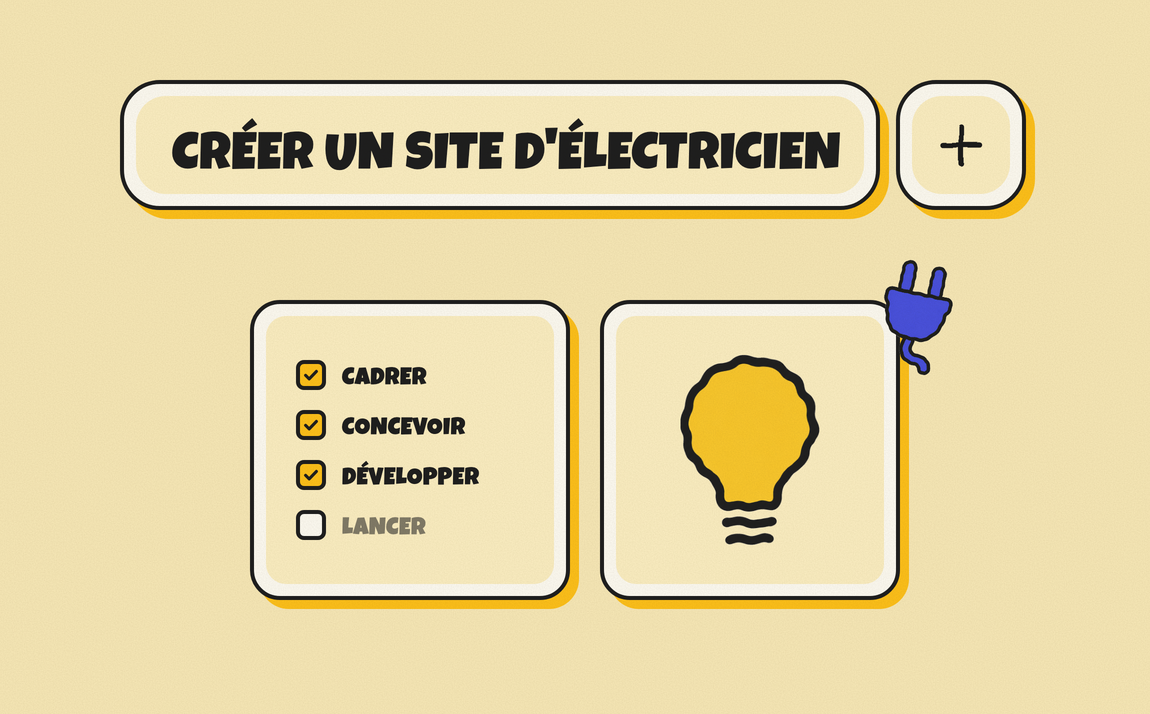
Set the budget according to your business
At Gemeos, the cost of an electrician website for a new build ranges from €5,000 to €13,000 excl. VAT depending on the number of pages, audiences and forms. The top of the range corresponds to EV charging (IRVE) businesses, maintenance for businesses and branch networks connected to a CRM.
| Your business | What the site includes, and what it leaves out | Budget at Gemeos |
|---|---|---|
| Independent call-out electrician | One presentation page and one contact page for one area, with services, contact details and a simple request; no online call-out booking | €5,000 to €11,000 excl. VAT |
| General electrical work and renovation | Eight pages for four services and ten jobs as completed projects, with a quote request; no technical calculations or regulatory simulation | €5,000 to €9,500 excl. VAT |
| EV charging and home automation | Twelve pages for two specialisms and six client case studies, a residential journey and a commercial journey, project form; no configurator or sizing calculation | €6,500 to €13,000 excl. VAT |
| Maintenance for businesses | Twelve pages for three audiences, documentation, recurring services, technical requests and dedicated contacts; no call-out management | €6,500 to €13,000 excl. VAT |
| Several branches | Three branches and three forms connected to a CRM, with request qualification, location and routing; no field scheduling software | €6,000 to €13,000 excl. VAT |
If the logo painted on your vans is hard to read on a phone screen, ask whether logo design is included in the quote. A business opening a second branch or moving into EV charging points can also review its identity with a branding agency before the mock-up, so that the site, the vehicles and the quotes carry the same name and the same colours.
Already have a site? A redesign that keeps your CMS and carries over up to 35 URLs (services, areas, references) costs €6,000 to €12,500 excl. VAT at Gemeos. Changing CMS while keeping the current design costs €6,500 to €19,000 excl. VAT, excluding licences and rewriting the content. If all you are missing is an EV charging and home automation section (six pages and two request journeys), allow €2,000 to €5,500 excl. VAT at Gemeos, with content that you supply.
The timeline depends on the scope, the time you need to gather texts and job photos, and your approvals; ask for a schedule broken down by stage.
Start from your services and your clients
A sole call-out electrician's site does not look like that of an EV charging business. Look at where your requests come from:
- Emergency call-outs and small jobs as an independent bring in clients with a problem right now (no power in a room, a socket overheating). They need your number on every screen, your towns and your call-out prices.
- In general electrical work and renovation, clients are preparing a rewiring to current standards or a full renovation, compare several quotes and look at your finished jobs. Plan pages per service and a gallery of completed projects.
- For EV charging, home automation or solar PV, the homeowner who has just bought an electric car and the managing agent equipping a car park do not ask the same questions and do not need the same form.
- In maintenance, managing agents, shops and offices look for a stable contact, maintenance contracts, dedicated contacts and sometimes technical documents.
- With several branches, each request must reach the right branch, ideally in your CRM, with the town and the type of work filled in.
If you combine two profiles, build the site around the one that needs to grow most over the next two years.
The longest part, next, is almost always gathering what only you have: the list of services you really sell (and those you no longer want to do), the towns where you work, your qualification numbers, your insurance certificates and your call-out prices. Photograph your jobs now, before and after: a rewired consumer unit, a charging point installed in a garage or car park. Ask for the client's consent and frame the shot without showing their address.
For the texts, a copywriting agency that knows the building trade will save you time if writing is not your strong point: explaining an electrical safety upgrade to someone who does not know what a 30 mA RCD is takes some trade knowledge.
Write up qualifications and prices accurately
The managing agent and the renovation client read these pages carefully, and wording mistakes are easy to make there. Prepare them before choosing a site template.
The IRVE qualification, above 3.7 kW
Article D. 353-2 of the French Energy Code reserves the installation of EV charging points to professionals holding a qualification issued by an accredited body, Qualifelec for example. The text provides for exceptions, notably for certain installations of 3.7 kW or less in a private home or its outbuildings, but not only those: have the rules for each type of installation checked before relying on an exception in your texts. Your IRVE page must name the qualification you hold, and must not suggest that you install more powerful charging points without it.
Qualifelec and RGE, field by field
A Qualifelec qualification covers specific fields. Display the one you have actually obtained, with its fields and expiry date, and remove the logo when it expires. The RGE label (France's "recognised guarantor of the environment" scheme) follows the same logic: awarded for a given field of work, for a period of up to four years and subject to inspections, it is a condition for grants such as MaPrimeRénov', and France Rénov's RGE directory lets any client check it. Place it on the page for the work it actually covers (heat pumps, solar PV), without suggesting that it also applies to emergency call-outs. These energy renovation pages must also present the France Rénov' public service with a link to its website, as the regulations require: the Anah communication kit provides the ready-to-use insert. For business clients, the maintenance page can state that your teams hold electrical clearance (habilitation électrique under the NF C 18-510 standard), a sign of reliability that no regulation requires you to display. Insurance, reviews and job photos complete this proof in what an electrician's website must show to reassure homeowners and managing agents alike.
The Prices page and the business's legal notices
Electrical work is listed in the annex of the order of 24 January 2017 on price information for call-out services: for the services it covers, your hourly rates incl. VAT, how time is counted, the prices incl. VAT of your fixed-price services, travel charges and any cost of the quote must be accessible to the customer. A repair is not excluded simply because it is priced on a quote: exclusions depend on the nature of the service and should be checked in the text. A Prices page accessible from the menu, with a table that is readable on mobile and that you can edit, settles the matter.
The rest falls under the notices common to any building business: identity and registration number, and a consumer mediator if you work for private customers (articles L616-1 and R616-1 of the French Consumer Code). Where professional insurance is mandatory for your activity, its details appear on your quotes and invoices (article L132-1 of the French Crafts Code), and the décennale certificate (France's mandatory ten-year building insurance) is attached to the quote for the work concerned. Also presenting your décennale or professional liability insurance on the site helps renovation clients check your cover.
Choose a tool you keep the keys to
An online website builder
You start from a template for tradespeople and replace the texts and photos: it is the quickest route for a call-out electrician starting out. The number of pages, form fields, access to the code and content export depend on the plan you subscribe to. Check these limits if you plan to open an EV charging section later.
WordPress, run by you or maintained by a provider
A CMS like WordPress gives a lot of freedom (pages, plugins for forms or reviews, choice of host), and you can change provider without starting from scratch. On the other hand, someone has to take care of hosting, updates to the CMS and plugins, backups and security. If that is not you, hand over this maintenance from the start.
An all-in subscription offer
Several companies offer tradespeople a site delivered with a monthly subscription, sometimes including management of the Google profile. Management is delegated, but the contract deserves a careful read. Is the domain name registered in your business's name? Do you get the texts and photos back if you leave? Who owns the Google Business Profile, and do you have administrator access? What is the commitment period, and what happens to the site on cancellation? With some plans, it goes offline the day the subscription ends.
An agency or a bespoke provider
The agency builds the structure from your services: one page per type of work, journeys for homeowners and for businesses, copywriting, mobile design, SEO and request tracking. Have the contract state that the site, the domain and the content belong to you. This route makes sense when the site has to serve several activities, several audiences or several branches.
| Option | What remains your responsibility | Domain and content | Profile it often suits | What to check before choosing |
|---|---|---|---|---|
| Online website builder | Texts, photos, updates, settings | Depends on the plan: check export and domain transfer | Independent call-out electrician, starting out | Page and form limits depending on the plan |
| CMS such as WordPress | Content, and technical maintenance if you do not hand it over | Yours, on the hosting you choose | General electrical work and renovation, if you are comfortable with the tool | Who handles updates, backups and security |
| All-in subscription offer | Little, depending on what the offer covers | Check in the contract (domain, texts, photos, Google profile) | Tradespeople who want to delegate without a website project | Commitment period and what happens to the site on cancellation |
| Agency or bespoke provider | Approving content, photos, trade information | Yours, if the contract explicitly says so | EV charging and home automation, maintenance for businesses, several branches connected to a CRM | Approval time to plan on your side |
These matches are only a guide, and a call-out electrician who is comfortable with computers can perfectly well run a WordPress site alone. People often change tools when the business changes: installing charging points, first contracts with managing agents, a second branch. If your old site already brings in calls, order a technical SEO audit before changing tools, to identify the pages that receive visits and the addresses to redirect.
Separate emergencies from planned jobs in the journeys
On mobile, a client with a power failure must be able to call you in a single tap. Someone preparing a renovation or a charging point needs a more complete form: type of building, supply capacity, photos. A single form drives away the first and tells you too little about the second. Plan from the site structure stage to separate urgent call-out requests from planned jobs.
For a call-out electrician starting out alone, a landing page dedicated to emergency call-outs, with a clickable number, the towns covered and prices, can be enough at first, provided it is well built.
Photo of the consumer unit, address of the property, access code: a call-out form collects personal data. Only ask for what is needed to prepare the job, state how it will be used and how long it will be kept. In your gallery, avoid photos where a client's façade or address can be recognised without their consent.
Go live, then count the jobs
Your service area and the Google profile
The Google profile and the site must give the same name, the same number and the same list of towns. First create one solid page per service, then town pages only if you have something specific to say about each area. The levers of an electrician's local visibility should be planned from the site structure design stage.
The keys to the site on launch day
Before going live, check that the domain is in the business's name with your own registrar login details, that the site runs on HTTPS, that backups are automatic and can be restored, and that you have an administrator account in your name. Also decide who updates the Prices page when your hourly rate changes.
Measure calls rather than visits
Count the calls made from the site, the forms submitted and the share that turns into a signed quote, by type of request (call-out, renovation, charging point, maintenance). This tracking shows which pages to work on first.
On these foundations, Gemeos designs electricians' websites organised by service and by audience, with call-out prices, qualifications and the consumer mediator built in from the mock-up stage.
FAQ
How much does it cost to create a website for an electrician?
€5,000 to €13,000 excl. VAT at Gemeos, depending on the number of pages, audiences and forms; EV charging (IRVE), maintenance for businesses and branch networks sit at the top of the range.
Can you create your electrical business website yourself, for free?
Yes, several online website builders have a free plan. This plan generally imposes an address on the tool's subdomain, advertising and limits on pages or forms, which quickly gets in the way of adding an EV charging page or a project form. For professional use, take at least a domain name registered in your business's name, and allow time for copywriting, job photos and updating your prices.
Why should an electrician have a website?
To be chosen by clients who compare before calling, especially for renovation and EV charging points. It is also where you publish your call-out prices and detail your qualifications and completed projects, which the Google profile alone does not allow. With SEO work on your services and your towns, the site can also make you appear in searches that combine "electrician" with the name of your town.
Which prices should an electrician publish on their website?
Those for call-outs, repairs and maintenance: hourly rate incl. VAT, how time is counted, prices incl. VAT of the fixed-price services offered, travel charges, and whether the quote is free or paid. Providing a quote is not enough to take a service outside the obligation; exclusions depend on the nature of the work and should be checked in the order of 24 January 2017.
Can you display Qualifelec, RGE or the IRVE qualification on your website?
Yes, if you hold the qualification, for the fields it covers and while it is valid. Remove the logo when it expires, and do not present a qualification for one field as valid for all your work.
Should an electrician's website mention Consuel?
No, no rule requires it, and Consuel does not certify businesses: it endorses certificates of conformity for installations. You can explain that you prepare this certificate for the client when it is needed.
How long does it take to create an electrician's website?
It mainly depends on what you can supply and approve: qualification numbers and expiry dates, job photos authorised by clients, call-out prices to publish. Ask for a schedule broken down by stage that shows when your provider will need you.