Projects
 Our Offers
 Dedicated team
 Blog
 Academy
 About Us
Tips8 min read
How much does it cost to build an e-commerce website?
Selling a handful of ready-to-ship products and connecting a catalogue to several stock locations do not call for the same e-commerce website. At Gemeos, building the website costs €7,000 to €15,000 excl. VAT for a "Starter shop" (30 simple products, 1 country and 1 language). The "Catalogue with variants" scope represents a budget of €7,000 to €15,000 excl. VAT (200 products, 3 attributes and 4 main categories).
The budget has to cover everything that actually makes ordering possible: choosing an available variant, knowing the delivery options, paying and receiving a consistent confirmation. The presentation pages are only part of the project. Preparing the products and exchanging data with stock or business management tools can weigh more than the look of the home page.
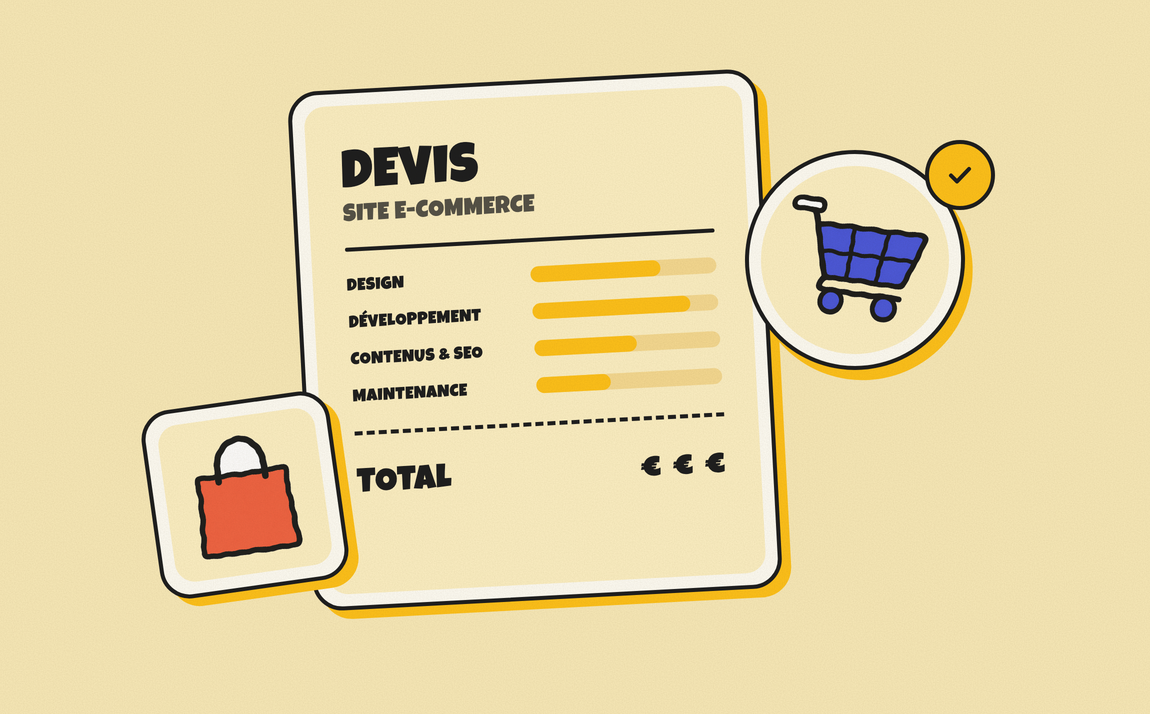
What budget should you plan for your online shop's website?
Budgets are given excluding VAT for the volumes and features stated. For a new build: scoping, site structure, UX/UI, CMS development, integration of the copy and visuals you supply, testing and onboarding. For a redesign, migration or enhancement: the work is carried out on an existing site. These services are not automatically cumulative. Copywriting, translations, new visuals, licences, subscriptions and third-party costs are to be specified in the quote.
| Service and project | Budget excl. VAT | Scope and limits |
|---|---|---|
| New build — Starter shop | €7,000 to €15,000 | 30 simple products, 1 country and 1 language. Basket, SaaS payment and 1 delivery method. Product pages and visuals supplied, commissions separate. |
| New build — Catalogue with variants | €7,000 to €15,000 | 200 products, 3 attributes and 4 main categories. Filters, variants and 2 delivery methods. No ERP or marketplace. |
| New build — B2B shop | €7,000 to €15,000 | 150 SKUs and 2 customer types. Trade access, and enquiry or order according to the rules supplied. Complex negotiated pricing and ERP to be scoped. |
| New build — International selling | €7,000 to €15,000 | 300 products, 3 languages and 3 markets. Localised catalogue and checkout journey per market. Tax, translation and carriers to be validated separately. |
| Redesign — Redesign and stock connection | €7,500 to €16,500 | 500 SKUs, 1 ERP and migration of 200 URLs. Stock and order synchronisation, plus recovery testing. Data quality, API and software fees to be confirmed. |
| Technical migration — CMS migration with design retained | €7,000 to €21,500 | 300 URLs, 1 language, 1 source CMS and 1 target CMS to be specified. Transfer of products, categories and sales pages. Checks: variants, stock, payments and orders in progress. Design and functional scope retained; exportable sources and available interfaces; licences and editorial overhaul separate. |
| Site enhancement — Connecting stock to the ERP | €1,800 to €5,000 | Existing shop, 300 SKUs and 1 ERP. Stock feeds, mappings and update checks. API supplied, no change of e-commerce platform. |
What needs to be ready to take a real order?
The initial scope is defined from a representative order. A customer finds the product, selects what they want to buy, checks the relevant information and chooses from the delivery options available. The payment and the confirmation must correspond to an order your team can then prepare.
This chain should be described before the mock-ups. Who holds the stock information? Which countries or delivery methods will be available? Who receives the order, and in which tool? A shop that looks finished can remain unusable if these decisions are pushed back to the end of the project.
The design phase can separate the features needed at launch from those that can come later. A focused catalogue, plus reliable payment and fulfilment, may take priority over a loyalty programme or complex personalisation. The choice should follow how you sell, not a list of features added because they exist elsewhere.
Benchmarks for the price of building a website give an order of magnitude, but they do not automatically describe the deliverables. A useful quote specifies what will be designed, configured, imported and tested. It also distinguishes content supplied ready to integrate from content the agency has to produce or put in order.
Why does the catalogue make the price of an e-commerce website vary so much?
Two catalogues containing the same number of products can require very different amounts of work. An item available in a single version does not have the same data as a product offered in several sizes, colours or pack sizes. Each variant can have its own SKU, stock, price and visuals, depending on how you operate.
The catalogue must let the customer understand what they are ordering. A generic photo, an ambiguous option or a poorly stated unit can make the selection uncertain. The work may therefore include a product page structure, preparing the attributes and harmonising the labels, as well as displaying them.
The information that reassures customers before a purchase must be available at the right moment. Dimensions, composition, compatibility or the contents of the parcel are not interchangeable from one product to another. The page template should accommodate the information that genuinely helps people decide, without forcing every range to use identical text.
Preparing the images is also a concrete cost item. Background removal, consistent framing, views of the variants and adaptation for mobile are not automatically supplied with the development. You need to decide who produces the files, names them and attaches them to the right SKUs.
For an import, test a representative sample before handing over the whole catalogue. It should contain the variants and special cases you will have to manage. A successful import of a simple product does not show that every product family will be carried over correctly.
Which choices change the build work?
| Shop component | Business decision to make | Work to define |
|---|---|---|
| Product and variants | What distinguishes each SKU sold and its availability | Product page templates, data, images and import |
| Basket and delivery | Methods actually possible by product and destination | Rules, messages, configuration and basket testing |
| Payment and order | Confirmed statuses and actions permitted after each response | Integration, events, confirmations and failure handling |
| Stock and business management | Source of each piece of data and behaviour when there is a discrepancy | Interfaces, synchronisation and monitoring of exchanges |
This table is for comparing the work involved, not for building a price option by option. The same feature may be available in the chosen solution, need configuring or require a specific integration. The project must check what is actually possible and how it works in your set-up, without promising that a plugin will solve every case.
Web design turns these rules into screens people can understand: choosing a variant, showing that an item is unavailable, the contents of the basket and moving on to checkout. The work is not limited to a product page mock-up without real data. It must show how the information behaves in the situations most likely to block a purchase.
The screens required by the French Consumer Code
Part of the checkout is set by law in France (the Code de la consommation). Before paying, the customer sees a summary of the essential characteristics and the total price, and the final button must make it clear that they are committing to pay. For the contracts concerned, the shop must also offer a withdrawal feature accessible from the interface, including for an order placed without an account, with a confirmation before sending and an acknowledgement of receipt.
Most shops must also meet accessibility requirements and publish information explaining how the site complies with them. These screens should be planned when you create an e-commerce website, alongside the catalogue and delivery: adding them after acceptance testing means reworking journeys that have already been approved.
Which pages did Gemeos rework for Cash Converters?
At Cash Converters, visitors may be looking for a second-hand product, wanting to sell an item or trying to find a store. Gemeos evolved the visual identity and designed the interfaces of the key pages: home page, categories, buy-back and stores. The mock-ups were integrated on a pre-production environment to check the pages and how they adapt to different screens.
This case concerns the brand experience and retail journeys. It is not enough to attribute a payment engine or stock synchronisation to the project. For your shop, the quote should distinguish the design of categories and product pages, their integration and the commercial connections actually covered.
How do you price payment without overlooking order statuses?
Choosing the payment provider is not enough to describe the integration. You need to know when the order is created, how the payment result is received and what the team sees in its tool. A refusal, an abandonment or a delayed confirmation must not trigger the same actions as a confirmed payment.
Stripe's documentation on server notifications describes, among other things, asynchronous exchanges and retried deliveries. This illustrates a point the project has to address: the shop must be able to receive an event later or several times without creating duplicate orders or starting unwarranted fulfilment. The exact mechanisms depend on the solution chosen.
Testing must cover both the customer's journey and the team's. A confirmation shown in the browser is not enough if the order does not appear in the right place. The test must check the data received, the messages sent and the operational follow-up planned.
Good to know: an order, a payment and a refund each have their own statuses. Grouping them under a single "processed" label can make tracking difficult. The site and the connected tools should use statuses that are clear and consistent with how you work.
Why should delivery and stock be scoped together?
The options offered to the customer depend on what you can prepare and ship. A product available in a physical store is not necessarily in the stock used for online orders. The project must specify which quantities are published and when they are updated.
For delivery, the rules may depend on destinations, products or the contents of the basket. The situations actually offered must be described before they are configured. A method shown for a simple order may not suit a bulky item or a mixed basket; these cases need testing.
A connection to your business management system adds decisions about responsibility. The site may receive SKUs and stock levels, then send orders back. Prices, descriptions and statuses may have other sources. A simple data map shows in which tool a piece of information should be corrected and what then needs to update.
What happens when an item is out of stock or an exchange is delayed must be agreed. The shop must not show as available data whose freshness nobody can vouch for any more. The development can provide for an alert, a block or a manual recovery depending on the approach chosen; these choices affect the scope and maintenance.
What should you prepare before choosing the launch features?
Build the project with representative products and orders. A sales presentation of the solution does not replace this preparation. Your team should be able to explain what it does today and what needs to change when you go online.
- A catalogue extract including a simple SKU, variants and the special cases to be sold at launch.
- The files and tools that are authoritative for SKUs, prices, stock, copy and images.
- The destinations and delivery methods actually offered, with their approved operational rules.
- How an order is handled, from receipt through to fulfilment and after-sales requests.
- The people responsible for content, products and transmission incidents.
This preparation makes it possible to separate a clean data migration from a substantial clean-up job. The number of SKUs to import only means something if the fields and files are usable. The quote can distinguish designing the template, testing the import and processing the full catalogue.
Reducing cart abandonment can also come down to simple decisions: making costs and options clear, removing an unnecessary step and explaining a blocker. Do not automatically add a follow-up tool or personalisation before checking the core journey.
How do you compare the build, a migration and running costs?
For a new shop, the budget covers design, content, configuration and the chosen integrations. For a redesign, carrying over the existing site can add SKUs, images and page addresses, with mapping work. Customer data and order history require a separate study depending on the tools and what can be carried over.
Running costs should not disappear into a lump sum that is hard to interpret. The platform subscription, plugins, hosting depending on the architecture, payment services and maintenance of the integrations should be identified after checking with the providers concerned. None of these costs should be assumed to be included in the build.
An e-commerce project should be estimated on its catalogue, ordering and management features.
An e-commerce web agency can scope this with your team, then link it to the design, content and development deliverables. The right quote will let you follow an order from end to end and understand who will maintain each part after go-live.
FAQ on the budget for building an online shop
How do you choose between a showcase catalogue and a transactional shop?
A catalogue presents products and can lead to a quote request. A shop must also run the basket, payment, delivery and order processing. The choice depends on what your team can actually sell and fulfil online. Take a representative product and order to compare the journeys, then the data and tools required. Platform and payment fees should be kept separate from the build work.
Is a catalogue with few products necessarily cheaper?
Not always. Customisable products, numerous variants or specific delivery rules can require more work than a larger, uniform catalogue. The quote should examine the product models and the operations needed to place an order, not just count the SKUs.
Can you use your store's stock to sell online?
It depends on your organisation and the tools available. You need to define which stock feeds the shop, when sales are taken into account and how discrepancies are handled. Synchronisation requires rules and testing; it does not follow simply from having point-of-sale software.
Should a customer account be required for every order?
This choice should serve the intended uses and what the solution can do. An account can be useful for finding past orders or accessing services, but it adds a journey and features to maintain. The project should examine what is needed before the purchase and what can be offered afterwards.
How do you handle a basket containing products with different delivery methods?
The rules must be defined before configuration: compatible methods, any splitting of the order and the information given to the customer. The budget depends on what the solution can handle natively and on the development required. A representative basket lets you check that the options offered can actually be fulfilled.
Can you add a subscription or personalisation after launch?
Yes, if the architecture and tools allow the planned change. These features should be scoped early enough when they affect the product, payment or fulfilment. They will then be covered by a specific scope; a future possibility should not be presented as already delivered.