Projects
 Our Offers
 Dedicated team
 Blog
 Academy
 About Us
Tips7 min read
How much does a startup website cost?
You are preparing a new offer, but the message, the target audience or the way you sell may still change. At Gemeos, building the website costs €6,500 to €14,000 excl. VAT for "Commercial launch" (one page and a contact page, 1 language). The "Product showcase" scope represents a budget of €6,000 to €12,000 excl. VAT (8 pages, 3 use cases and 1 language).
This budget covers the public website. It does not automatically fund your product, a connected service, an application or an investor area. Before choosing the screens, you need to decide what the website should help you check: whether the offer is understood, whether a segment is interested, a request for a pilot or a sales enquiry. That decision is what gives the web project a precise content.
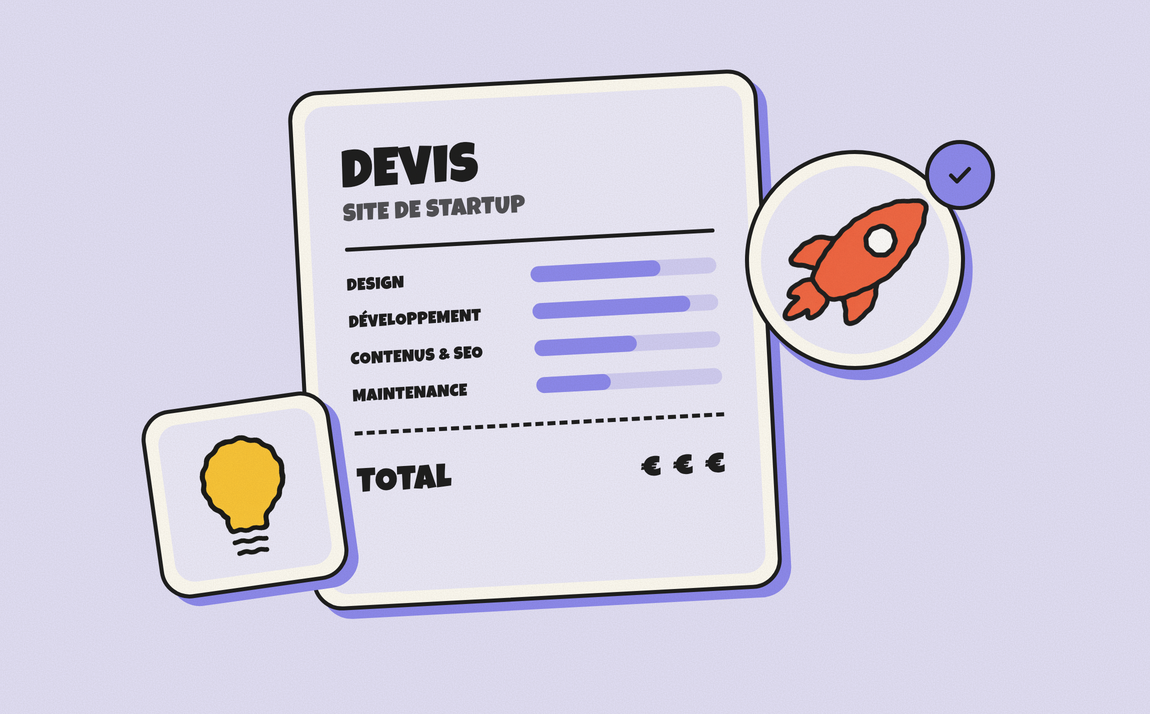
What budget should you plan for your startup's website?
Budgets are given excluding VAT for the volumes and features stated. For a new build: scoping, site structure, UX/UI, CMS development, integration of the texts and visuals you supply, testing and handover. For a redesign, migration or update, the work is on an existing website. These services do not automatically add up. Copywriting, translations, new visuals, licences, subscriptions and third-party costs are to be specified in the quote.
| Service and project | Budget excl. VAT | Scope and limits |
|---|---|---|
| New build — Commercial launch | €6,500 to €14,000 | One page and a contact page, 1 language. Value proposition, proof and contact request. No application or full brand identity. |
| New build — Product showcase | €6,000 to €12,000 | 8 pages, 3 use cases and 1 language. Product, use cases and demo. No product development. |
| New build — Acquisition before growth | €4,000 | 15 pages, 4 landing pages and 1 CRM. Content, lead qualification and enquiry tracking. No advertising budget or ongoing SEO. |
| New build — International rollout | €14,000 to €35,500 | 20 pages, 3 languages and a resource centre. Structured content and migration of 40 URLs. Translations supplied, no product back office. |
| New build — Website connected to an existing application | €8,000 to €16,000 | 12 pages and 2 interfaces with the product. Trial, existing accounts and tracking of the move to the product. No authentication or billing built from scratch. |
| Redesign — Redesign of the existing website | €7,500 to €15,500 | 45 URLs to review, 1 language, up to 5 templates; CMS retained. Offers, use cases and launch content carried over. Checks: demo, trial and existing sales tools. Existing texts lightly revised; no change of CMS and no new business software. |
| Technical migration — CMS migration with the design retained | €6,500 to €19,000 | 45 URLs, 1 language, 1 source CMS and 1 target CMS to be confirmed. Transfer of offers, use cases and launch content. Checks: demo, trial and existing sales tools. Design and functional scope retained; exportable sources and interfaces available; licences and editorial overhaul quoted separately. |
| Website update — Adding acquisition pages | €1,200 to €3,500 | Existing website, 5 pages and 1 form connected to the CRM. Landing page template and enquiry tracking. No software product or advertising subscription. |
What decision should your startup website help people make?
First, choose the action you are actually able to handle. An industrial startup may be looking for companies to run a pilot; a newly launched service may want meetings; a marketplace in preparation may collect expressions of interest. These actions do not require the same pages or the same form. Grouping them behind a "Get started" button mainly risks creating a poorly defined expectation.
The scoping work is there to pin down the audience, the problem being solved and the real next step. It must also separate what exists from what is planned. A prototype, a demo, a feature in development and an offer on sale are not interchangeable. The website can present your ambition without suggesting that an announced service is already available.
If several target audiences are being considered, prioritise one for the launch. It can be useful to design a foundation able to accommodate other segments, without writing all the pages straight away. The saving comes from postponing work on content that has not settled yet, not from the promise of a universal website that would suit every future line of business.
When is a launch page enough, and when do you need several pages?
A focused page can suit a simple offer with a single action. The "Commercial launch" scope, at €6,500 to €14,000 excl. VAT, includes one page and a contact page in one language. Full brand identity, market research and product development are scoped separately.
Several pages become useful when different readers need different explanations. An industrial partner may be looking for the terms of a pilot, while a future customer wants to understand how the service is used and how it works in practice. Use cases, resources and a team presentation can then form a standard showcase website within the stated range, depending on the templates and services chosen.
So the question is not how to keep the number of pages as low as possible. The aim is to avoid squeezing different topics into a page that is hard to share. A page dedicated to a pilot can have its own address, its terms and its contact, without forcing the reader through the startup's whole story.
Why do content and visuals change the web budget so much?
A team can know its technology inside out and still struggle to explain what a customer is buying. Web copywriting turns the mechanism into usage: who uses the solution, in what situation, with what prerequisites and what next step. A technical text supplied by the founders is not always ready to publish, but it can serve as a solid basis for interviews and precise copywriting.
Visuals should match how far along you are. A photograph of a prototype, a diagram of how it works or a usage sequence each provide different information. Commissioning an animation before the offer is settled can lead to costly rework. A simpler, editable diagram may be preferable if the process is still changing.
To reassure customers and investors, proof must remain attributable. A research partner is not necessarily a customer, a trial is not a commercial launch and a support programme is not a product certification. Have the status of each logo and each figure confirmed before adding it to the mock-ups.
The quote can separate concrete deliverables: interviews, copywriting for the priority pages, diagrams, screenshots or photo shoots. It should also state who supplies the material and who approves it. Time spent clarifying information limits back-and-forth after the design stage; it does not disappear because the startup already has an investor deck.
How did Gemeos bring brand and website together for Ecogem?
Ecogem needed to assert its identity as a startup committed to the ecological transition while keeping an understandable link with Pure Ventures. Gemeos worked on the branding, art direction, UX/UI journeys, front-end integration and SEO. The CMS organises projects, articles and resources in particular; training supports the team in getting to grips with it.
The scope was therefore not limited to launching a presentation page. It combined defining the brand universe and translating it into content templates that can evolve. For a startup that already has an identity and approved mock-ups, these items will not be split in the same way: the quote must start from what really exists.
How can you prepare for changes of target audience without rebuilding the whole website?
Separate what stays stable from what is likely to change. Your identity, the team and some operating principles may last, while offers, sectors and proof evolve. Page templates and reusable components make these changes easier, provided the architecture was designed with future content in mind.
Take a startup that starts with a pilot with manufacturers before offering a service to their distributors. The new target audience may need a distinct promise, examples and journey. Reusing a layout saves development; it does not replace the positioning and copywriting work. A new ordering feature, on the other hand, is a separate development.
Evolving the website as you grow also requires simple editorial rules. Who can publish a new offer? Is technical approval needed to change a feature description? How do you remove an old promise from pages, files and forms? Autonomy comes from these decisions and from training on real tasks, not just from access to a content management tool.
The technology is chosen to fit this organisation. A small team that edits its pages and a project that reuses content across several channels do not necessarily need the same architecture. The choice should explain what your team will be able to change on its own and which changes will require outside help, without making the CMS the main promise of the project.
What should be kept separate between the public website and an investor area?
The public website gives an accessible understanding of the offer and the company. Documents intended for investors may contain confidential information: financial details, contracts, trial data or internal assumptions. They should not be published in the website's media library simply because a page does not appear in the menu.
Google distinguishes between keeping content out of search results and restricting access to it. A directive that blocks indexing does not stop someone with the link from opening the content. If you need a private area, budget for a suitable tool and access management, with invitations, removal of rights and responsibility for updates. The need may be covered by an existing service rather than by development on the website.
Good to know: preparing a website before a funding round does not mean copying out the whole investor pack. A public presentation can explain the team, the project and the milestones you can demonstrate, while the detailed documents stay in an appropriate space. The two should be consistent without being identical.
What testing and updates should you plan after launch?
The first check concerns the enquiry that reaches your team. A form may collect an application for a pilot, a customer request or a partnership proposal. The recipients and the information to collect should reflect that difference. A confirmation message should announce the next step that is actually organised, without promising commercial availability the team cannot deliver.
- Test the priority journey on a phone, with the information a prospect is actually able to provide.
- Check that the enquiry arrives with its context: offer, page of origin and the relevant contact person.
- Review availability announcements, feature descriptions and links to proof with the people responsible for them.
- Prepare a way to change or remove old pages if the positioning changes.
- Keep the access credentials, the rights to the visuals and the information needed to bring in another provider.
Updates are then prioritised based on concrete observations: questions received, information that is misunderstood or enquiries that are impossible to qualify. The number of visits alone does not tell you whether the website explains an offer properly. Tracking can distinguish a pilot request from a sign-up for information, without turning every action into a sale or a guaranteed result.
Product features and application development are scoped separately from the marketing website. Hosting, licences and maintenance should also be kept separate from the build. The website budget and its updates should set out responsibilities and the services chosen.
Web support for a startup works best when it starts from your next commercial step and what you can show today. Bring together the priority offer, the available proof and the changes already being considered. This basis makes it possible to cost a useful launch without prematurely funding every possible version of the company.
FAQ on the budget for a startup website
How should you adapt the website if the priority is fundraising rather than sales?
The public website should make the project, the team and the publishable evidence of its progress easy to understand. An investor deck and its confidential documents can stay in a separate space. If prospects also use the website, keep a journey suited to their needs; not all visitors are looking for the same proof. The quote separates content production, the public presentation and sharing tools, without promising any funding outcome.
Can you launch the website before the product is on sale?
Yes, if the status is clear and the proposed action is real: joining a mailing list, requesting a conversation or taking part in a defined pilot. Visuals and texts must not present a feature that is still planned as available. When you want to create a startup website, the format often follows this stage: a test page while the product does not exist, a showcase website at launch, then a website connected to the application when the first users arrive. The web quote can plan the transition to sales pages without including product development.
Should you create a separate website for investors?
Not necessarily. The public website can remain shared, with a consistent presentation for customers, partners and investors. Confidential documents belong in a separate private area or a specialist service. This choice depends on the access to be managed and the documents to be shared, not on the supposed prestige of a second website.
Does a change of target audience require a complete redesign?
It depends on what changes. Audience pages and examples can be replaced within an existing architecture. A new sales model, an offer that becomes transactional or a profoundly changed identity require more work. Reusable templates reduce some rework, without making all changes equivalent.
Can prototype visuals be used on the final website?
Yes, if their status is explicit and they remain representative of the project presented. Identify the images to replace at the next stages and keep the editable files. A screenshot or render must not suggest that a feature has been delivered when it has not yet.
How do you keep control of the website if the founders later hand over marketing?
Plan for named user accounts, company access to the domain and hosting, rights to the assets created and documentation of routine changes. Training can be repeated with the future marketing lead. This handover is easier to organise if information and access are not tied to a single person.