Projects
 Our Offers
 Dedicated team
 Blog
 Academy
 About Us
Tips9 min read
How to create a website for an SME, from scoping to launch
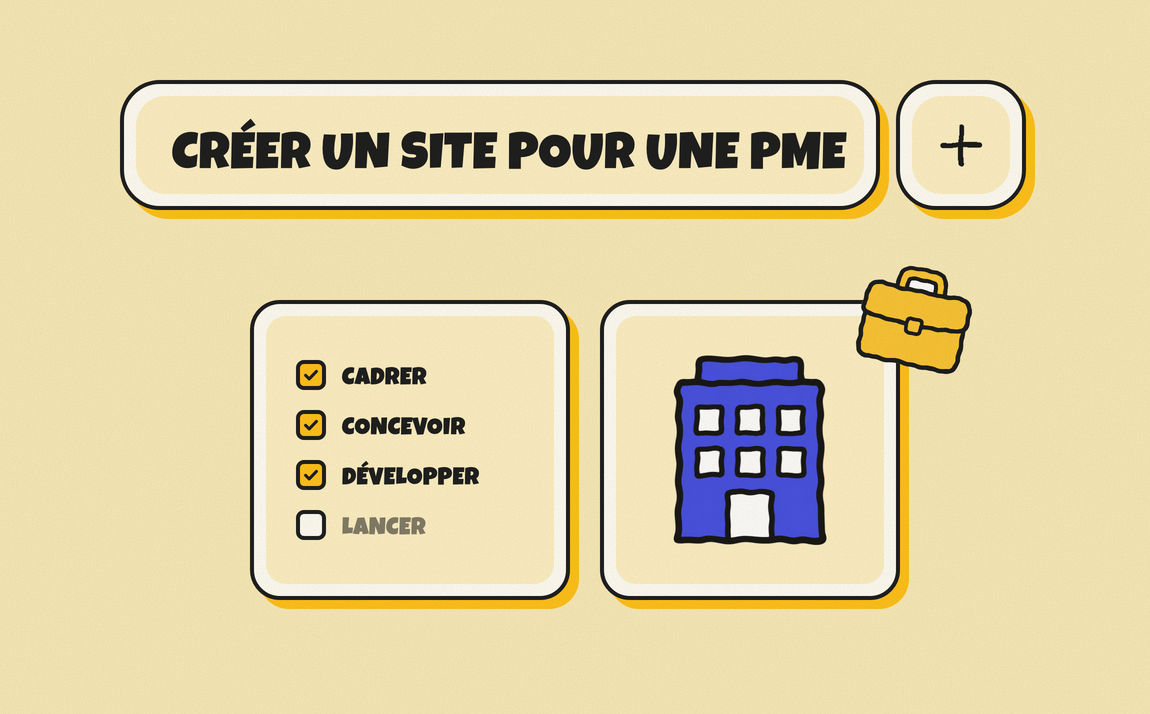
To create a website for an SME, you work in three stages: scope the project (the site's role, the internal decision-maker, the existing site, locations and languages), design a site connected to the company's tools and compliant with its obligations, then go live while keeping control of access and updates. As an SME web agency, we find that a project rarely goes off track because of the design: it is one of these decisions, left pending, that resurfaces in the middle of production.
Around the kick-off table, the managing director, sales and HR each arrive with their own list. This guide puts them back in order, whether you are creating your first proper website or rebuilding an ageing one. If it is the company's image itself that has aged, bring in a branding agency before the website: a full visual identity is not part of the showcase package costed below.
Who owns the website project internally in an SME?
In an SME, the website concerns several departments with different expectations. Sales want qualified quote requests, HR wants applications, and management wants a solid image in front of banks, key account buyers or a future acquirer. Choose one main objective: it is what will settle two conflicting requests.
Next, appoint a single decision-maker and one contact per department, who supplies the content and proofreads their section. Specify who approves sensitive copy (terms and conditions, key figures). If your priority is sales, creating a website that generates customers for an SME calls for separate work on offers, proof and forms.
| Main objective | Pages that support it | Tool to connect | Metric to track |
|---|---|---|---|
| Sales enquiries | One page per offer, references, contact | CRM | Enquiries received per offer |
| Recruitment | Careers page, job ads, company life | Recruitment software (ATS) | Applications per position and per location |
| Network of locations | One page per location with address, opening hours, team | CRM or each site's mailbox | Contacts per location |
| Catalogue and documentation | Product sheets, filters, downloadable technical data sheets | PIM or ERP export | Downloads and enquiries linked to a product reference |
| Corporate image | History, key figures, commitments, news | Audience measurement tool | Visits to company pages and contacts from partners |
Should you create, redesign or migrate the existing website?
Most SMEs already have a website. List the current URLs, the pages that bring in traffic or enquiries, the content that is still accurate (technical data sheets, references, location pages), and above all the accounts: who has access to the domain name, the hosting and the measurement tool? If some of your contacts already come from Google, involving an SEO agency at this inventory stage avoids deleting pages that are doing their job.
The inventory then points to the type of project. A redesign is suitable when the content management tool works for you but the presentation, journeys or site structure no longer keep pace with the company (new offers, new location, repositioning); the whole challenge is to set the priorities of an SME redesign so you do not rework everything at once. If the design still holds up but the CMS is holding you back (no more updates, impossible to add a location, dependence on a single provider), a migration with the design retained is sometimes enough. The point to watch is then the redirect plan for a migration: keep the URLs that remain valid and redirect each moved page to its equivalent, otherwise links break and the visibility you have built up may erode. Building from scratch is justified when the existing site has no remaining value (very old site, outdated content, changing brand), but still keep the list of old URLs so you can redirect them.
Which pages should you plan for your offers, your locations and recruitment?
One page per offer, written with the sales team
One page per offer, with the references that prove it and a suitable form, carries most of the sales enquiries. This copy is worked on with the sales team, who know buyers' objections; conversion-focused copywriting starts from these objections rather than from the company brochure.
One page per location and one version per useful language
With a head office and four regional branches, a single contact page is not enough: each location needs a page with its address, opening hours, team and a form that reaches the right place. A single domain with local pages is easier to maintain and to rank than a series of mini-sites; a separate site is mainly justified for a genuinely distinct brand. The essential pages of an SME website are not the same for a branch network as for a manufacturer distributing a catalogue.
Add a language when real customers or distributors read it. Decide who supplies the translations, who updates them when an offer changes, and which pages are translated (often not all of them). Each language version also needs its own URL structure and tags in order to be indexed.
Job ads published according to the rules
For many SMEs, the website is used as much to recruit as to sell. Decide whether job ads are published per location, who puts them online and who removes them once the position is filled. The recruitment section of the website benefits from showing the roles and teams. The French Labour Code (Code du travail) prohibits publishing a job ad that sets an upper age limit (article L5331-2) and distributing a job ad written in a foreign language, except for the exceptions provided for in the text (article L5331-4). On the data side, the CNIL, the French data protection authority, recommends not keeping an unsuccessful application for more than two years after the last contact, and informing the candidate if you keep it in a talent pool. A bill presented to the French Council of Ministers in September 2026 also plans to require a salary range in job ads. Check how far its passage has progressed when you publish your ads; adding a salary field to the job ad template now will save you from reworking every page later.
The legal notices and accessibility your size requires
No professional body (Ordre) regulates an SME's website: the rules depend on your legal status, your size and the website's features.
The website must state the company name, the legal form and share capital, the head office address, an email address and phone number, the registration number, the intra-EU VAT number where applicable, the name of the publication director (directeur de la publication) and the host's contact details. You also need a privacy policy separate from the terms and conditions, accessible from every page, and, if you use trackers subject to consent, a mechanism where refusing is as easy as accepting. If you sell online to consumers, the general terms and conditions of sale must appear on the website. The details are in the official page on mandatory notices on a company website from Service Public Entreprendre. Name the publication director from the outset, often the legal representative: they are answerable for the content published by every department.
Accessibility depends on your size. Article L412-13 of the French Consumer Code (Code de la consommation) requires operators to make certain services accessible to people with disabilities, including e-commerce, for services provided since 28 June 2025. Companies with fewer than ten people whose turnover or balance sheet total does not exceed €2 million are exempt. An SME above these thresholds therefore does not benefit from this exemption for its online sales to consumers. It must also explain publicly how its service meets these requirements. The text provides for exceptions (fundamental alteration of the service, disproportionate burden), to be documented if you rely on them. For a showcase website with no online sales, the text does not expressly cover this case: check with your adviser what your website actually allows (appointment booking, customer area, online quotes).
How do you connect the website to the CRM, the ERP and the recruitment software?
An SME often already has a CRM, recruitment software, an ERP that holds the product references, and sometimes a shared calendar. Without a connection, someone will copy every enquiry by hand.
Does a quote request go into the CRM with the offer concerned and the nearest location? Does an application arrive in the ATS with the right position? Do the technical data sheets come from an ERP or PIM export, or are they entered a second time in the website? Agree now on what stays outside the website: stock management, online payment or full synchronisation with the ERP change the nature of the project.
Finally, plan for measurement: tracking each enquiry through to the CRM shows which offers and which locations generate revenue. If your website already presents your offers well, this connection can be made without a redesign, by linking the existing forms to the CRM with routing by offer and by location.
Choosing the CMS and the delivery option based on these connections
An online website builder is enough for a simple site, if someone in-house has the time; it reaches its limits with several locations, connections to your tools or permissions per contributor. A CMS installed and configured, in-house or by a technical provider, lets you manage permissions per location and connections to your tools, but needs someone for updates and security. An agency takes care of scoping, design, development and connections to your tools, and can write the offer pages; it is the most structured option, and often the most expensive.
The choice of CMS follows from the previous steps. How many people publish, and do the head office and the locations need different permissions? Do you need repeatable templates for offers, branches or product sheets? What connectors exist for your CRM or ATS? Is multilingual content handled natively? A CMS such as WordPress covers many SME needs, provided the plugins are well chosen and maintained. A so-called headless CMS is more justified when the same content feeds several websites or applications.
What budget should you plan with Gemeos for an SME website?
The quote follows from the decisions detailed above: number of locations, tools to connect, existing material to carry over. Our guide to the cost of an SME website details each scenario.
| Scenario | Scope | What is not included | Gemeos range (excl. VAT) |
|---|---|---|---|
| Corporate showcase website | 10 pages, 4 offers, 1 language; team, offers, references, contact | Business system, full visual identity | €6,000 to €12,000 |
| Catalogue with documents | 80 product references, 50 initial documents; product sheets, filters, content administration | Stock, payment, ERP | €7,500 to €16,500 |
| SME with several locations | 5 locations, 2 languages, 60 URLs to carry over; local pages, recruitment, contacts by location | Translations (supplied by the company), intranet | €7,500 to €16,500 |
| Business development website | 18 pages, 6 offers, 1 CRM; journeys by audience, forms, lead tracking | Paid campaigns, ongoing SEO | €14,000 to €35,500 |
| Connected web ecosystem | 20-page showcase website and 2 documented interfaces; CRM, recruitment or catalogue depending on the tools retained | Licences and source software features | €14,000 to €35,500 |
| Redesign of the existing website | 100 URLs to review, 1 language, up to 5 templates, CMS retained | Complete rewrite of the copy, change of CMS, new business software | €9,500 to €20,500 |
| CMS migration with design retained | 100 URLs, 1 language, 1 source CMS and 1 target CMS | Editorial overhaul, licences | €8,000 to €23,500 |
| Connect sales enquiries | Existing website, 4 forms, 1 CRM; routing by offer and location, delivery tests | ERP, full redesign | €1,200 to €3,500 |
Software licences (CRM, ATS, ERP), translations not supplied, paid campaigns and long-term search engine optimisation remain separate. When the SME relies on Google to find customers, a semantic SEO audit carried out before the site structure helps decide which pages to create based on your prospects' actual searches.
Whatever the option, ask who writes the copy, who configures the connections to the CRM or ATS, who keeps the access details, and what is included after launch (maintenance, fixes, minor enhancements). For the timeline, ask for a schedule by stage: it depends on the scope, the preparation of content and internal approvals.
How do you keep control of the website after launch?
Access in the company's name before the switchover
Ownership of access causes more problems than the choice of tool. The employee who created the hosting account leaves, the former provider no longer responds, and nobody can change the domain name any more. Put every account in the company's name, with a generic address or at least two named administrators. Also require HTTPS, backups you know how to restore, named user accounts and a procedure for removing access when an employee leaves.
| Item | In the name of | What to check in the contract |
|---|---|---|
| Domain name | The company, as registrant with the registrar | Account access, renewal and transfer conditions |
| Hosting | The company, or the provider with documented access | Backups, restoration, HTTPS certificate, reversibility at the end of the contract |
| CMS (administrator account) | At least two internal administrators | Role-based permissions, list of accounts, whether updates are included |
| Measurement tools and Search Console | The company | Access handed over, ownership of historical data |
| CRM and recruitment software | The company, according to the vendor's licence | Who configures the connection with the website and who maintains it |
| Content and source files | The company | Assignment of rights to commissioned copy, mock-ups and photos, delivery of source files |
Updates after launch
Appoint an editorial lead, often in marketing or communications, and one contributor per location or department for routine updates: opening hours, teams, job ads, new references. Sales offers are reviewed when the company changes its services, and the list of accounts is reviewed whenever someone leaves. Also track the metrics chosen during scoping.
To launch a new offer or a campaign aimed at a specific audience, a custom landing page connected to the CRM avoids weighing down the main website's structure. Visibility in search engines, on the other hand, is built over time, with choices to make according to your resources.
At Gemeos, we support SMEs from scoping through to running the website. With several decision-makers and tools already in place, our first job is often to help management make decisions in the right order, before drawing a single page.
FAQ
What is the difference between an SME and a very small business?
An SME has fewer than 250 people, with annual turnover of no more than €50 million or a balance sheet total of no more than €43 million. What is commonly called a TPE (very small business) in France corresponds to the micro-enterprise defined by Decree No. 2008-1354: fewer than 10 people and turnover or a balance sheet total of no more than €2 million.
How much does it cost to create a website for an SME?
At Gemeos, €6,000 to €35,500 excl. VAT for a new build, and €9,500 to €20,500 excl. VAT for a redesign. The difference depends mainly on the number of locations and languages, the tools to connect (CRM, recruitment software, catalogue) and the volume of pages to carry over.
Can you create your SME's website for free?
Yes, for a very simple website, with the free plan of an online website builder. For an SME, the CRM connection, pages per location, permissions per contributor and a domain name in your own name quickly go beyond what these plans allow.
How long does it take to create an SME website?
It depends on the scope, the preparation of content and the number of internal approvals. Ask your provider for a schedule by stage that also shows when you need to supply copy, photos and feedback.
Does an SME website have to be accessible to people with disabilities?
Yes for an e-commerce service aimed at consumers and provided since 28 June 2025, except for exemptions provided for by French law, notably for micro-enterprises providing services. For a website with no online sales, check with your adviser which other accessibility regimes apply and what the website's features allow.
Should you rebuild the whole website or just connect it to the CRM?
Not necessarily rebuild everything. If the website presents your offers properly and only the enquiries are getting lost, connecting the forms to the CRM may be enough; at Gemeos, this work costs €1,200 to €3,500 excl. VAT. A redesign is justified when the journeys, site structure or CMS are holding back the company's development.
How do you make an SME website visible on Google and in AI tools?
By working on search engine optimisation over time, offer by offer and location by location, rather than all at once at launch. For AI assistants that answer buyers directly, a GEO audit lets you check how they present your company and which pages they cite.