Projects
 Our Offers
 Dedicated team
 Blog
 Academy
 About Us
Tips8 min read
How much does a very small business website cost?
Your prospect has heard about your small business through a recommendation and wants to check what you can take on. At Gemeos, building the website costs €5,000 to €11,000 excl. VAT for a "Launch presence" (one presentation page plus a contact page, 1 language) and €6,500 to €13,000 excl. VAT for "Local prospecting" (8 to 12 pages, 3 services and 3 areas actually covered).
A very small business website should extend the owner's sales work: explaining the services before a call, showing an example of a job and capturing the context of each enquiry. A service business selling a few well-defined jobs does not need the same scope as a business that organises appointments, tailored quotes or orders.
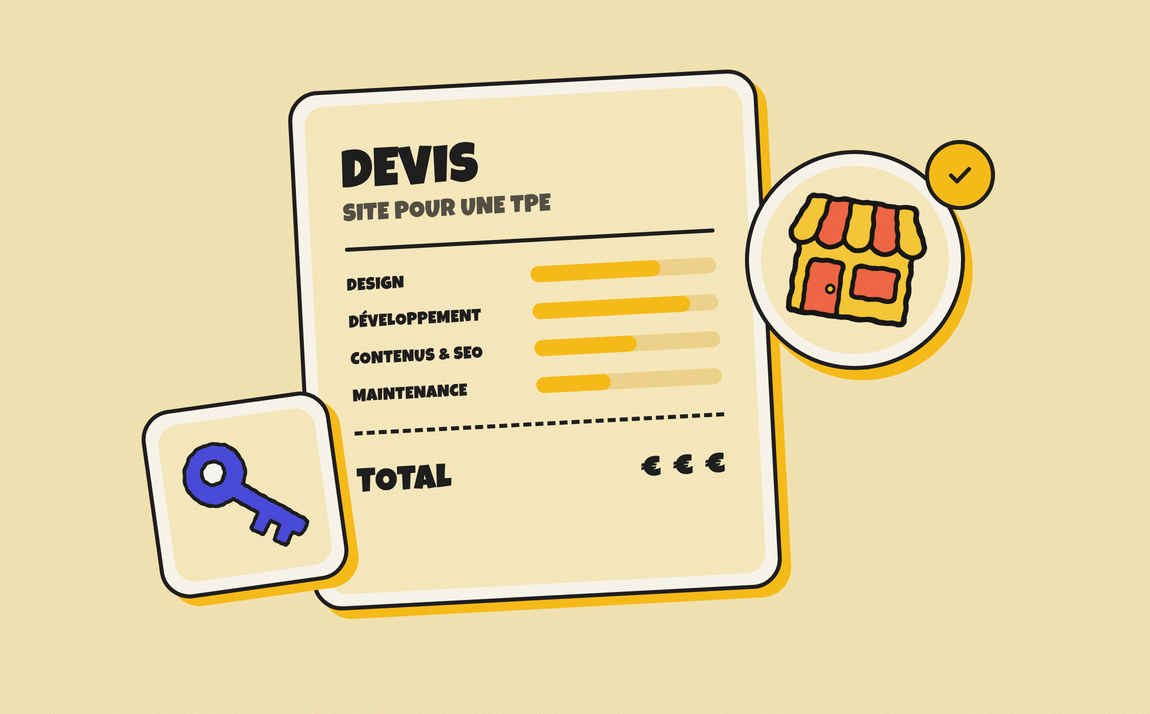
What budget should you plan for your very small business website?
Budgets are given excluding VAT for the volumes and features stated. For a new build: scoping, site structure, UX/UI, CMS development, integration of the texts and visuals you supply, testing and handover. For a redesign, migration or upgrade: the work concerns an existing site. These services do not automatically add up. Copywriting, translations, new visuals, licences, subscriptions and external costs must be specified in the quote.
| Service and project | Budget excl. VAT | Scope and limits |
|---|---|---|
| New build — Launch presence | €5,000 to €11,000 | One presentation page plus a contact page, 1 language. Core services, contact details, simple form. No catalogue and no integration with business software. |
| New build — Service business | €5,000 to €9,500 | 5 to 7 pages, 3 offers, 1 language. Service pages, references and contact requests. Existing texts and brand identity supplied, no booking. |
| New build — Local prospecting | €6,500 to €13,000 | 8 to 12 pages, 3 services and 3 areas actually covered. Distinct local pages, testimonials and enquiry tracking. No SEO subscription and no automatically generated pages. |
| Redesign — Showcase site redesign | €8,500 to €16,500 | 10 to 15 existing pages to rework, 4 templates. Inventory, light rewriting, redirects and form checks. No change of brand identity and no business software connection. |
| New build — Services with appointments | €5,500 to €11,500 | 8 pages and 3 appointment categories. Integration of an existing SaaS calendar and booking tests. Calendar licences and development of a calendar excluded. |
| Technical migration — CMS migration with design retained | €6,500 to €19,000 | 15 URLs, 1 language, 1 source CMS and 1 target CMS to be specified. Transfer of offers, references and forms. Checks: external calendar and enquiry recipients. Design and functional scope retained; exportable sources and available interfaces; licences and editorial overhaul billed separately. |
| Site upgrade — Add appointment booking | €1,200 to €3,500 | Existing 8-page site, 1 calendar and 3 slot types. Integration, confirmations and appointment tracking. No design overhaul and no CMS replacement. |
How do you prepare a very small business website when the owner also handles the customers?
The quote should describe the contributions expected from you, because the provider cannot approve your offer or your terms on your behalf. You need to set aside time to pass on information, review and make decisions. The time required depends on the state of your content and the number of people involved; no universal figure can be given.
In a small business, the same owner may handle production, sales and customer follow-up. A project that needs daily approvals can then stall, even if its price looks attractive. Ask for identifiable stages and a single point of contact, then agree on how you will send your feedback.
This organisation continues after delivery. A news section is only useful if someone can keep it fed. Stable offer pages and a selection of references may suit your availability better than an editorial calendar that nobody keeps to.
Which website should a very small business that sells through referrals or on quotation pay for?
The choice depends on how your customers find you and buy from you. A small business that works mainly through referrals can use its site to confirm its credibility. A business that wants to develop a new offer also needs to explain that service and organise the enquiries it wants to receive.
| Role of the site | Useful scope to cost | What can wait, depending on your business |
|---|---|---|
| Reassure after a referral | Offer, team or contact person, proof and contact | Regular sections with no content available |
| Receive enquiries for several services | Offer pages, examples and a needs-based form | Client area if no recurring exchanges justify it |
| Prepare an appointment | Practical information, qualification and access to the existing calendar | Custom-built calendar if an existing tool already does the job |
| Sell standardised products or services directly | Catalogue, ordering, payment and order processing | To be costed as a sales journey separate from a simple presentation site |
Integrated content must be distinguished from content to be produced. Texts and visuals are supplied in the new-build scenarios presented; copywriting, new photography and additional connections must appear in the quote.
A web agency for small businesses should therefore explain why a feature is necessary for your organisation. Online booking, for example, does not provide the same service as a callback request. Your availability to handle the contact matters as much as the button being there.
Which services make up the cost of a very small business website?
The price of a website should correspond to identifiable work. A very small business may need help formulating its offer and preparing its proof as much as it needs development. Ask what will be delivered, what your business will supply and what you will be able to change afterwards.
| Service | Expected outcome | Contribution to plan on your side |
|---|---|---|
| Scoping and architecture | Offers, audiences and contact journeys organised | Approve your priorities and the limits of your services |
| Content | Texts and references ready to integrate, in a defined volume | Pass on business information and authorise the proof used |
| Journey and interface design | Pages that read well on a phone and a presentation consistent with your brand | Decide between proposals and distinguish an identity to be created from a website design |
| Development and contact | Editable templates, forms and tested notifications | Define who receives and handles enquiries |
| Migration and handover | Carry-over of useful existing material, logins and training | Identify the old pages to keep and a person able to publish |
Should the business's brand identity be redone?
An existing brand may be enough if its elements are usable and consistent: logo, colours and visuals. Web design then organises these elements to present the offer. If you are also changing the name or positioning, have the branding work and its deliverables costed separately. A new identity should not be assumed to be included in a website build.
What should be ready at delivery?
The contract should state the content actually integrated, not just the templates available. An empty reference page and a reference published with text and photos are not the same deliverable. Also have the tests named: receipt of a form, confirmation displayed, display on a phone and an offer updated by your team.
During an SEO migration, prepare the list of old pages and documents still in use. The quote should distinguish content carried over, texts rewritten and the handling of old addresses. Keeping a short structure does not exempt you from checking the links from your business cards, directories or sales documents.
Why can two quotes for a small business be very different?
Quotes do not always cover the same work, even when they state the same number of pages. Scoping the offers, copywriting, visuals and testing may be included, offered as options or left to you.
A service-based very small business can present its offers on pages with the same structure: problem addressed, service proposed, example of a job and information needed for the quote. The work increases if each service targets a different audience or needs its own journey. Preparing this content with the owner does not cost the same to produce as integrating texts that are already finalised; the quote should make this difference visible.
Web design also deals with real situations: understanding an offer on a phone, finding a number and sending an enquiry. A reusable page template can avoid designing each offer separately. It does not, however, produce your texts or your photographs.
To create a professional website on a very small business budget, start by making this work visible. Prepare the elements available and assign what is missing:
- An accurate description of each offer and its limits.
- The questions your customers ask before requesting a quote.
- Usable photos and the references you are authorised to publish.
- Contact details and how replies to enquiries are organised.
- The name of the person who will approve the content and test changes.
Testimonials and examples must remain genuine. If you have no case you can publish, explain your method and the stages of the service without turning a fictitious scenario into a client result.
Which form helps a small business prepare its quotes?
A simple form may be enough if enquiries are then followed up by an identified person. Its budget should cover the necessary fields, receipt, confirmation and testing, not just its appearance.
For a very small business with two offers, choosing the service and a short description can prepare the callback. If the service area or the type of client determines whether you accept the job, this information deserves to be explained before submission. Avoid asking for a full file when an initial conversation is enough.
To generate useful contact requests, also define what happens next: who receives the message, how it is assigned and where the follow-up is recorded. A tracking spreadsheet may be fine at the start if your volume and organisation allow it. Connecting to sales software becomes a separate cost item when it has to avoid re-keying or route enquiries to several recipients.
The features of a small business website should be chosen according to these needs. A chatbot, a client area or a calculator require content, rules and maintenance. Their presence is not a sufficient reason to choose the most comprehensive quote.
How can you limit the quote without paying twice for the same work?
At launch, keep the important offers, the proof available and a reliable contact route. Postpone features whose usefulness or owner has not been defined. A reduced scope remains relevant if it lets customers understand your business and reach you.
Do plan for likely changes, however. If a second offer is already on sale, hiding it to stay on a single page can make the site less useful. Conversely, developing a client area straight away for a service still in preparation ties up budget in rules that may change.
When accepting the site, make one of the changes provided for in the contract yourself and send an enquiry from a phone. Check the message received and the person who handles it. These tests show whether the services purchased match the way you work, beyond the mock-ups.
How do you compare a one-off build price with a subscription offer?
Compare the same duration and the same scope. A monthly fee may spread a build cost, fund support or bundle several services. You need to know what you are paying for, for how long and what remains accessible at the end of the contract. To create a website for a very small business, a subscription should therefore be compared with a DIY site and with a project entrusted to an agency, with the same requirement in every case: a domain name registered in the business's name and administrator access that you hold.
For each proposal, ask for:
- The initial cost and all scheduled payments over the period being compared.
- The content, templates and features actually delivered.
- The changes included and their limits.
- The accounts accessible to your business and how content can be retrieved.
- The end-of-contract terms and any fees that may apply.
What costs remain to be paid after the build?
The site needs an address, hosting and maintenance suited to its components. Licences and content work may be added to these costs. Ask for the renewal amounts and the services covered, noting the items already bundled in a single contract.
The chosen tool should allow the changes you will actually make: changing a service, adding a client reference or announcing a closure. WordPress, Webflow and a headless architecture are among Gemeos's approaches. For your very small business, above all have these operations checked with the person who will take over the site, along with the logins they will keep.
If your offers are stable and you publish little, simple content management may be enough. If an assistant has to keep availability up to date and a partner approves prices, user rights and the publishing workflow require additional scoping. This organisation explains the work to be funded far better than a list of technologies.
Afnic, the registry for .fr domains, explains how to manage a domain name, including renewal and the importance of up-to-date contact details. For your business, keep a list of accounts, contacts and renewal dates. A person who has left the team must not remain the only point of access to this information.
Gemeos SEO/GEO support starts at €1,000 excl. VAT per month, with a scope to be defined. This service is separate from the build. SEO work should serve objectives compatible with your sales capacity: a service to develop, a relevant area or a type of enquiry you are looking for. It does not guarantee a volume of customers.
Prepare your priority offers, the content available and the person who will handle enquiries to get a quote suited to your very small business. You will be able to compare what will be ready at launch, the work left for you to do and the costs to plan for afterwards.
FAQ on the cost of a very small business website
Which web project should come first if the business mainly lacks qualified enquiries?
First identify where prospects drop off: are they unable to find your business, do they misunderstand the offer, or do they send enquiries outside your scope? The first case may justify visibility work; the second, a rework of the service pages; the third, clarifying the areas and the form. Bring a few recent enquiries to the scoping stage. They will help you choose the useful services before deciding on a complete redesign.
We work mainly through referrals: should we pay for a large site?
Not necessarily. The site can confirm your business, show proof and allow a referred prospect to contact you. If you have few offers and they are easy to explain, a compact format may be suitable. Different services or audiences may justify dedicated pages. The quote should follow this actual role, without assuming a full acquisition programme.
I handle customers on my own: can calls during jobs be avoided?
The site can favour a form or a callback request with the necessary information. State the availability you can genuinely keep to, without promising an immediate response. The journey should deliver the enquiry into a tool you actually check. Automatic slot booking requires additional scoping if your schedule changes often.
Can offers for professionals and for private customers be presented on the same site?
Yes, if visitors quickly understand what applies to them. Different terms, examples or quotation methods may call for separate pages, even if some of the templates are shared. The provider should cost the content and journeys each audience needs, not just add two buttons to the home page.
We have no employee in charge of marketing: do we still need a blog?
Not by default. Start with accurate offers, up-to-date information and references you can maintain. A blog requires someone responsible for writing and approval. If it is part of a specific visibility objective, have its production and cost defined; creating an article template does not implicitly include regular publishing.
Should a new line of business planned for later be paid for in the first quote?
Have what prepares for the change separated from what can wait. A reusable template can make it easier to add an offer; its texts and specific features still need to be produced. If the new line of business is not yet defined, ask for the conditions for adding it later rather than detailed development based on assumptions.
What should the training cover if an assistant manages the updates?
Choose real tasks: changing an offer, replacing a photo and updating contact details. The assistant should have the appropriate logins and be able to repeat these actions. Have the documentation provided and the help available after handover specified. Training on the tool does not replace your internal process for approving sales information.