Projects
 Our Offers
 Dedicated team
 Blog
 Academy
 About Us
Tips7 min read
What budget should an SME plan to build or redesign its website?
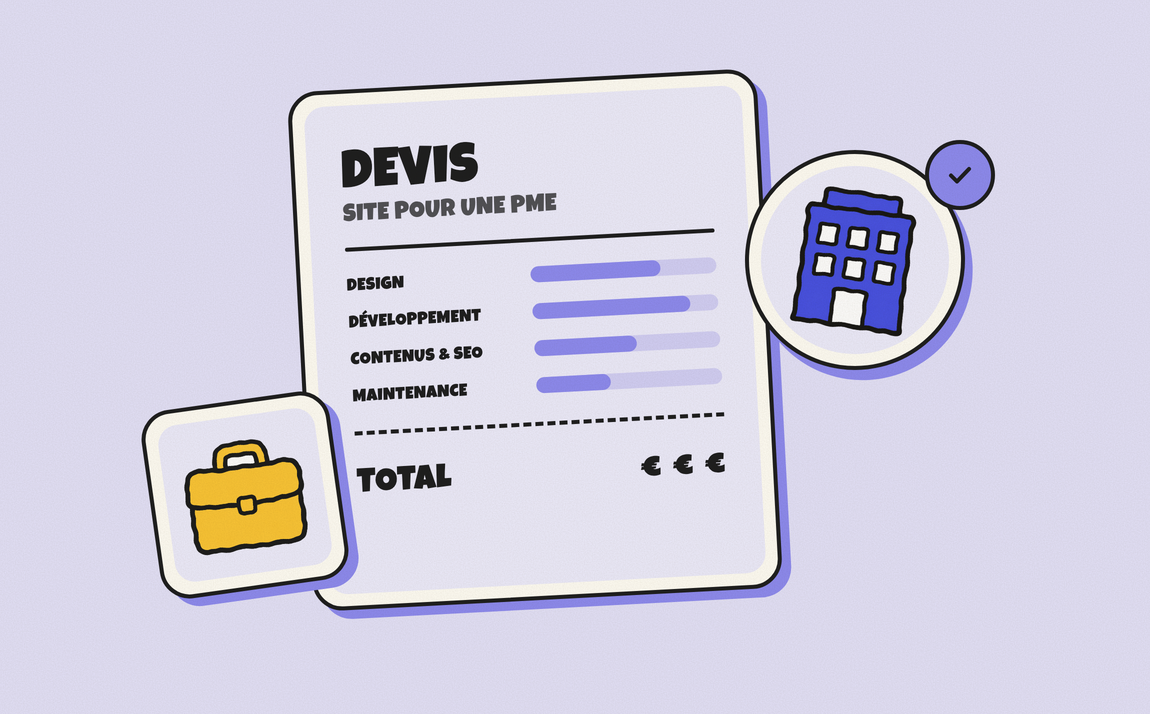
A new line of business, teams spread across several sites and offers that have changed: your website may no longer present the company you run today. At Gemeos, the budget for building the website is €6,000 to €12,000 excl. VAT for "Corporate showcase website" (10 pages, 4 offers and 1 language). For "Business development website", allow €14,000 to €35,500 excl. VAT (18 pages, 6 offers and 1 CRM).
The project has to put your offers back in order without interrupting the enquiries the company already receives. The budget therefore covers preparation, copywriting, design and the transfer of existing material as much as development. A connected catalogue, customer accounts or exchanges with your management software add processing that needs to be costed separately.
What budget should you plan for your SME's website?
Budgets are given excluding VAT for the volumes and features stated. For a new build: scoping, site structure, UX/UI, CMS development, integration of the copy and visuals you supply, testing and onboarding. For a redesign, migration or enhancement: the work is carried out on an existing site. These services are not automatically cumulative. Copywriting, translations, new visuals, licences, subscriptions and third-party costs are to be specified in the quote.
| Service and project | Budget excl. VAT | Scope and limits |
|---|---|---|
| New build — Corporate showcase website | €6,000 to €12,000 | 10 pages, 4 offers and 1 language. Team, offers, references and contact. No business system or full brand identity. |
| New build — Business development website | €14,000 to €35,500 | 18 pages, 6 offers and 1 CRM. Journeys by audience, forms and lead tracking. No paid campaigns or ongoing SEO. |
| New build — Catalogue with documents | €7,500 to €16,500 | 80 product references and 50 initial documents. Product sheets, filters and content administration. No stock, payment or ERP. |
| New build — SME with several locations | €7,500 to €16,500 | 5 locations, 2 languages and 60 URLs to carry over. Local pages, recruitment and contacts by location. Translations supplied, no intranet. |
| New build — Connected web ecosystem | €14,000 to €35,500 | 20-page showcase website and 2 documented interfaces. CRM, recruitment or catalogue depending on the tools retained. Licences and source software features excluded. |
| Redesign — Redesign of the existing website | €9,500 to €20,500 | 100 URLs to review, 1 language, up to 5 templates; CMS retained. Transfer of services, locations and resources. Checks: CRM, recruitment and catalogue tools. Existing copy lightly revised; no change of CMS or new business software. |
| Technical migration — CMS migration with design retained | €8,000 to €23,500 | 100 URLs, 1 language, 1 source CMS and 1 target CMS to be confirmed. Transfer of services, locations and resources. Checks: CRM, recruitment and catalogue tools. Design and functional scope retained; exportable sources and available interfaces; licences and editorial overhaul separate. |
| Website enhancement — Connect sales enquiries | €1,200 to €3,500 | Existing website, 4 forms and 1 CRM. Routing by offer and location, delivery tests. No ERP or full website redesign. |
Where do you start when the website no longer reflects the SME's business?
Start with what the company sells today and wants to grow. Internal divisions do not always match the questions customers ask. An SME may offer installation, maintenance and support, while its website still sorts the offers by team names that have become hard to understand. Scoping should find an organisation that visitors grasp without knowing how your company is structured.
Gather recent enquiries and a few representative sales exchanges. They help identify missing information, services that get confused and contacts that are misdirected. The point is not to publish client files, but to use these situations to define the pages and the questions they need to answer.
The priorities of an SME redesign can then be more specific than "modernising the image". For example: separating one-off services from ongoing contracts, making a new line of business understandable, presenting several locations or enabling the sales team to share the right references. Each priority should translate into a deliverable and a journey that can be tested.
This phase avoids automatically carrying over the whole old website. Some content remains useful; other content describes a discontinued offer or an organisation that no longer exists. The agency should be able to distinguish what to keep, rewrite, merge and delete, with your business line managers, before producing the new templates.
Which services make up the cost of an SME website?
The price brings together different pieces of work that should remain identifiable. Scoping and site architecture define the offers and journeys. Copy and images provide usable material. Design organises this material into readable pages. Development then makes it possible to publish, update and receive enquiries according to the chosen setup.
| Web project workstream | Deliverable to specify | Contribution expected from the SME |
|---|---|---|
| Putting the business lines in order | Site architecture, priority pages and contact journeys | Decide which offers to sell and name the people responsible for them |
| Making content usable | Transfer or copywriting, references and authorised images | Supply the facts, documents and approvals for publication |
| Enabling updates | Editable templates, permissions and training on routine tasks | Identify the people who prepare, approve and publish |
| Managing the transition | Transfer of URLs, delivery tests and post-launch checks | Provide access and test enquiries with the recipients |
Two quotes in the same range can divide this work very differently. One may provide for integration based on copy finalised by your team; the other may include interviews and a rewrite of the priority pages. Without this distinction, the price of a website does not let you compare the time the SME will still have to put in.
The number of templates matters more than the number of pages alone. Several references can use a shared template; a new line of business may need its own journey.
How do you organise production without tying up the whole company?
Appoint one contact who can coordinate decisions, then an approver for each important area. Management can approve the positioning, a business line manager the services, and someone from sales the information needed to route enquiries. Circulating every paragraph around the whole company lengthens timelines without guaranteeing a clearer decision. To set the cost of a small business website, you need to know, among other things, what the owner approves and how they follow up enquiries. In your SME, show the coordination, permissions and handovers that are actually needed, rather than deducing the budget from the size of the company.
Content preparation should be planned as part of the project. Identify the documents that exist, those that need reworking and the information that has to be gathered through interviews. A sales brochure may contain useful material without being a web page as it stands: it may mix offers together or assume a context the visitor does not know.
The essential pages of an SME website should above all cover the priority business lines and the proof behind them. A reference can explain the assignment actually carried out, the services provided and the context that may be shared. Photographs, logos and quotes require approval before publication. They should not be reused simply because they appear in an old presentation.
The copywriting service can be limited to a defined set of pages, then accompanied by a guide for the following ones. This passes on a method without pretending that every employee will become a writer. You still need to decide who prepares, who checks and who publishes future content.
What level of autonomy should you plan for if teams and responsibilities change?
Autonomy is measured on specific tasks: editing an offer, adding a reference, replacing a contact or announcing a new location. The website should provide templates and fields that the people concerned understand. Giving access to every setting is not necessary for a team to work effectively.
The technical choice follows from this organisation. One tool may suit simple editorial pages, while another project needs to reuse content across several channels or connect to an existing system. The agency should explain what can be edited and which interventions will still be needed. A technology name alone does not demonstrate the company's future autonomy.
Training works best with your own content: adding a service, publishing a reference and correcting a phone number. Short documentation on these tasks remains useful when someone joins the team. The company's accounts and key access rights should also be organised so they do not depend on a single employee or a personal account.
Good to know: an editable website is not a website that keeps itself up to date. A discontinued offer, a replaced manager or a relocated site requires a decision and a correction. The budget should provide for organisation and handover, not just access to the interface.
Which connections are useful, and which can wait?
Fund a connection when it serves an identified exchange. If sales staff re-enter every enquiry into the same tool, a transfer may be useful. If a catalogue receives its information from a reference database, synchronisation can limit duplicate updates. However, the available features, data and rules need to be checked with the people in charge of the tools concerned.
A connection raises questions that a form alone does not: how do you match a company already on file, who should the enquiry be assigned to, and what happens if the transfer fails? The project must test these behaviours. A receiving email address may remain suitable for a simple process, provided the response is organised and the enquiry is usable.
Customer accounts, automated quotes and personalised pricing are features to be scoped according to your business. It may be sensible to launch a clear public presentation first, then the connected services, with the necessary links planned in advance.
How do you replace the website without losing the journeys that work?
Before going live, identify the old URLs that customers, partners and sales staff use. Some appear in emails, brochures or bookmarks. The change of structure should plan where each one leads, so that visitors find relevant information instead of landing on an unrelated page or an error.
An SEO migration covers, among other things, the transfer of pages and the mapping between old and new URLs. It does not guarantee a level of traffic, but it helps plan the necessary checks. A business line that is still offered should not disappear from the new website simply because its label has changed in the navigation.
- Review the offers and contacts with the operational managers before they are published.
- Test an enquiry for each business line and each location concerned, using dummy data.
- Check the important old pages and the links still used in your sales materials.
- Check downloads, replaced files and any private access included in the scope.
- Decide who follows up enquiries and fixes problems after launch.
Maintenance and enhancements should be kept separate from the build price, depending on the contract: hosting, licences, technical work and content. SEO/GEO support from Gemeos starts at €1,000 excl. VAT per month, with a scope to be defined; it does not replace maintenance or the updating of your offers. The recurring budget should match tasks and a real capacity for sign-off within the SME.
To work with a web agency for SMEs, prepare your list of priority business lines, representative content and the enquiries you want to receive. Also have the people who will be able to decide and publish named. The quote can then specify what will be designed, carried over and handed over, with a website the company can run after launch.
FAQ on the budget for an SME website
Which web work should you prioritise if the company wants to enter a new market?
Choose the offers and audiences concerned, then check the proof available to address them precisely. An adaptation may cover use-case pages, languages, references and the routing of contacts, without changing the whole website. If the offer or the sales journey changes more substantially, the scope grows. Scoping should distinguish reusable content from content to be produced for this market, and assign its approval to the managers concerned.
Should you rebuild the website after adding a new line of business?
Not automatically. If the site architecture, templates and contact journey can accommodate this offer clearly, an extension may be enough. A redesign becomes more relevant when the business lines as a whole are poorly organised or the content no longer reflects the company. Starting from scratch to create a website for an SME is mainly justified when the existing site has no remaining value, for example outdated content or a changing brand; in that case, keep the list of old URLs so you can redirect each one to its equivalent. The assessment should focus on usage and on what needs to be carried over, not on the age of the website alone.
Can each department publish its own pages?
Yes, with suitable permissions and approval. Managers can prepare their content in shared templates, while one person checks consistency before publication. The project should define the limits on editing and the shared information, to avoid contradictory contact details or offers between departments.
How do you cost a website for several locations?
Identify what is shared and what genuinely differs: business lines, contacts, teams, references or areas served. A location template can be reused, but local content must reflect a real presence and organisation. The rules for routing enquiries and for updates are part of the scope.
How do you hand over the website when a marketing manager leaves the company?
Prepare a handover that brings together the company's accounts, recovery contacts, subscriptions and technical contacts. Add the routine tasks and the people who approve the offers for each business line. The new manager must be able to find the access details, edit content and check that enquiries are received. Ask for the project to specify the documentation and training available for this handover, without relying on a personal account.
Can you keep old references if the SME's offer has changed?
Yes, when they remain relevant and are presented in context. The date, the scope and the company's role help avoid giving a false impression of a current offer. A past project should not be used to promise a discontinued service. Have the references sorted with the business line managers and keep only what can be published.