Projects
 Our Offers
 Dedicated team
 Blog
 Academy
 About Us
Tips9 min read
How to create a website for a real estate company: audiences, obligations and budget
To create a website for a real estate company, you list its audiences (landlords, tenants, co-owners, investors), check the rules that apply to each, separate the role of the website from that of the business software, then design the pages and choose the tool. A real estate web agency starts there because, in the same week, a landlord is looking for someone to manage their studio flat, a tenant wants to report a leak and a co-owner is looking for the latest minutes of the general meeting.
This guide is for real estate businesses that manage more than they sell: lettings management, syndic (the managing agent of a French copropriété), property investment companies (foncières), investment firms and groups with several entities. An SEO semantic audit carried out beforehand shows which searches justify a page and, depending on what the site needs to carry (service pages only, an asset catalogue, several entities, connected software), the budget at Gemeos ranges from €7,000 to €20,000 excl. VAT.
Start with the list of audiences and what each one comes to do
A real estate company rarely has just one type of client. Write one line per audience, with what they are looking for:
- Landlords want to understand your management mandate, what it covers and what it costs.
- Tenants are looking for a contact, a procedure (incident, notice to quit, certificate) and rarely more.
- Co-owners want their documents and access to the syndic's online area.
- Investors, whether private or institutional, look at assets, documents and the way you manage them.
- Buyers of new-build homes compare developments, units and floor plans.
For each one, note the expected action (book an appointment, download a document, request a management proposal) and rank them. The audience at the top of the list decides the home page.
If your main business is sales, the site is organised around listings, mandates and sellers, a different project that Gemeos handles as a web agency for real estate agencies. The same goes for a developer selling off-plan: a property developer's website revolves around developments and units.
Turn this list into a site structure and an SEO plan
Each audience has a visible entry point ("Landlords", "Tenants", "Co-owners", "Investors") leading to pages written for them, with their own contact: the management department, the building manager, the investment team. SEO is decided at the same time. An SEO agency starts from your actual locations to plan one page per business line and per town where you operate, each with its own content (buildings managed, neighbourhoods, contacts), and listings whose titles, structured data and sitemap are generated from the fields.
Display the fee schedule, the legal notices and the status of units
The fee schedule comes first. The order of 10 January 2017 applies to any professional who brings buyers or tenants together with sellers or landlords, for sales, lettings and management. The site displays the maximum prices of the services, including VAT, stating who pays them; if the price depends on the value of the property or the rent, it shows the bands and says whether they are cumulative. This information must be easily accessible online, including from every listing: a link to the fee schedule in the footer and on every listing settles the matter.
The legal notices include what identifies the professional. The decree of 20 July 1972 (the "Transactions sur immeubles et fonds de commerce", "Gestion immobilière" and "Syndic de copropriété" professional licences, or cartes professionnelles) requires the licence number and place of issue, together with the financial guarantor where applicable, to appear on documents, contracts and correspondence. The text does not expressly mention websites, but it is prudent to include them there. If you work with consumers, the name and contact details of your consumer mediator also appear on the site.
| Business line | To display on the website | What stays in the business software | Reference text |
|---|---|---|---|
| Lettings management | Management and letting fee schedule, mandate services, contact per audience | Prospective tenants' application files, management reports | Order of 10 January 2017; decree no. 2015-1437 |
| Syndic de copropriété | Presentation of the service, contact, link to the online area | Copropriété documents and individual accounts, by profile | Law of 10 July 1965, art. 18; decree no. 2019-502 |
| Sales | Fee schedule, listings with a legible DPE, link to the fee schedule from every listing | Mandates, tracking of viewings and offers | Order of 10 January 2017 |
| Development (off-plan sales, VEFA) | Development and unit pages, unit statuses, floor plans, sales contact | Reservation contracts, calls for funds | Depending on the content of the pages, to be reviewed by your legal adviser |
| Investment | Assets, public documents, risk warnings | Subscriptions, reporting to partners or investors | AMF (French financial markets authority) rules on marketing communications |
Build the pages for landlords and tenants
A landlord comparing two property managers wants to know what the mandate covers, what is charged separately and how they will keep track of their rent. The landlord pages start from these questions rather than from a list of services.
A sitting tenant comes for a specific reason: to report an incident, give notice or obtain a certificate. One page per procedure, with the right contact and the response time you actually meet, avoids a good share of phone calls.
Prospective tenants often arrive through a listing. Housing listings follow the rules on the DPE (the French energy performance certificate) set out by service-public.fr: legible, colour energy and climate ratings, the statement "logement à consommation énergétique excessive" (excessive energy consumption) for classes F and G, and an estimate of annual energy costs with its reference year. A well-displayed label does not, however, mean the property can be let: in mainland France, class G has been excluded since 2025 from the new leases, renewals and tacit renewals concerned, a check to make before publishing. The choice of features for a real estate website (multi-criteria search, filters, map, alerts) then depends on the number of units to let.
In lettings management, the question concerns the applicant's file. The documents a landlord or their agent may request form an exhaustive list (decree no. 2015-1437 of 5 November 2015), and the law prohibits asking for any sum to reserve the property. The CNIL (the French data protection authority) requires applicants and guarantors to be informed of their rights, documents to be destroyed as soon as they are no longer needed and access to be restricted. The website form is therefore limited to what is needed to call the applicant back, and the file goes through a secure tool.
Connect co-owners to the syndic's online area
For a syndic, the boundary between the website and the business software is set out in law. Under article 18 of the French law of 10 July 1965, a professional syndic must offer secure online access to the copropriété's digital documents, unless the general meeting decides otherwise. Decree no. 2019-502 of 23 May 2019 sets the minimum list on three levels: common documents (copropriété regulations, minutes of general meetings, etc.), each co-owner's documents relating to their unit (individual account, calls for funds) and the documents of the conseil syndical (owners' council). This profile-based access belongs in the syndic software, which already manages the accounts and permissions. The website presents the service, gives the building manager's contact details and places a link to the online area in the header. Rebuilding an extranet within the website would double the number of accounts to manage without giving co-owners anything more.
Present a portfolio to investors
For a property investment company (foncière) or an investment firm, take stock of the catalogue: how many assets or properties, in how many categories, with which fields (floor area, type, location, status, public documents), updated by whom and how often? Also check your management or marketing software. A documented API or export feed can populate the listings, if the data and access rights allow it. Without a usable connection, the listings are entered by hand, and one person is responsible for the statuses.
Design a listing template that works for a hundred assets
With a hundred assets, nobody rereads every listing. The template sets out, once and for all, the expected fields and the contact attached to each listing. The work of a web design agency then focuses on this template: where the status goes, a floor plan that is legible on mobile, comparing two assets.
If your pages present an investment product (SCPI units, funds, club deals), they fall under the AMF rules on marketing communications: their content must be accurate, clear and not misleading. Have these pages approved by your compliance department at the mock-up stage, when moving a warning costs nothing.
A group that has grown through acquisitions often keeps several logos and several websites. Creating the new site is an opportunity to establish a shared brand identity, which is then used on signage and brochures, and to plan an English version if the group operates in two countries.
Choose between the software's website module and a CMS
The choice is between the website module supplied by your real estate software and a CMS. The module pulls in your properties effortlessly but limits service pages, design and SEO, and ties you to the vendor. A WordPress website build requires a connection if the catalogue is large, and survives a change of software. In both cases, check before signing that the domain name is registered in your company's name, with your own access to the registrar, that you have an administrator account and that copy, photos and floor plans belong to you and can be exported.
One page per unit, from the website to the site hoardings
Mimco Real Estate, the residential subsidiary of the MIMCO group, develops new-build schemes in Luxembourg for families, first-time buyers and investors buying off-plan. Gemeos first worked on the identity (three routes, one chosen): an architect's grid, a palette of white, pearl grey and black, and a mint green reserved for calls to action. The same art direction is used on the brochure and the site hoardings.
Every development and every unit has its own page. Visitors search by property type, location and budget, view the floor plans and the table of available, reserved or sold units, locate the development on a map and book an appointment. With twelve guides on buying in Luxembourg, the site has 94 indexable pages, with tags generated from the CMS and structured data. Full details are in the presentation of Mimco Real Estate's website and identity.
Cost the project, from a services site to a connected catalogue
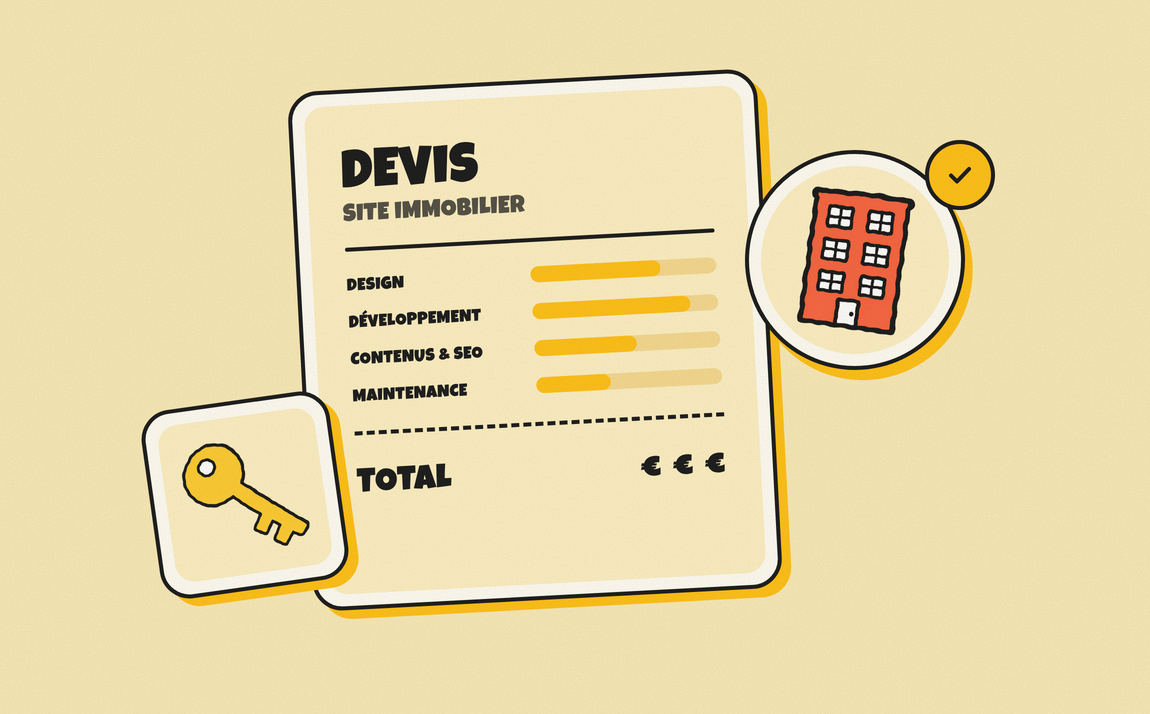
At Gemeos, the difference in the cost of a real estate website comes first from whether there is a catalogue, then from the number of audiences, entities and tools to connect.
| Scenario | Reference scope | What is included | What is not included | Budget (excl. VAT) at Gemeos |
|---|---|---|---|---|
| Real estate services company | 8 pages, 4 business lines, 1 language | Management, investment or advisory pages, dedicated contacts per business line | Listings and landlord area | €7,000 to €14,500 |
| Property or asset catalogue | 40 listings, 4 categories, 3 filters | Search, public documents, contacts linked to each listing | Connected software (manual updates) | €9,000 to €20,000 |
| Property manager with several audiences | 15 pages, 3 audiences, 12 resources | Journeys for landlords, tenants and investors | Collection of sensitive files | €9,500 to €19,000 |
| Multilingual real estate group | 4 entities, 2 languages, 60 assets | Shared catalogue, migration of 80 URLs | Translations (supplied by you) and management extranet | €9,000 to €20,000 |
| Connection to a real estate tool | 1 catalogue source and 1 CRM, 100 initial assets | Synchronisation of listings, forwarding of enquiries to the CRM | Building real estate software; a documented API is required | €9,000 to €20,000 |
For an existing site, a redesign at Gemeos costs between €11,500 and €24,500 excl. VAT (up to 100 URLs reviewed, CMS retained), and adding a catalogue of 50 assets to a live site between €2,000 and €5,500 excl. VAT. The timeline depends mainly on the state of your listings, access to the API and compliance reviews: ask for a schedule broken down by stage.
Also include conversion tracking in the specifications: to know how many landlords request a management proposal, and from which pages, every form and every phone number is tracked separately, by business line and by town.
Keep properties, units and their availability up to date
Decide who changes the statuses, and when
A real estate website deteriorates mainly through its listings. A flat that has been let but is still shown as available generates pointless calls: decide who changes the status of properties, units and assets, and at what point (signing of the lease, the deed or the reservation contract). If the catalogue is synchronised, compare the site and the software regularly, because a change of API version can stop updates without any alert. Date public documents and replace a renewed DPE or an outdated brochure. SEO for a real estate company benefits from these updates, as the town pages and listings stay accurate.
Prepare the switchover from an existing site
Before a redesign, list the URLs that receive visits and links, prepare the redirect plan and have a technical audit carried out before the switchover.
Secure accounts and data
The site stays on HTTPS, backed up, with an up-to-date CMS and plugins. Negotiators, property managers and copropriété assistants each have a named account, closed when they leave, and the domain name remains in the company's name. Enquiries received through forms often contain a property address, a rent or a landlord's situation: delete those that are no longer needed. Finally, check that trackers requiring consent stay blocked until the visitor agrees. Strictly necessary trackers and certain exempt audience measurement tools follow a different regime.
Open campaign pages
To find landlords in a new town or market a specific asset, a dedicated landing page build lets you speak to a single audience, with a single form, without touching the site structure.
At Gemeos, a real estate website starts from the list of its readers. The listing template, where the fee schedule and legal notices go, and the boundary with the business software are settled at mock-up stage, with your management, syndic or investment teams and, for investment product pages, your compliance department.
FAQ
How much does it cost to create a real estate website?
At Gemeos, from €7,000 to €20,000 excl. VAT depending on the scenario, including €7,000 to €14,500 excl. VAT for a services site without a catalogue. Redesigning an existing site costs between €11,500 and €24,500 excl. VAT.
Can you create a real estate website yourself for free?
Yes, for a simple presentation of your business, with a website builder or the website module included in some management software. The limits appear with the catalogue and the audiences: properties updated by hand or pages locked by the vendor, a fee schedule and legal notices to add yourself, and a site that disappears if you change software.
Does a syndic's website need an extranet?
Not the showcase website, but the syndic does. A professional syndic must offer co-owners secure online access to the copropriété's documents, unless the general meeting objects by the majority set out in article 25. This area is generally provided by the syndic software, and the website links to it.
Can you receive prospective tenants' application files through the website form?
It is possible, but not advisable without a secure tool. The form must only ask for documents on the exhaustive list, and no sum to reserve the property, which the law prohibits. Applicants must be informed of their rights and their documents destroyed when no longer needed, for example after an application has been turned down.
Which legal notices must appear on a real estate company's website?
It depends on the business line. An intermediary who brings sellers or landlords together with buyers or tenants displays their fee schedule in accordance with the 2017 order, accessible from the site and from every listing. A property investment company presenting its own portfolio is not automatically in this situation. All of them include the company's identification details, then have what applies to them checked: professional licence and guarantor, consumer mediator, DPE in listings, AMF rules for investment product pages.
How can you tell whether AI assistants cite your real estate company?
By asking the assistants your prospects' questions, which is what a GEO audit does. For example, you search for a lettings manager or a syndic in your town, then note whether your company appears and which pages are used. Precise, up-to-date pages by business line and by town give them material to cite.