Projects
 Our Offers
 Dedicated team
 Blog
 Academy
 About Us
Tips9 min read
How much does a real estate website cost?
Bringing sales, lettings management and advisory services together under one brand calls for a real estate website that can direct each visitor to the right business line. At Gemeos, the budget for building the website is €7,000 to €14,500 excl. VAT for "Real estate services company" (8 pages and 4 business lines, 1 language) and €9,000 to €20,000 excl. VAT for "Property or asset catalogue" (40 listings, 4 categories and 3 filters).
A real estate group's website must help a landlord understand the management offer, a seller find the sales team and an existing client get back to their account. The brand pages can share a common design; the services, the proof points and the recipients of enquiries remain specific to each business line.
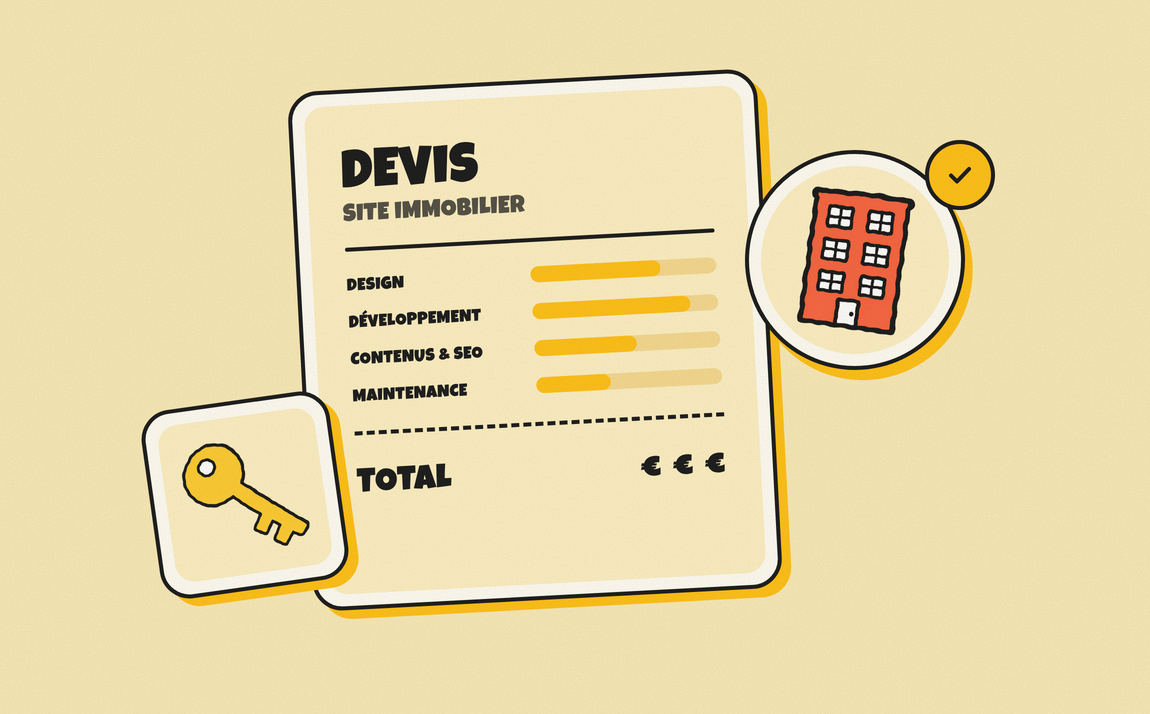
What budget should you plan for a real estate website?
Budgets are given excluding VAT for the volumes and features stated. For a new build: scoping, site structure, UX/UI, CMS development, integration of the copy and visuals you supply, testing and onboarding. For a redesign, migration or enhancement: the work is carried out on an existing site. These services are not automatically cumulative. Copywriting, translations, new visuals, licences, subscriptions and third-party costs are to be specified in the quote.
| Service and project | Budget excl. VAT | Scope and limits |
|---|---|---|
| New build — Real estate services company | €7,000 to €14,500 | 8 pages and 4 business lines, 1 language. Management, investment or advisory, with dedicated contacts. No listings or landlord area. |
| New build — Property or asset catalogue | €9,000 to €20,000 | 40 listings, 4 categories and 3 filters. Search, public documents and context-specific contacts. Manual updates, no connected software. |
| New build — Property manager with several audiences | €9,500 to €19,000 | 15 pages, 3 audiences and 12 resources. Journeys for landlords, tenants and investors. No collection of sensitive files. |
| New build — Multilingual real estate group | €9,000 to €20,000 | 4 entities, 2 languages and 60 assets. Shared catalogue and migration of 80 URLs. Translations supplied, no management extranet. |
| New build — Connection to a real estate tool | €9,000 to €20,000 | 1 catalogue source and 1 CRM, 100 initial assets. Synchronisation and forwarding of enquiries. Documented API required; does not include building real estate software. |
| Redesign — Redesign of the existing site | €11,500 to €24,500 | 100 URLs to review, 1 language, up to 5 templates; CMS retained. Carry-over of assets, documents and service pages. Checks: property filters, CRM and contacts per business line. Existing copy lightly revised; no change of CMS and no new business software. |
| Technical migration — CMS migration with design retained | €8,000 to €23,500 | 100 URLs, 1 language, 1 source CMS and 1 target CMS to be confirmed. Transfer of assets, documents and service pages. Checks: property filters, CRM and contacts per business line. Design and functional scope retained; exportable sources and available interfaces; licences and editorial overhaul quoted separately. |
| Site enhancement — Adding an asset catalogue | €2,000 to €5,500 | Existing site, 50 assets and 4 categories. Listings, public documents and context-specific contacts. No landlord extranet or ERP. |
When should several business lines share one real estate website?
A shared site makes sense if the brand carries a coherent offer and visitors can quickly identify the service they need. It lets you present the organisation as a whole, then lead visitors to the business lines and teams. Putting several menus side by side is not enough to create that coherence.
Keeping separate sites can be justified if the brands have genuinely different positioning, clienteles or publishing responsibilities. The web project must then define the links between them and the role of the group's showcase site. This decision comes before you compare website development quotes: a shared site and several standalone sites are not the same service.
Have the situations that apply to you reviewed before choosing:
- A single brand must present several real estate services and direct visitors to the right teams.
- Brands that are kept must share certain components without losing their positioning.
- Existing sites must be merged, with content and URLs to carry over.
- A corporate site must explain the group while leaving the catalogues or client services in their current tools.
The role of a web agency for real estate businesses is to make this choice and its consequences explicit. For a shared project, ask for a site structure that shows the business lines, the territories and the points of contact. If several sites remain necessary, have their design distinguished from what can be shared.
The subject here is a real estate brand with several business lines brought together. An agency focused on its sales mandates, or a developer marketing its own schemes, needs a more targeted, trade-specific scoping. The listings catalogue and the available units should not take up the whole quote when the group's presentation needs clarifying first.
Which services affect the cost of a real estate group website?
Strategy and copywriting must give each offer a clear place. A landlord who delegates the management of a property is looking for different support from a seller. Your site must explain this difference, state which team is responsible and offer a suitable next step, without repeating the same page with a different heading.
This work starts with your actual offers: services provided, areas covered, contacts and available content. The agency can organise this information and write the pages within the agreed scope. It cannot infer a new management or advisory service from a passing mention on your old site. To create a website for a real estate company that combines management and sales, also list, for each business line, the fee schedule, which must remain accessible online from every listing, and the notices relating to professional licences (cartes professionnelles): this regulatory content comes on top of writing the service pages.
The design must then express the relationship between the shared brand and the business lines. Shared navigation and consistent components can produce a readable whole; the pages must keep the explanations specific to each business line. A web design service is therefore costed on templates and user journeys, not just on a home page.
Designing group-wide navigation does not mean carrying over every office's pages: the inventory, the writing of service pages and the integration of branch locations are separate volumes of work. Catalogues and client access are then defined according to the tools you keep.
Which scenario applies depends on the need assessed, not on the "real estate group" label. Bespoke features, complex interactions or a broader architecture must be described before the budget is derived from them.
What can be shared without making every business line the same?
Sharing applies to elements that play the same role; it does not mean forcing every business line into an identical page. A branch page can be shared if it correctly links the business lines and teams present. The selling points of a management offer, on the other hand, must remain distinct from those of a sales service.
The table helps you request a proposal that separates the shared foundation from the work specific to each business line. It does not put a figure on any automatic saving: reusing existing elements first requires checking their quality and compatibility.
| Project element | Possible shared foundation | Work specific to each business line |
|---|---|---|
| Identity and interfaces | Visual guidelines, navigation and reusable components | Hierarchy of the offer and presentation of services |
| Branches and teams | Address template, profiles and relationships between entities | Business lines available, areas and actual contacts |
| Service content | Writing method and approval workflow | Scope, proof points and explanation of each service |
| Enquiries | Form components and confirmations | Relevant questions, destination and follow-up of the enquiry |
| Administration | Publishing principles and training on the shared foundation | Permissions, approvals and data entrusted to the teams |
| Carrying over existing sites | Inventory method and URL mapping | Content, files and dependencies of each source site |
The same logic applies to media. A portrait can be used on a group page and on a local page; you still need to define who keeps the profile up to date. Photographs of a development or a property do not, by default, become brand visuals that can be reused everywhere.
Have content production and data entry specified. Delivering a reusable page template and integrating the pages of every team are two separate volumes of work. A quote may be low because preparation and integration remain largely your responsibility; this split must be visible.
How did Gemeos support the MIMCO Platform website?
MIMCO Platform presents real estate investment solutions. Gemeos supports the redesign of the experience, the site build and SEO, with templates for products, documents and educational content. The journey must help investors understand what they are looking at and find the related information.
This project concerns real estate investment, with ongoing support as the site evolves. It differs from an agency's listings portal: asset pages, documentation and editorial resources shape a different experience. Identifying this difference during scoping makes it possible to cost the right templates and their maintenance, rather than reusing a catalogue of real estate features unrelated to the business.
How do you connect a real estate website to sales and management tools?
Start with what must stay in the existing tools. The sales software, lettings management and customer service can play distinct roles. The public website does not need to bring their data together simply because it brings the brand together. It must provide the useful access points and forward the planned enquiries.
Distinguish between a link to a tool, displaying its content and exchanging data. A connection must be described with the fields concerned, their origin, the direction of the exchanges and the failure cases. If several software packages feed the site, have their formats and identifiers reviewed before asking for a shared interface.
A shared catalogue adds decisions: which types of property to publish, which teams can edit them and how to handle differing statuses? A single search is only useful if the information can be matched without ambiguity. The features of a real estate website should be chosen on the basis of these uses, not to reproduce everything a property portal displays.
Enquiries also need routing rules. Specify what identifies the business line, the entity and the context of the enquiry, then who takes over the conversation when a recipient is unavailable. Configuring, testing and documenting these rules are deliverables; adding a form does not automatically cover them.
To measure the site, separate the actions that matter to each business line and agree on the information sent to the tracking tools. A request for a sales mandate, a management question and a login to a client area do not mean the same thing. The measurement set-up should help the teams read their activity without lumping all clicks together.
What should you plan for to carry over several existing sites?
Carrying over starts with an inventory of the sites, the content and the access rights. A new identity alone cannot decide which copy to keep or which URLs to retire. Useful pages, downloadable files and points of contact must be reviewed with the people responsible for each business line.
The SEO migration work must define the mapping between old and new pages, the redirects required and the checks after the switchover. When a piece of content moves, its destination must remain relevant. Merging domains does not mean sending all their visitors indiscriminately to the group's home page.
Also define what will not be transferred: outdated content, old offers or documents to be redone. How they are handled is part of the scope to be organised. The service must allocate the editorial decision, the technical execution and approval by your teams, rather than leaving this sorting until launch.
For acceptance testing, choose user journeys that are representative of several business lines and source sites. It must be possible to find a useful old page, reach the right contact and use the access points to the tools you keep. The checks set out in the quote should not cover only the look of the new site.
Who will manage the shared brand and the local pages?
The publishing organisation must follow actual responsibilities. The central team can manage the brand and cross-cutting content; local managers can propose changes for their branches. The project must define who publishes and who approves, then check that the chosen tools support this organisation.
The central team must be able to update the group's presentation while a local manager corrects their contact details or proposes a service page. The CMS must link branches, business lines and contacts without having to copy all the information. WordPress, Webflow and headless are among Gemeos's approaches; the choice must be checked against these publishing permissions and the tools that hold the operational data.
Ask for onboarding that shows your own tasks: changing a branch's address, assigning a contact to a business line, preparing a new service page and checking its links. Autonomy is judged on these tasks, not on an abstract demo of the editor.
SEO must arbitrate between brand, business-line and branch pages. Two teams using the same vocabulary do not necessarily need two pages targeting the same search. This architecture and content work is specified in the quote, before local pages are multiplied.
Recurring costs remain separate from the build price: hosting, licences, any connections and maintenance depending on the chosen set-up. Content upkeep must specify who corrects a piece of information and under what conditions. The number of sites kept also affects what has to be administered.
To prepare your quote, gather the brands and domains concerned, the offers to present, the tools to keep and the people who will approve. Ask for a proposal that distinguishes the shared foundation, the work specific to each business line and the carry-over of existing content. You can then decide what should be brought together without paying for a set of features whose use nobody has defined.
FAQ on the budget for a shared real estate website
Which web services should you prioritise after several offices merge?
Start by clarifying the brand on display, the business lines that continue and how to direct visitors who know the old names. The team, branch and service pages must show the right contacts. Carrying over existing URLs and content that is still useful is a work package to identify. Client portals or listings can continue to rely on separate tools. Scoping must distinguish this editorial and technical merger from a simple visual refresh.
Can you keep the names of acquired offices on the group website?
The design can make room for the brands your organisation keeps. Have the quote specify the pages that present the brands, their links with the business lines and the contacts. Keeping several domains or several sites adds further carry-over and maintenance work, to be itemised separately in the quote.
Do you need to publish listings to present a lettings management business?
Not necessarily. A management offer can start by explaining the support provided to landlords and offering the right contact. Publishing a stock of rentals must meet a defined use and rely on usable data. It is not an automatic prerequisite for creating the showcase site.
Does a landlord area have to be rebuilt along with the public website?
An existing tool can stay in place. The project can be limited to clarifying access to it and the information that goes with it. A rebuild or a tighter connection requires defining the users, data and features concerned; it cannot be inferred from the price of an access page.
How do you compare a per-site quote with a quote for the whole group?
Compare the templates, integrated content, connections and carry-over work actually included. A group-wide quote may leave local data entry to your teams; a per-site quote may reuse shared elements. The amount alone does not tell you how the work is split.
Does adding a new business line require a complete redesign?
Not always. An architecture designed to accommodate several business lines can evolve if the content and user journeys remain compatible. A new offer may also require a different template or integration. Have the quote distinguish between publishing, adapting and developing, without promising that every addition will be automatic.