Projects
 Our Offers
 Dedicated team
 Headless CMS
 Webflow
 WordPress
 Blog
 Academy
 About Us
Tips8 min read
How much does a website for a wealth management firm cost?
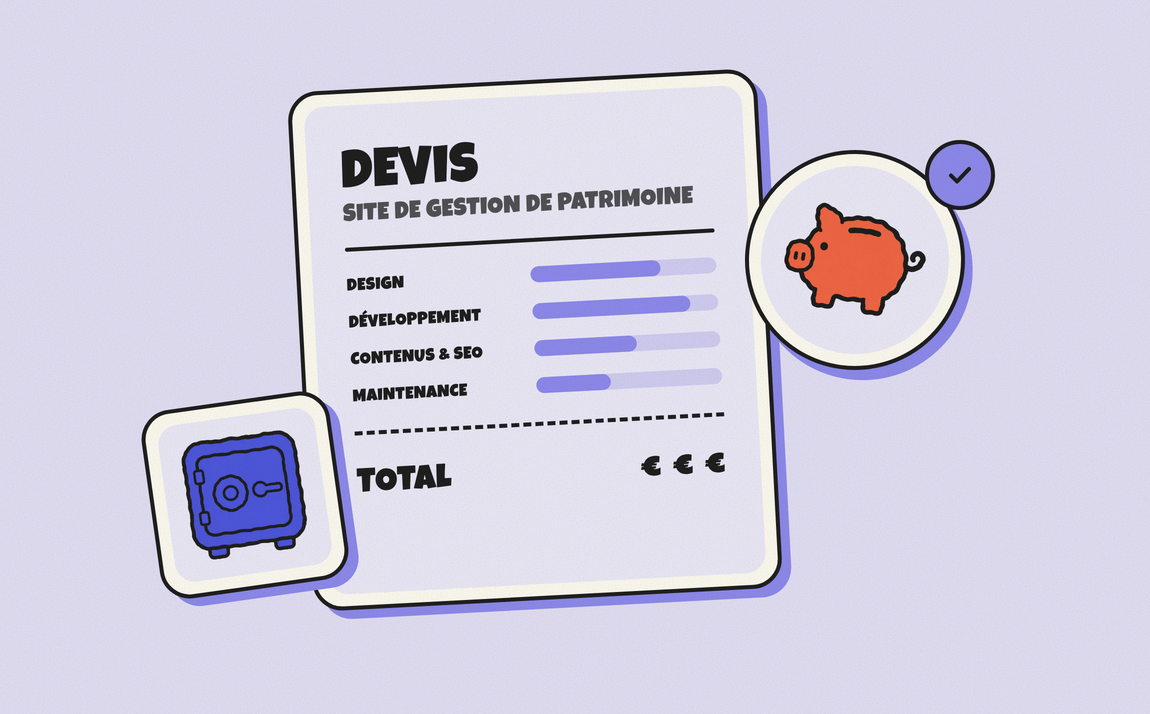
A referral brings you a prospect, but your website still has to show them who will advise them and on which engagements. To build the website, allow €7,000 to €14,500 excl. VAT at Gemeos for an "Independent adviser" (7 pages, 3 areas of expertise and 1 language) and €9,500 to €19,000 excl. VAT for a "Firm with several areas of expertise" (12 pages, 6 areas of expertise and 5 advisers).
The job is not to publish everything you know about tax or investments. It is to make your engagements easy to understand, present verifiable information and set up the right kind of first conversation. Collecting the details of a client's financial situation and giving access to client documents fall outside the scope of the public showcase site.
What budget should you plan for your wealth management firm's website?
Budgets are shown excluding VAT for the volumes and features stated. For a new build: scoping, site structure, UX/UI, CMS development, integration of the texts and visuals you supply, testing and handover. For a redesign, migration or upgrade: the work concerns an existing site. These services do not automatically add up. Copywriting, translations, new visuals, licences, subscriptions and third-party costs are specified in the quote.
| Service and project | Budget excl. VAT | Scope and limits |
|---|---|---|
| New build — Independent adviser | €7,000 to €14,500 | 7 pages, 3 areas of expertise and 1 language. Firm presentation, client situations covered and external booking tool. No account aggregation or financial planning simulation. |
| New build — Firm with several areas of expertise | €9,500 to €19,000 | 12 pages, 6 areas of expertise and 5 advisers. Profiles, needs-based journeys and qualified contact. No collection of clients' financial documents. |
| New build — Acquisition and education | €9,500 to €19,000 | 15 pages and 30 initial resources. Resource library, content by client situation and appointment tracking. Resource copywriting and ongoing SEO priced separately. |
| New build — Firm with several offices | €9,000 to €20,000 | 4 offices, 10 advisers and 2 languages. Appointment routing and migration of 50 URLs. Translations supplied, no client area. |
| New build — Client access linked to an existing tool | €9,500 to €19,000 | 12 pages and 1 external wealth management tool. Client entry point, login help and journey testing. No bank connection or development of the wealth management software. |
| Redesign — Redesign of the existing site | €8,500 to €19,000 | 60 URLs to review, 1 language, up to 5 templates; CMS retained. Areas of expertise, advisers and resources carried over. Checks: appointments and access to the existing wealth management tool. Existing texts lightly revised; no change of CMS or addition of business software. |
| Technical migration — CMS migration with design retained | €6,500 to €19,000 | 60 URLs, 1 language, 1 source CMS and 1 target CMS to be confirmed. Transfer of areas of expertise, advisers and resources. Checks: appointments and access to the existing wealth management tool. Design and functional scope retained; exportable sources and available interfaces required; licences and editorial overhaul separate. |
| Site upgrade — Add a journey by client situation | €1,200 to €3,500 | Existing site, 6 pages and 3 forms. Content supplied and routing to the right adviser. No collection of clients' financial documents and no simulator. |
How do you present your engagements without turning the site into an investment catalogue?
Organise the pages around the situations you support and what your engagements actually involve. Preparing a transfer of wealth, thinking through how business assets are structured or reviewing several assets at once each call for a different explanation. Page titles should let readers recognise themselves without suggesting that individual advice has already been given.
Each page can state who the engagement is for, the topics covered, how a first conversation works and the limits of what the firm does. The copy works best when it starts from your presentation documents and interviews with the people who hold the meetings. It should not invent a method identical for every firm, or announce a solution before a situation has been analysed.
The structure becomes simpler when engagements and people are properly linked. A visitor reading a page for business owners should be able to identify the right contact and understand the next step. Creating a page for every product can, on the contrary, obscure your advisory role and make updates heavier.
What determines the budget for a wealth management website?
The cost of building a website depends mainly on the page templates, how they are designed and the work required on the content. A presentation that is already structured does not need the same support as a firm whose engagements, profiles and resources have to be completely reorganised.
The editorial scope deserves particular attention. Rewriting technical texts to make them accessible, preparing adviser profiles and getting wording approved all take time. This work can be shared with your team, provided it is clear who supplies what and who signs off publication. It also includes the compliance page expected of a CIF (conseiller en investissements financiers, the French financial investment adviser status): ORIAS registration number (the French register of intermediaries) and categories, professional association, applicable rules, complaints handling and, for private clients, the mediator's contact details. This page, written when you create a wealth management website, is reviewed by the firm's association before going live.
| Wealth management content or journey | Work to be funded | What changes the scope |
|---|---|---|
| Presenting an engagement | Interview, copywriting and approval of the proposed process | Number of genuinely distinct engagements and content available |
| Adviser profile | Role, office, exact credentials and verifiable details | Individual responsibilities and how often the team changes |
| First meeting | Routing to the right person, confirmation and instructions | Existing booking link or integration; no implied detailed financial review |
| Resources and client documents | Separating general publication from individual exchanges | Editorial template for the former; access and data priced separately for the latter |
An elaborate animation is no substitute for a clear explanation. Web design should above all prioritise information: the firm's role, contacts, trust signals and how to get in touch. Supporting documents can remain accessible without taking over the initial journey.
What proof should you prepare before the mock-ups?
Gather the information that precisely identifies the firm and the professionals presented. Titles, statuses and affiliations must match each person's actual situation. A credential held by one person does not automatically extend to every team member or every activity of the firm.
The AMF (the French financial markets authority) explains that authorisation checks depend on the activity carried out and the registers concerned. The site should therefore use the correct titles and make them easy to verify, rather than display a generic statement suggesting a single approval. Your team remains responsible for validating this information before publication.
The proof a wealth management firm can show goes beyond logos. A profile can explain the adviser's role and area of work. A method page can describe how the client relationship begins. These elements help prospects assess your support without publishing confidential data or promising future performance.
Good to know: before publishing a testimonial or a client situation, have the firm's managers check what can be shared and the consents required. Even without a name, combining a profession, a location and a family event can make someone recognisable. An engagement example can describe the firm's work without revealing the assets, amounts or details of the file.
What should a wealth advisory firm's contact form ask for?
Limit the first form to the information you genuinely need to arrange the conversation. A category of need and contact details may be enough to route the request. Asking straight away for a detailed inventory of assets creates collection and data protection work that a simple first contact does not require.
- Name and the contact details needed for a call back, with a preferred contact method if your organisation uses one.
- A general topic: wealth transfer, business owner situation or another engagement the firm actually offers.
- The preferred contact or office where there are several locations.
- A short message clarifying the request, without asking for supporting documents or detailed data at this stage.
The form should explain what happens next. Does the visitor know whether they will be called back, whether they choose a time slot or whether they need to wait for confirmation? The message received by the firm should contain the information useful to the right recipient, without being needlessly circulated to the whole team.
An external booking tool can be linked to the site without developing a bespoke calendar. You still need to check the appointment types available, how they are assigned to advisers and the confirmation displayed. If your tool cannot work the way you want, that limit must be identified before the journey is designed.
Do you need a client area to launch the firm's website?
Not if the aim of the launch is to present your services and receive enquiries. The public site can direct clients to an area already provided by your software, where that service exists and suits your organisation. A clearly labelled link does not have the same scope as building a new portal.
A custom-built or connected client area requires defining users, accessible documents, permissions and exchanges with existing tools. Who grants access? Who revokes it? How is a document attached to the right file? These questions shape the design, the testing and the upkeep of the service.
The fee for building a showcase site tells you nothing about the price of a wealth management portal. The proposal should separate these work packages. You can launch the public part before the connected service, preparing the entry points and avoiding promising a feature that is not yet available.
How do you handle resources and news without weighing down production?
Publish content your firm can genuinely check and maintain. A dated news item, a general explanation and an engagement page are not managed in the same way. Readers should be able to recognise the nature of the page and its context, without confusing general information with a recommendation suited to their situation.
The service can include an article template, links to the relevant engagements and organisation by topic. There is no need to carry over all the archives at launch. Select the resources that are still relevant and identify those that need reviewing before publication.
During a redesign, also review the old addresses. Links may be circulating in your email signatures, your documents or your exchanges with clients. Carrying over useful pages and setting up redirects keeps these links working when the structure changes.
What commitments should you ask for on delivery and updates?
Training should enable your team to edit a profile, correct a piece of information and publish a resource without improvising the layout. A session built around these tasks is more useful than a general demonstration of every CMS option. Approval of sensitive information should remain traceable after delivery.
Hosting, any licences and maintenance are separate from the build project. Support needs may change as the firm grows: new offices, new engagements or content updates. A well-prepared structure makes these changes easier, without guaranteeing that every change can be made without outside help.
To price your project with a wealth management web agency, bring together the engagements to present, the profiles concerned, the information to verify and the onboarding journey. You can then compare proposals on their deliverables and organisation, with a clear boundary between the public site and client tools.
How did Gemeos build VMP Capital's online presence?
VMP Capital brought several wealth management entities together under a shared brand. Gemeos worked on the branding, art direction, UX/UI journeys, site build and SEO. The challenge was to present a coherent wealth management boutique, with entry points suited to private individuals and to entrepreneurs whose business and personal needs overlap.
The site prioritises the firm's areas of expertise and allows news, publications and the team to be managed in the CMS. For a wealth management firm, this project illustrates two services to separate in the quote: building the shared identity, and organising the offers in a site the team can keep up to date. A redesign that keeps an existing brand and settled content would call on this work differently.
How did Gemeos develop Hellébore Gestion Privée's website?
For the Hellébore Gestion Privée redesign, Gemeos worked from the existing brand guidelines to modernise the firm's presence while keeping its brand cues. The engagement covered art direction, interface design, organising pages by client profile, migration from WordPress/Elementor to Webflow and SEO structuring. The navigation keeps access to MoneyPitch for clients. This access is distinct from the firm's public pages and from any application development: the project page presents Hellébore Technologie as a later stage.
FAQ on the cost of a wealth management firm's website
Which content should you prioritise to grow a client base of business owners?
Present the situations in which the firm works and how to start a first conversation, with examples you are authorised to publish. Profiles and engagements should make the support clear without suggesting that a wealth management answer has already been decided. The initial enquiry can state the reason and the contact, then be picked up by the firm. The editorial budget pays for this clarity; it does not imply collecting a full financial review on the public site.
How do you present a wealth transfer engagement without giving the impression that a solution has already been chosen?
Describe the situations the firm supports, how the conversation unfolds and who the contact is, based on your actual practice. The button can lead to an appointment request, without asking the visitor to pick a product up front. The quote can include an engagement page and its contact journey, approved by the people who hold these conversations.
Can you ask for a full financial review in the public form?
The first contact can explain your approach without immediately asking for all the data needed for a study. If a detailed questionnaire is wanted, its use, collection and processing should be scoped as a separate feature. The public journey should stay proportionate to its purpose.
How do you publish statuses and registrations without copying them everywhere?
The content management system can centralise this information and associate it with the right profiles or activities. That makes updating easier and reduces inconsistencies. The exact wording, the person concerned and the means of verification still need to be approved by the firm.
How do you route a business owner whose request concerns both their company and their personal situation?
The page can explain the engagements actually offered to business owners and identify the person in charge of the first conversation. The form is used for routing, without asking straight away for details of business and personal assets. If several advisers or offices are involved, define who receives the request and how the assignment is reviewed, rather than forwarding the message to the whole team.
How do you distinguish a first wealth management meeting from a follow-up request from an existing client?
The site can offer one entry point to discover the firm's services and another to reach one's adviser or find the client tool already in use. Confirmations should state what will actually happen next for each request. Have these journeys tested with a new contact and an existing client, specifying the recipients and the confidentiality instructions. Adding a booking calendar does not replace this organisation.