Projects
 Our Offers
 Dedicated team
 Headless CMS
 Webflow
 WordPress
 Blog
 Academy
 About Us
Tips8 min read
How to create a website for a financial services firm: from regulatory status to budget
To create a website for a financial services firm, make your decisions in this order: your status and your audiences, the first-contact journey, what your pages can promise, the pages that will get you found, the tool and how it is run, then the budget. Advisory firm, credit broker, asset management company or fintech: all of them publish pages that present offers and fall under advertising rules; for a CIF (French financial investment adviser) or a fund, information must be accurate, clear, not misleading and identifiable as marketing. As a web agency specialising in finance, we come across these decisions in every project.
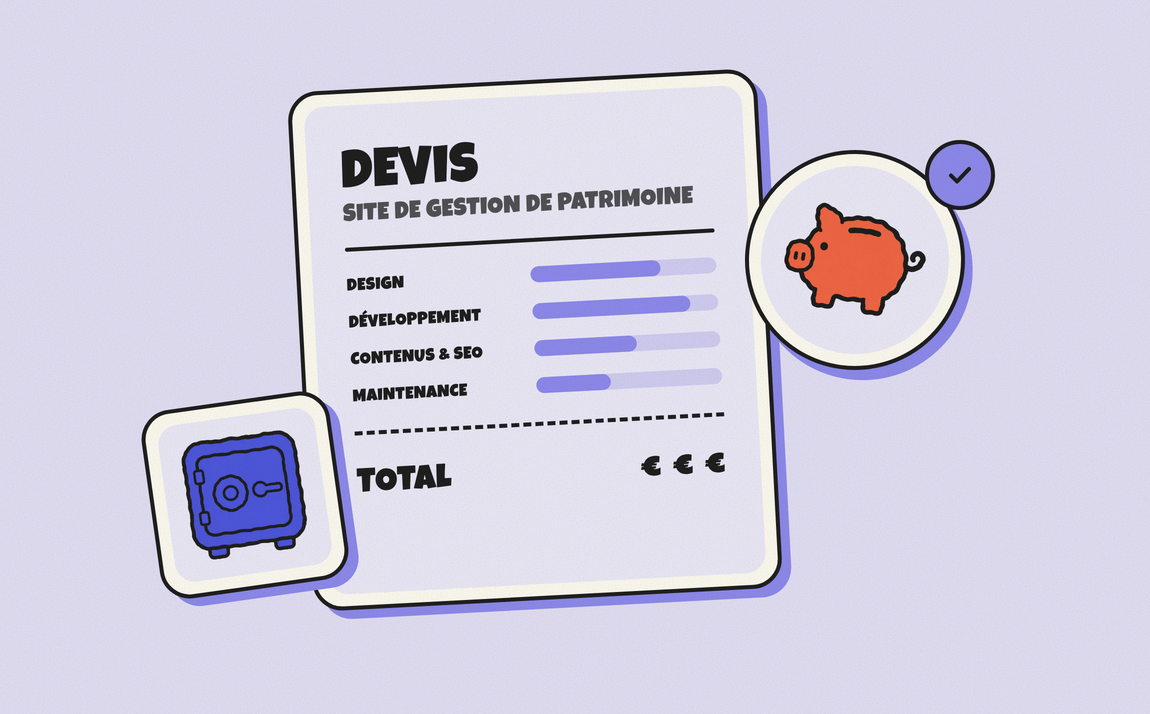
At Gemeos, building a financial website costs from €7,000 to €14,500 excl. VAT for an advisory firm with appointment booking, and up to €42,500 excl. VAT for an international group in three languages. If your visual identity needs to evolve, the branding work is carried out alongside the page design.
1. Start from your regulatory status and your audiences
Your status determines what the site must display, what it cannot say and where each notice should go. A French wealth management adviser (CGP) often holds several statuses at once: CIF, insurance intermediary and IOBSP (banking and payment services intermediary), and each one adds its own notices.
| Status | What must appear | Where to place it | Reference text |
|---|---|---|---|
| Financial investment adviser (CIF) | Identity, CIF status, ORIAS number (French register of intermediaries), membership association, relationships with the institutions whose products you offer, method of remuneration; never the AMF logo or "authorised by the AMF" | Footer, firm page, expertise pages | Code monétaire et financier (French Monetary and Financial Code), art. L541-8-1; AMF position DOC-2006-23 |
| Insurance intermediary | Name, address, ORIAS number; name of the insurer as soon as a page details a policy | Footer and policy pages | Code des assurances (French Insurance Code), art. R521-4 |
| Credit broker or agent (IOBSP) | Name, address, ORIAS number, intermediary category; for advertisements falling under article L322-2 of the Code de la consommation, the statement that no payment is made before the loan is obtained, as well as the name and address of the institutions you work for | Footer, offer pages, simulators, forms | Code monétaire et financier, art. R519-24; Code de la consommation (French Consumer Code), art. L322-2 |
| Asset management company, funds | Communications identifiable as marketing, risks as visible as benefits; for a UCITS, where to obtain the prospectus and the key information document | Strategy pages, fund pages | Regulation (EU) 2019/1156, art. 4 |
| Fintech, payment or credit institution | Status and the authority that granted it, wording to be validated with your compliance team; depending on the activity and size, check whether the accessibility requirements for consumer banking services apply | Product pages, pricing, sign-up | Décret n° 2023-931 (accessibility), scope to be validated with your compliance team |
Some of this information should be given to the client in good time rather than repeated on every page. These pointers are not exhaustive: the wording and placement of your notices should be validated with your RCCI (compliance and internal control officer) or your professional association, especially if you hold several statuses.
An advisory firm speaks mainly to business owners, self-employed professionals and families preparing to pass on their wealth; its pages need to reassure before they sell, with precise evidence. An asset management company often addresses three audiences: private investors, advisers who distribute its funds, and institutional investors. Several audiences do not require several sites, but they do require distinct entry points and sometimes restricted access. To structure a financial website's architecture by audience, start from the question each visitor has on arrival.
The website of an advisory firm or a broker presents expertise and prompts an appointment. That of an asset management company also hosts a document library that follows the rhythm of reporting. That of a fintech explains a product and leads to a demo. In all three cases, the site connects to business tools (portfolio management software, lending engine, a partner platform's subscription tool, application) without replacing them, and this boundary protects your budget. As for pages, plan a home page that says who you work for, one page per area of expertise or strategy, the team, the method, a contact page or restricted access, and a regulatory information page.
2. Choose the first-contact journey
| Journey | What the visitor sees | What you supply | What stays outside the site |
|---|---|---|---|
| Appointment booking (advisory firm, wealth management adviser) | Time slots from your existing calendar, with the reason for the appointment | The calendar tool and the types of appointment | The wealth fact-find and the onboarding document |
| Financing request (credit broker) | One form per project: property purchase, debt consolidation, business financing | The questions for each project and the CRM that receives the requests | The feasibility study and the lending decision |
| Demo request (fintech) | Use cases, then a demo request sent to the CRM | The use cases and the lead assignment rules | The application and sign-up |
| Restricted access (asset management company) | A login page leading to the investor or partner area | The existing access solution and the eligibility rules | Portfolio data |
The mock-up starts from this journey: a broker puts the choice of project at the top of the page, an asset management company places restricted access in the header, a fintech shows the use case before the demo button. When an offer or use case deserves its own landing page, for a campaign for example, landing page creation follows the same notice rules as the rest of the site.
The form, for its part, asks only for what is strictly necessary. The GDPR requires you to collect only the data needed for the purpose: name, contact method, subject and time slot are enough for a first conversation. Supporting documents and anti-money laundering checks belong to client onboarding, with secure tools. Two or three well-chosen questions are enough to turn visits into qualified appointments.
3. Decide what your pages can promise
"Guaranteed return", "risk-free", "credit approved in 24 hours": in finance, such phrases expose their author. The Code monétaire et financier requires CIFs and investment service providers alike to provide accurate, clear and non-misleading information, including in their marketing communications, which must be recognisable as such.
For a fund, the European regulation requires risks and benefits to be presented with equal prominence. A past performance shown as a large figure above a warning in small grey print does not respect this balance: the warning goes next to the figure it qualifies, in the same text size. A warning to be accepted before opening the fund pages changes the navigation, so it must be decided at the design stage.
Rather than a warning copied from the prospectus, state in short sentences what the investor is risking (capital loss, lock-up period, reduced liquidity), without jargon or dramatisation. Presenting complex financial offers clearly helps the prospect as much as the compliance reviewer.
An offer page generally goes through the RCCI, the legal team and sometimes the product manufacturer. This workflow must exist in the tool: draft, approval, a record of who approved what, dated versions of documents.
Presenting unlisted assets to investors and their advisers on the same site
Opale Capital is an asset management company specialising in unlisted assets (private equity, private debt, infrastructure), which addresses private investors and the wealth management professionals who distribute its funds. Of three art direction routes, the one chosen makes the opal a visual signature, with a texture in the corners of the photos; the logo is retained and yellow is reserved for calls to action.
The site serves its two audiences without mixing them: a separate Partners area, with its own contact form, and a login page with two entry points. Each asset class has its own page, with its risks and its FAQ. The fund pages are accessible behind a warning reserved for sophisticated investors, and a notice about the risks of unlisted assets appears at the foot of every page. Search visibility relies on pages by asset class and by strategy and on 45 articles in five categories. Articles, team, funds, FAQ and videos are managed as collections, so the team publishes without any new layout work.
4. Plan the pages that will get you found
Your prospects search for "courtier rachat de crédits professionnel" (business debt consolidation broker) or "fonds dette privée investisseur particulier" (private debt fund for individual investors), rarely "financial website". Expertise pages, fund or offer pages and resources answer these queries; an SEO agency plans them with the site structure, before the copywriting. They also help you appear in ChatGPT and Perplexity answers, which cite clear, dated sources.
A borrowing capacity or savings effort calculator attracts traffic, provided you know who supplies the calculation rules and who validates the results. At Gemeos, we build it from your rules and from test cases that you validate, with no promise of eligibility. A fintech, on the other hand, is compared before it is tried: pages by use case and honest comparison pages, which also say when the product is not a good fit, capture searches that the home page does not cover.
5. Choose the tool and keep the keys to the site
A CMS such as WordPress suits a firm that publishes articles and a few expertise pages. An asset management company with dozens of funds needs fund pages linked to their documents, dated versions, filters by strategy and several languages. In both cases, the tool must support the compliance review workflow, with distinct roles (writer, approver, administrator), and connect to your calendar, your CRM or your investor area.
On security, the minimum: HTTPS everywhere, named accounts with two-factor authentication, no shared credentials, tested backups, monitored updates. The domain name and the content belong to your firm, with access you keep if you change provider. If you are an entity subject to the DORA regulation (asset management company, investment firm, payment institution, among others), the website hosting or maintenance contract may need to appear in your register of ICT third-party providers: ask your compliance team before signing.
The AMF regularly publishes warnings about websites that impersonate authorised firms. A prospect must be able to check that it really is you: a domain consistent with your company name, email addresses on that domain, an accurate ORIAS number and address that can be checked against the register. A sentence on the contact page ("we will never ask you to transfer money to a personal account") helps your clients spot fraud.
6. Organise the launch and the life of the site
Before publishing an offer page, check that the status, the ORIAS number and the professional association are up to date, and that the product-specific notices are present: partner institutions for a loan, the insurer for a policy, regulatory documents for a fund.
If you are starting from an existing site, prepare the redirect plan to redesign a financial website without losing its search rankings. An SEO semantic audit of the current site then shows which queries each page already covers and which remain unanswered.
A financial website ages quickly: a new banking partner, a closed fund, a change of ORIAS category, a rule that changes, such as the credit notice of 20 November 2026. Appoint an owner and a review date for each type of page.
7. Set the build budget with Gemeos
| Profile | Typical scope | Included | Out of scope | Budget at Gemeos |
|---|---|---|---|---|
| Advisory firm with appointment booking | 8 pages, 4 areas of expertise, 1 language | Team, areas of expertise, integration of your existing calendar | Client area, collection of financial documents | €7,000 to €14,500 excl. VAT |
| Fintech at launch stage | 10 pages, 4 use cases, 1 CRM | Product presentation, demo, lead tracking | Development of the financial application | €8,500 to €17,000 excl. VAT |
| Funds with structured documentation | 15 funds, 100 documents, 2 languages, 4 filters | Fund-document links, versions, editorial sign-off | Connected performance data | €9,000 to €20,000 excl. VAT |
| Institutional asset management company | 12 pages, 5 strategies, 30 public documents | Team, documentation, sign-off workflows | Portfolio data, investor area | €9,500 to €19,000 excl. VAT |
| Finance broker | 12 pages, 5 offers, 3 forms by project | Financing requests sent to the CRM | Lending decision, simulator | €11,500 to €22,500 excl. VAT |
| International financial group | 25 pages, 3 audiences, 3 languages | Documentation, contacts by country, migration of 80 URLs | Translations (supplied), account portal | €17,000 to €42,500 excl. VAT |
Some features change the scenario and the cost of a financial services website. At Gemeos, a 12-page showcase site with a six-input calculator, or a 15-page showcase site connected to an existing investor area, costs between €9,500 and €19,000 excl. VAT. A connected financing application (one processing tool, three application steps) costs between €8,000 and €17,000 excl. VAT, once access, sensitive data and responsibilities have been scoped. A fintech with a centre of 80 resources in two languages costs between €17,000 and €42,500 excl. VAT. On an existing site, a redesign that keeps the CMS costs €11,500 to €24,500 excl. VAT, a CMS migration with the design retained €8,000 to €23,500 excl. VAT, and structuring a fund library €2,000 to €5,500 excl. VAT.
Include conversion tracking in the scope: appointments booked, financing requests sent to the CRM, demos requested, logins to the partner area, fund document downloads. It is set up before launch, in line with cookie consent.
The timeline depends on the scope, content preparation and approvals, especially when offer pages have to be reviewed by compliance. Ask for a step-by-step schedule that includes your RCCI's review time.
Gemeos designs websites for advisory firms, asset management companies, brokers and fintechs. We start from their status and their sign-off workflows to settle the pages and notices before designing the first screen.
This article provides general guidance, up to date as of 6 November 2026. It replaces neither the opinion of your compliance team or professional association, nor a review of all the obligations applicable to your business.
FAQ
What notices must appear on a financial investment adviser's website?
Its identity, its CIF status, its ORIAS number and its professional association, with the information relevant to its activity (relationships with partner institutions, method of remuneration) and the legal and GDPR notices. A CIF is registered with ORIAS even without any insurance or credit activity; if it holds several statuses, it also states its other categories. The medium and placement of this information are validated with its association.
Can a wealth management adviser display the AMF logo on their website?
No. The AMF prohibits a CIF from using its logo, whatever the medium. Nor should it describe itself as "authorised by the AMF": it is its professional association that is approved.
How much does a website for a financial services firm cost?
At Gemeos, a new build ranges from €7,000 excl. VAT, the lower end for an advisory firm with appointment booking, to €42,500 excl. VAT, the upper end for an international group in three languages. A redesign that keeps the CMS costs €11,500 to €24,500 excl. VAT.
Which CMS should you choose for an asset management company's website?
It depends on the volume of funds and documents. A CMS such as WordPress is enough for a firm that publishes articles and a few expertise pages. With dozens of funds, versioned documents, filters and several languages, the content architecture matters more, and a headless CMS agency can assess whether separating content from its presentation suits your case.
Can you build your financial firm's website yourself with a website builder?
Yes, for a few pages at the start. The obligations remain the same (notices according to status, balanced communications, limited form, account security), and the limits appear with sign-off workflows, document libraries and restricted access.
Can ChatGPT create a financial firm's website?
No, not on its own. It can suggest a site structure or first drafts of copy, but it cannot validate your regulatory notices, and it sometimes writes misleading wording without flagging it. Every offer page must be reviewed by someone who knows your status and your products.
How long does it take to create a financial website?
It depends on the scope, content preparation and approvals, in particular compliance reviews. Ask for a step-by-step schedule that includes these reviews.